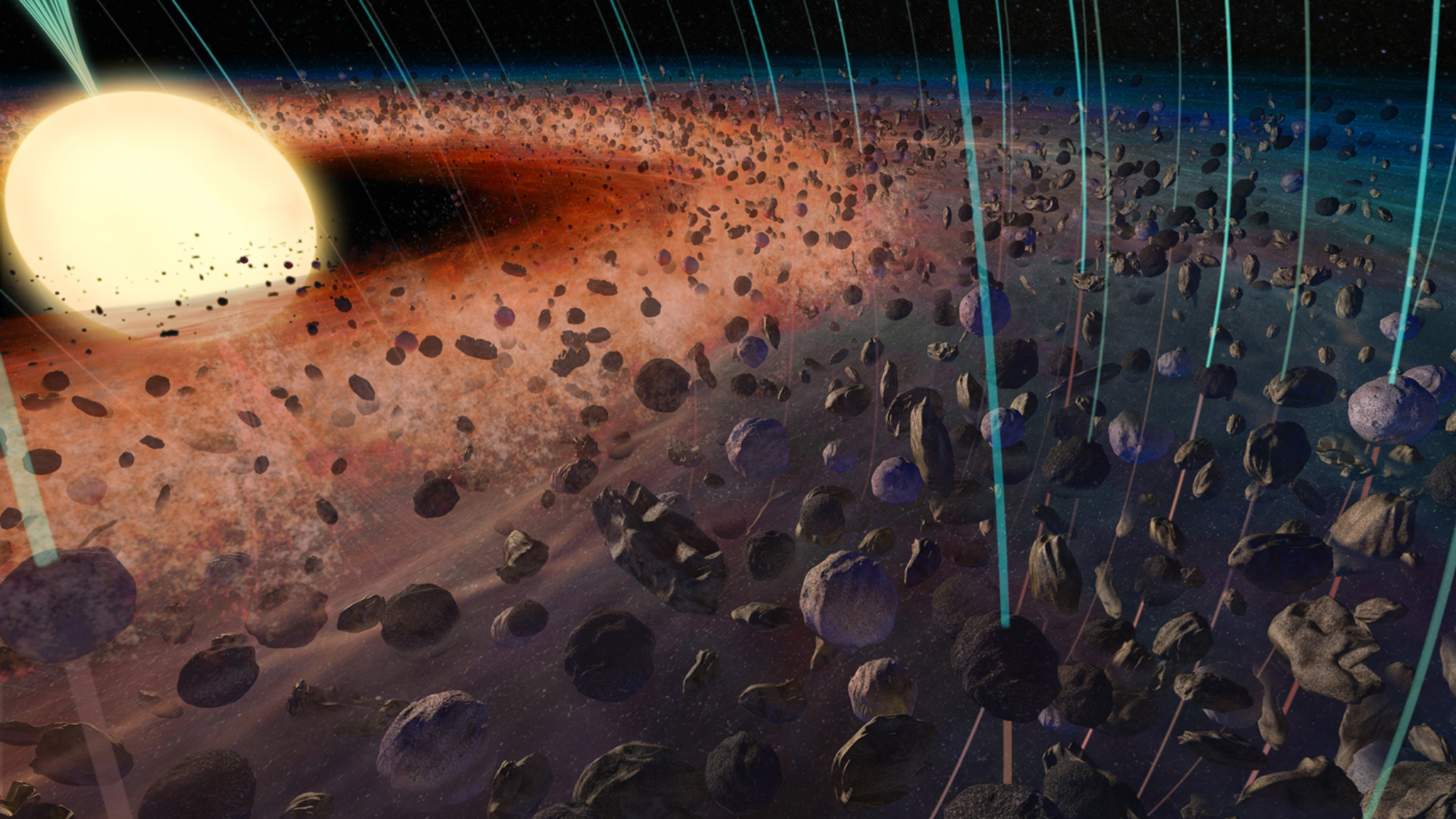
New research indicates that meteorite dust contains a “fossil record” from the solar system’s formation, highlighting the significant role of magnetism in this process. Approximately 4.6 billion years ago, a solar nebula—a cloud of gas and dust—began to flatten into a protoplanetary disk, where planets eventually formed.
Traditionally, gravity was viewed as the primary force shaping this early solar environment, but findings suggest magnetism played a crucial role too. Specifically, the study focused on calcium-aluminum-rich inclusions (CAIs) found in meteorite DOM 08006, recovered from Antarctica, possibly making them the oldest known solar system materials.
These CAIs indicate a magnetic field existed during the solar nebula phase, significantly stronger than Earth’s current magnetosphere, which influenced the solar nebula’s flattening. The transition from a spherical cloud to a disk is considered a pivotal moment in solar system history.
The research reveals that this magnetic field, generated from charged particles within the collapsing gas cloud, likely influenced the materials that formed the solar system. By analyzing the CAIs, researchers observed a remanent magnetization, validating the existence of this prehistoric magnetic field.
The scientists discovered evidence of a magnetic field at least 12 times stronger than Earth’s, implicating it in the inward movement of gas within the protoplanetary disk toward the forming sun. The findings emphasize that to fully understand solar and planetary formation, magnetic fields must be considered. This study was published on August 7 in the Proceedings of the National Academy of Sciences.