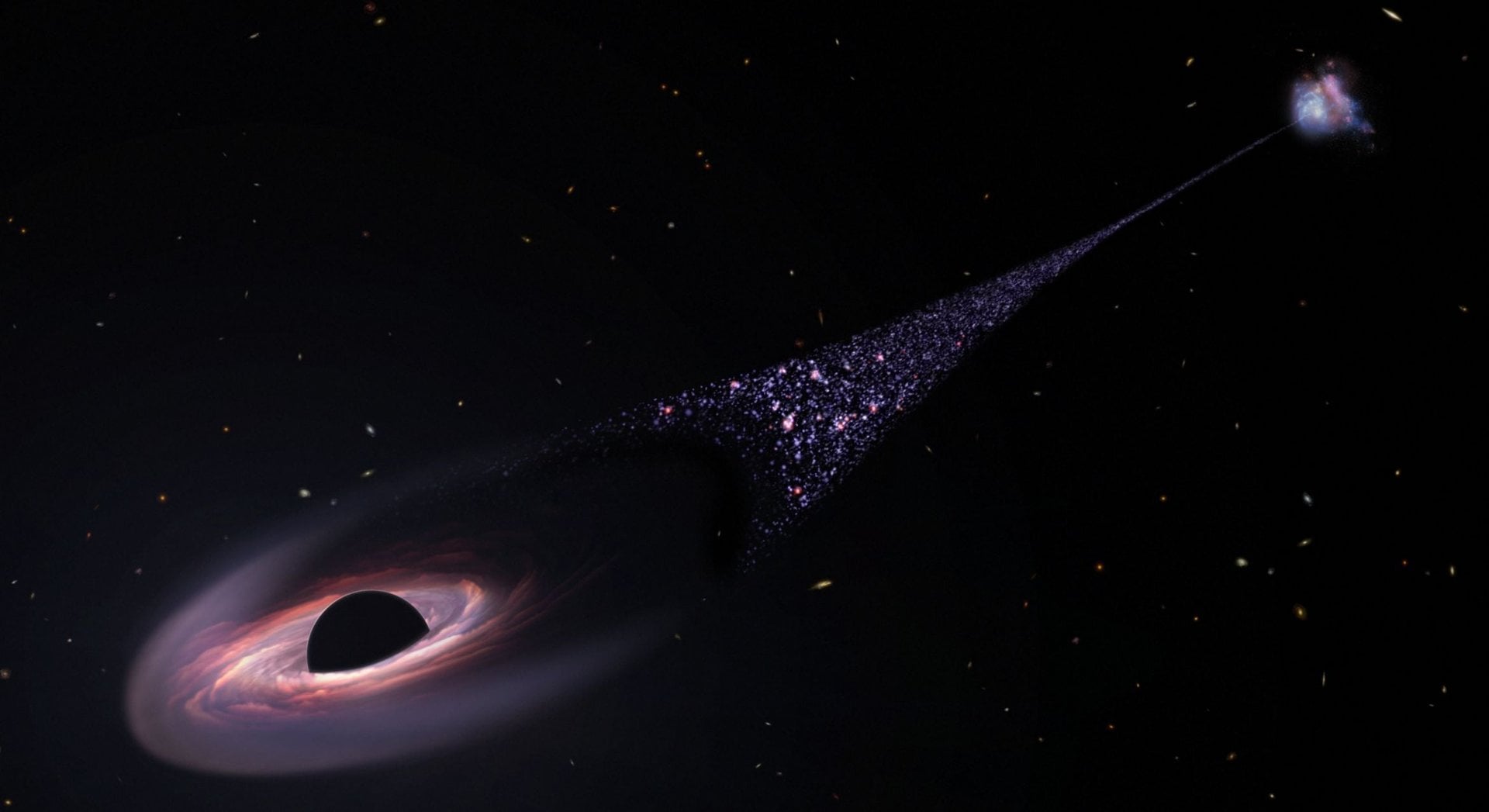
In September 2022, astronomers made a remarkable discovery involving a galaxy approximately 7.5 billion light-years from Earth. They observed a thin line stretching over 202,000 light-years from the galaxy’s center, marked by a feature that showed young stars forming as it traveled through intergalactic space at about 1,000 km/s (620 mi/s). This feature, named RBH-1, is thought to be a supermassive black hole (SMBH) that was ejected from its galaxy due to a violent merger event.
In a recent study led by astronomers from the University of California, Santa Barbara (UCSB), RBH-1 was analyzed using data from the Hubble and James Webb Space Telescopes, revealing its origins and the dynamics of the merger that likely caused its ejection. The findings, published in Physical Review Letters, provide significant insights into gravitational wave (GW) studies and the behaviors of supermassive black holes.
Astrophysicists have long studied the gravitational waves created during black hole mergers, which were predicted by Einstein’s Theory of General Relativity. These waves ripple through spacetime and can be detected from vast distances. Notably, if the black holes are uneven in mass, the resultant wave may propel the newly formed black hole in a different direction.
The team, led by Tousif Islam from UCSB, traced RBH-1 back to the merger event responsible for its existence by simulating numerous black-hole pairs to determine the speeds produced during such events. Their simulations indicated that the black holes involved had similar masses, with one being at most six times heavier than the other, and both were spinning rapidly and misaligned.
The study concluded that the merger that gave birth to RBH-1 occurred roughly 70 million years ago, involving two galaxies with SMBHs that had already evolved through galactic interactions. The researchers observed that the spins of the black holes suggested misalignment in the galaxies’ rotations as well.
Importantly, General Relativity postulates that 5-10% of galactic mergers could lead to the ejection of the resulting SMBH, making RBH-1’s observation a notable first in this phenomenon. Future studies will aim to merge the understanding of gravitational waves with galactic mergers, leveraging next-generation observatories like the Laser Interferometer Space Antenna (LISA) to detect these low-frequency signals.
For further details, check the original sources from UCSB and Physical Review Letters.