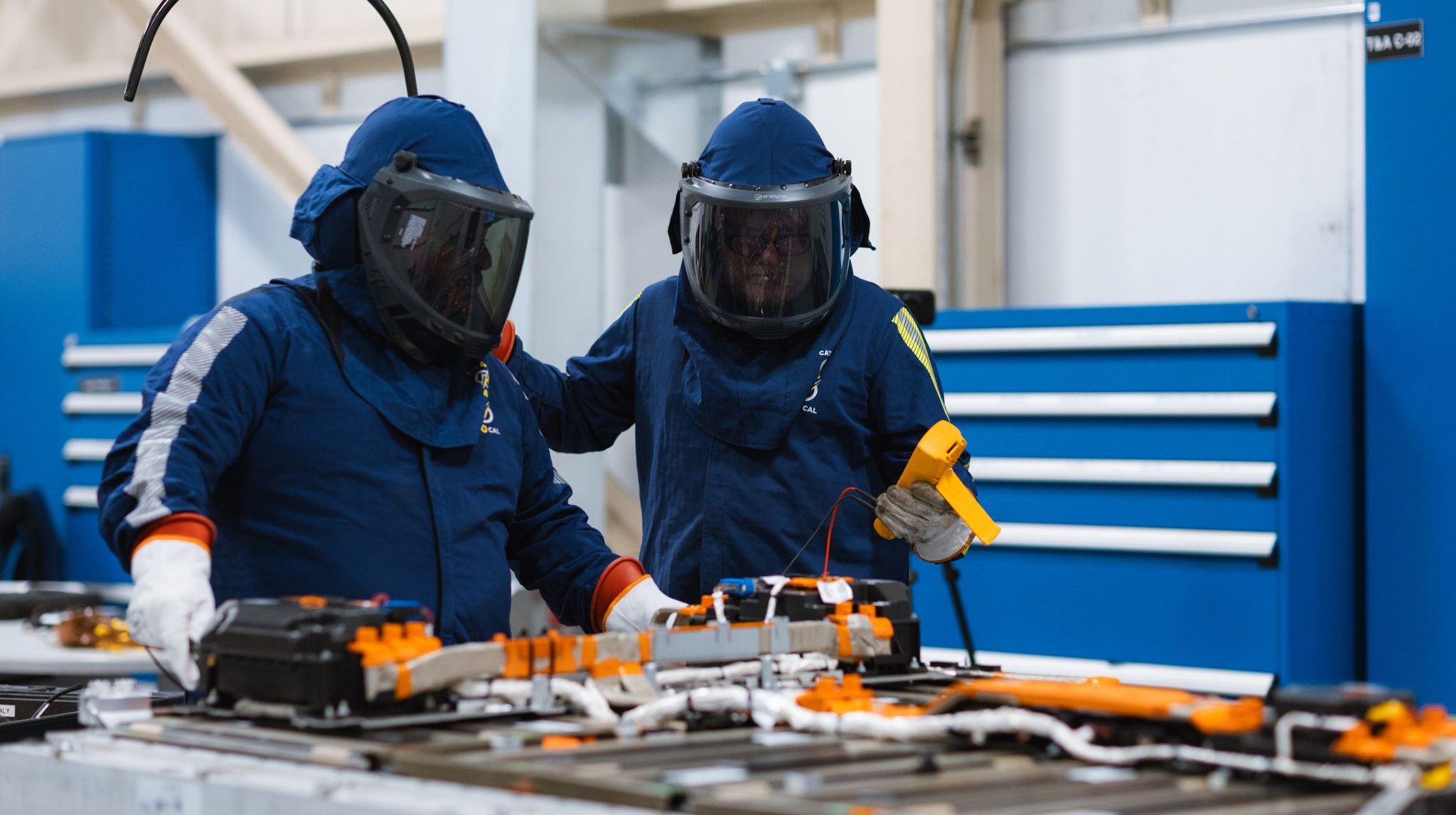
Antonio (Tony) Mancina, director of Canada engineering for Stellantis, discusses the new North America Battery Technology Centre at the Automotive Research and Development Centre (ARDC) in Windsor, Ontario.
Stellantis’s North America Battery Technology Centre
The North America Battery Technology Centre in Windsor, Ontario, is a pivotal hub for Stellantis’s battery development and validation efforts across the region. Covering over 8,600 m², the facility is designed for testing battery cells, modules, and packs for both battery-electric and hybrid-electric vehicles. This ensures thorough validation of performance, durability, reliability, and safety under varying operating conditions.
Key features include:
- 35 walk-in climatic test cells allowing up to 63 simultaneous pack tests.
- 11 reach-in test cells for up to 132 simultaneous cell tests.
- Testing capabilities at up to 1,100 kW for battery packs and up to 3 kW for cells, in extreme temperatures ranging from -40°C to 65°C.
Construction commenced in late 2023 and concluded in late 2025. The centre is expected to generate about 55 high-skilled engineering and technical jobs and forms part of Stellantis’s larger US$2.6 billion investment, started in May 2022, aimed at enhancing its Canadian operations and accelerating electrification efforts.
It also aligns with Stellantis’s global battery development network, which includes a similar facility in Turin, Italy, facilitating data sharing and engineering collaboration.
Types of Projects at the North America BTC
This facility will focus on:
- Non-destructive validation testing of battery systems.
- Root-cause analysis and engineering investigations related to battery performance and quality.
- Enhancing validation processes throughout the development cycle and strengthening internal expertise.
Partnerships with Academic Institutions
The Battery Technology Centre builds on the ARDC’s collaboration with the University of Windsor and other prominent Canadian universities, such as McMaster University and the University of Waterloo. This partnership fosters research in key areas, including electrification and lightweighting. Over the past three decades, the ARDC has hosted more than 800 engineering student placements, thereby nurturing the future of automotive engineering talent.
Role of ARDC in Stellantis’s R&D Ecosystem
The ARDC is vital to Stellantis’s product development, aiding in engineering and development for nearly all vehicles launched by North American brands. The extensive 93,000 m² facility houses approximately 800 employees and features unique research and development support amenities, including road-test simulators and proprietary software capabilities.
With over US$1.4 billion invested in R&D in Canada, the ARDC plays a significant role in enhancing local technical expertise and providing valuable hands-on experience for students through co-op placements.
Focus Under the FaSTLAne 2030 Strategy
Under Stellantis’s FaSTLAne 2030 strategy, the ARDC’s focus is evolving to support the ambitious growth plans through 2030, including launching 11 all-new vehicles in North America. The Battery Technology Centre exemplifies this commitment to advancing battery technology for future electrified vehicles, emphasizing affordability and versatility in product development.
Explore more about bringing cutting-edge battery technology to high-performance vehicles.