A Potential Breakthrough in Dark Matter Research
Dark matter, the elusive substance that makes up about 85% of the universe’s mass, has intrigued physicists for decades. A recent development at the Sanford Underground Research Facility (SURF) in South Dakota has sparked excitement in the scientific community with the recording of a single particle interaction that could potentially indicate the presence of dark matter.
The LUX-ZEPLIN Experiment
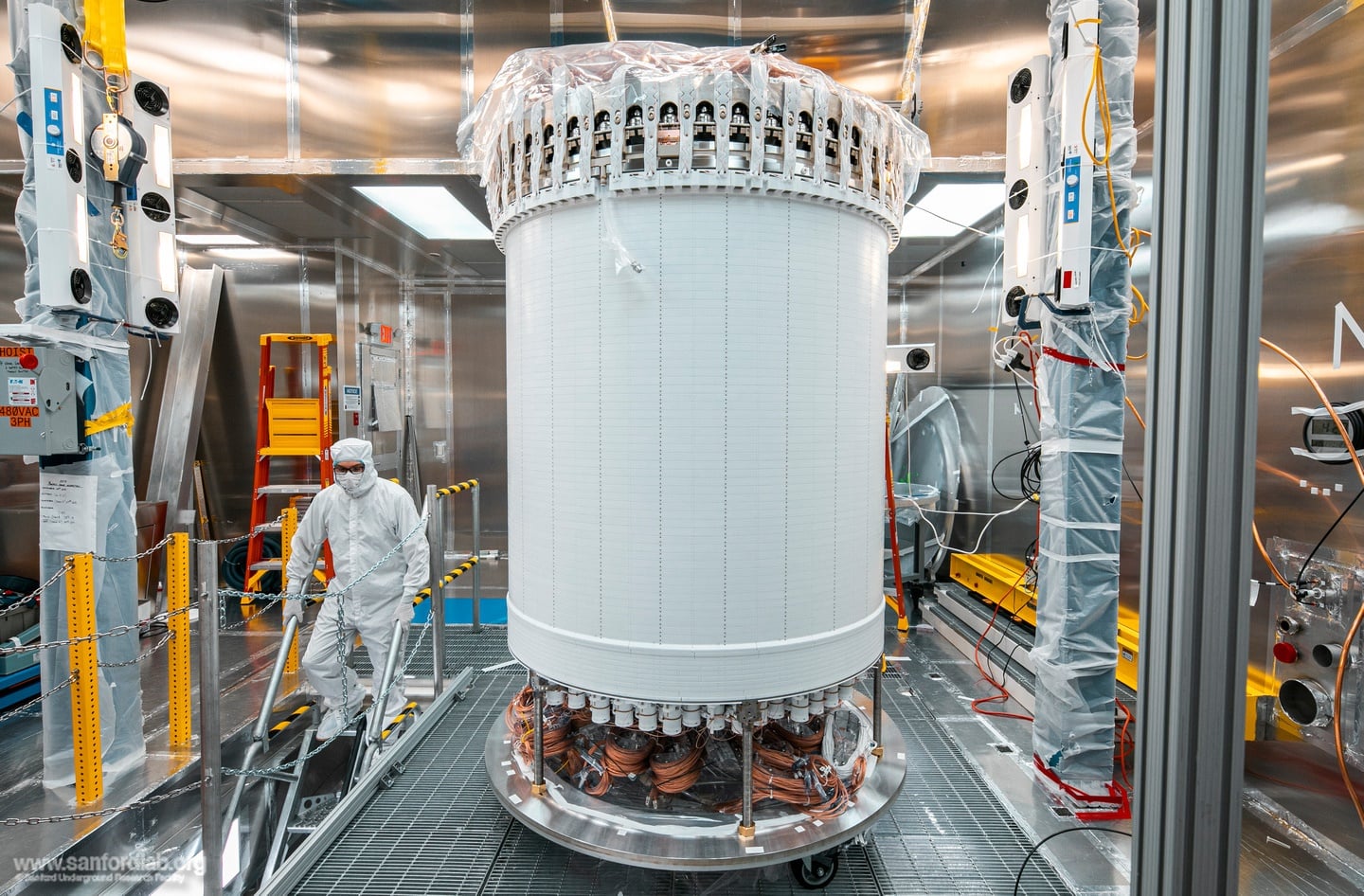
The LUX-ZEPLIN Dark Matter Experiment (LZ), operational since 2021, utilizes a sensitive detector filled with 10 tons of ultra-pure liquid xenon to capture rare particle interactions. Researchers analyze these events to detect weakly interacting massive particles (WIMPs), a leading candidate for dark matter.
A recent review of 220 days’ worth of data from March 2023 to April 2024 highlighted an anomalous event that displayed unusual energy characteristics, deviating from known background signals typical of normal matter. Rick Gaitskell, a physicist at Brown University, expressed caution but noted the event’s intriguing nature.
Analyzing Anomalies
The reported particle, if confirmed as dark matter, would possess over 200 times the mass of a proton. However, the significance of this detection was marked at 2.6 sigma, below the conventional threshold of 5 sigma required for a discovery. Statistical evaluations suggested a 0.5% likelihood that the observed event was a result of known interactions rather than a new particle.
Historical Context
The quest to understand dark matter began in the 1930s with astronomer Fritz Zwicky’s observations of galaxy clusters. Vera Rubin’s later findings solidified the theory of missing mass, ultimately pointing to the existence of dark matter. Current leading candidates include WIMPs, while other theories explore massive compact halo objects (MACHOs), strongly interacting massive particles (SIMPs), and axions.
Future Prospects
Daniel Akerib from SLAC National Accelerator Laboratory emphasized the importance of further verification, noting that more consistent results and interactions across different isotopes would be necessary for confirming dark matter’s existence.
While LZ is making strides, other experiments like the XENON Dark Matter Project and China’s Jinping Underground Laboratory also contribute to this critical field. The ongoing exploration into dark matter and dark energy remains vital, especially with new instruments like NASA’s Nancy Grace Roman Space Telescope expected to enhance our understanding of these cosmic mysteries.
As scientists continue to delve into the findings, the community remains both hopeful and cautious, firmly grounded in the scientific rigor required to unravel the complexities of our universe.