WIMP Detection and the LUX-ZEPLIN Experiment
What is WIMP?
- WIMP stands for Weakly Interacting Massive Particle, a candidate for dark matter, which makes up approximately 85% of the universe’s mass but is invisible and hard to detect.
Recent Developments at LUX-ZEPLIN:
- Researchers at LUX-ZEPLIN (LZ), the world’s largest dark matter detector, have announced a potential detection of a particle interaction that could be attributed to a WIMP. This interaction was reported with a significance of 2.6 sigma, meaning there is a 1 in 200 chance that it might be a random occurrence. To confirm this discovery definitively, more data is needed to achieve a 5 sigma level of significance.
About LUX-ZEPLIN:
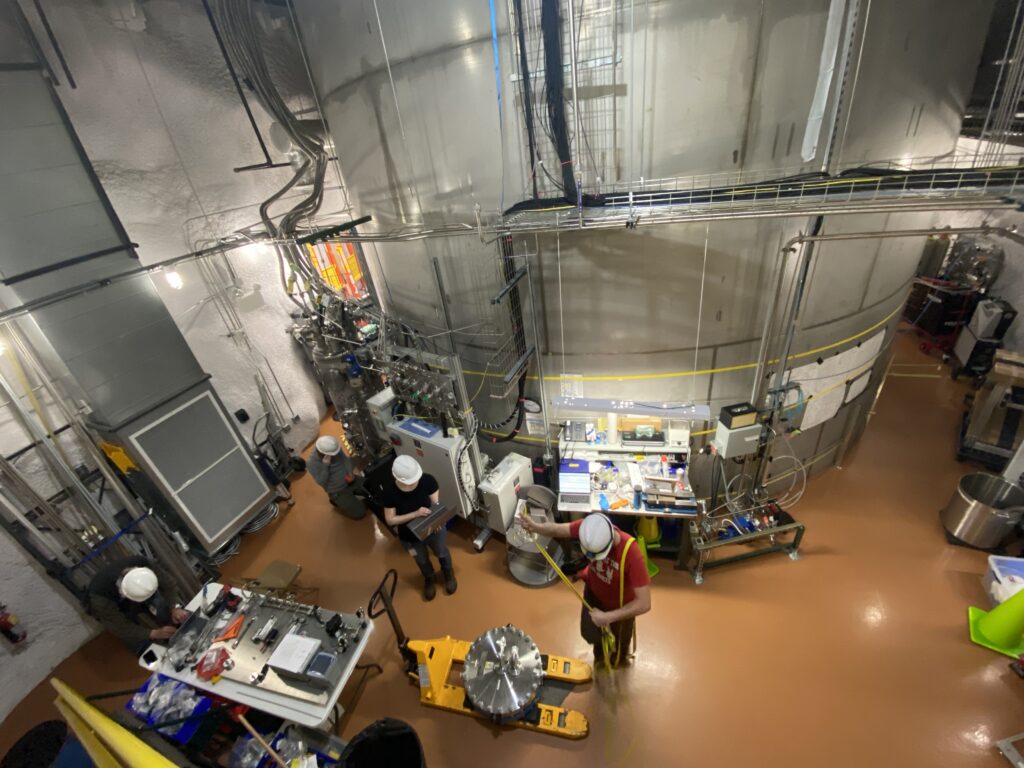
- LZ is an international collaboration of 250 scientists from 39 institutions, managed by the U.S. Department of Energy’s Lawrence Berkeley National Laboratory. It is situated nearly one mile underground in South Dakota and employs 10 tonnes of ultrapure liquid xenon to search for dark matter particles.
Understanding Dark Matter
-
What is Dark Matter?
- Dark matter is a theoretical form of matter that doesn’t emit light or interact with electromagnetic forces, making it undetectable by conventional means. Its existence is inferred from gravitational effects, which suggest that galaxies contain more mass than can be accounted for by observable matter.
-
Vera Rubin’s Contributions:
- American astronomer Vera Rubin was pivotal in providing evidence for dark matter in the 1970s, showing that the outer edges of spiral galaxies rotate as quickly as their centers, indicating the presence of additional unseen mass.
Additional Resources
For those interested in a deeper understanding, consider the following links:
Conclusion
The potential detection of a WIMP at LUX-ZEPLIN could be a groundbreaking development in our understanding of dark matter. The quest continues to unravel the mysteries of what constitutes most of the universe. Will this finding open new pathways in physics, or will it lead to further questions? Only time—and further data—will tell.