The current state of the conflict involving Iran has sparked extensive speculation. Many experts are questioning how Iran might respond as the U.S. appears to be maintaining the status quo to avoid further media attention during the midterm elections. Conversely, Iran seems determined to apply increasing pressure, particularly on energy prices, to influence U.S. policy. Notably, the Iranian government is also attempting to minimize impact on the global economy, a crucial consideration for their actions. Meanwhile, former President Trump is likely to continue provoking Iran to assert control over the unfolding events.
A recent U.S. drone strike targeted Iranian missile launchers on Larak Island, which have reportedly been utilized to plant new mines after the U.S. claimed to have cleared the Strait of Hormuz. Analysts have critiqued the U.S. claims of successfully rerouting crude oil through the Oman side of the Strait, especially as Oman has now agreed to block this route, which may enable Iran to more aggressively restrict oil traffic and further increase prices.
In a recent discussion between Malcolm Nance and Mario Nawfal, Nance elaborated on the capabilities of Iranian missile launchers, which possess a range of 130 km. He suggested that this positioning allows Iran to potentially lay mines along the coast of the UAE and even within Fujairah’s port on the Gulf of Oman. Such operations could significantly hinder maritime traffic and ship-to-ship transfers critical to stealthy operations.
Nance’s insights provide valuable context, suggesting that the U.S. may not have acted as quickly as claimed and that Iran could have already planted new mines. This contradicts U.S. assertions that they struck before any further mining occurred. His analysis sheds light on logistical aspects regarding how the missile launchers were transported to Larak Island and the complications involved in their detection.
Key excerpts from Nance’s discussion can be found in a lightly edited machine transcript:
“The significant question is why did they position that rocket launcher on Larak Island? The reasoning is clear; they wanted the capability to launch rockets as far down the western coast of the UAE as possible….”
“When you’re driving down the coast toward Fujairah, you’ll see at least 100 oil tankers in the water. Fujairah could host upwards of 150 tankers at times. With increased ship-to-ship transfers occurring, it would be an ideal location to deploy sea mines that would remain undetected until a vessel strikes them. If you effectively block Fujairah and the tankers, you can extend the reach of your operations without resorting to missile strikes.”
We are currently navigating a fog of misinformation; thus, the following should be treated with caution. Here’s an initial report from The Guardian regarding the U.S. attack:
A U.S. official confirmed a strike on two Iranian missile launchers on Larak Island, marking the first U.S. military action of this nature since late July.
“Today, U.S. forces targeted two Iranian launchers observed preparing to deploy rockets with sea mines into the Strait of Hormuz,” stated the official on Sunday.
Iranian officials reported the attack resulted in several casualties among soldiers and civilians, vowing a forthcoming response from Tehran.
Iran’s semi-official media further asserted that the US conducted a drone strike on the island.
Later, reports from Reuters indicated Iran had retaliated against U.S. forces in Jordan, claiming all incoming missiles were intercepted without notable damage.
As history has shown, U.S. assertions of no damages have often proven inaccurate.
Another viewpoint on Iran’s response comes from Hormuz Report on Twitter:
“BREAKING: The IRGC has reportedly launched anti-ship cruise missiles and drones from Larak Island as U.S. military assets escort vessels in the southern Omani corridor.”
“Three loud explosions were heard on Larak Island as the IRGC enhanced its surveillance of ships utilizing this route,” noted Martin Kelly from EOS Risk Group.
“An Iranian vessel illuminated and warned passing ships that they are being monitored and may face action if they do not alter course.”
The corridor supported by U.S. forces is now reportedly facing threats from the IRGC and heightened Iranian surveillance.
Additional claims from Al Jazeera include:
- Iran purports to have targeted U.S. bases in Jordan and military sites at Al Minhad airbase in the UAE following American airstrikes on Larak Island.
- The UAE’s Defense Ministry has rejected claims that their airbase was targeted.
PressTV has additionally stated that UAE facilities were also affected:
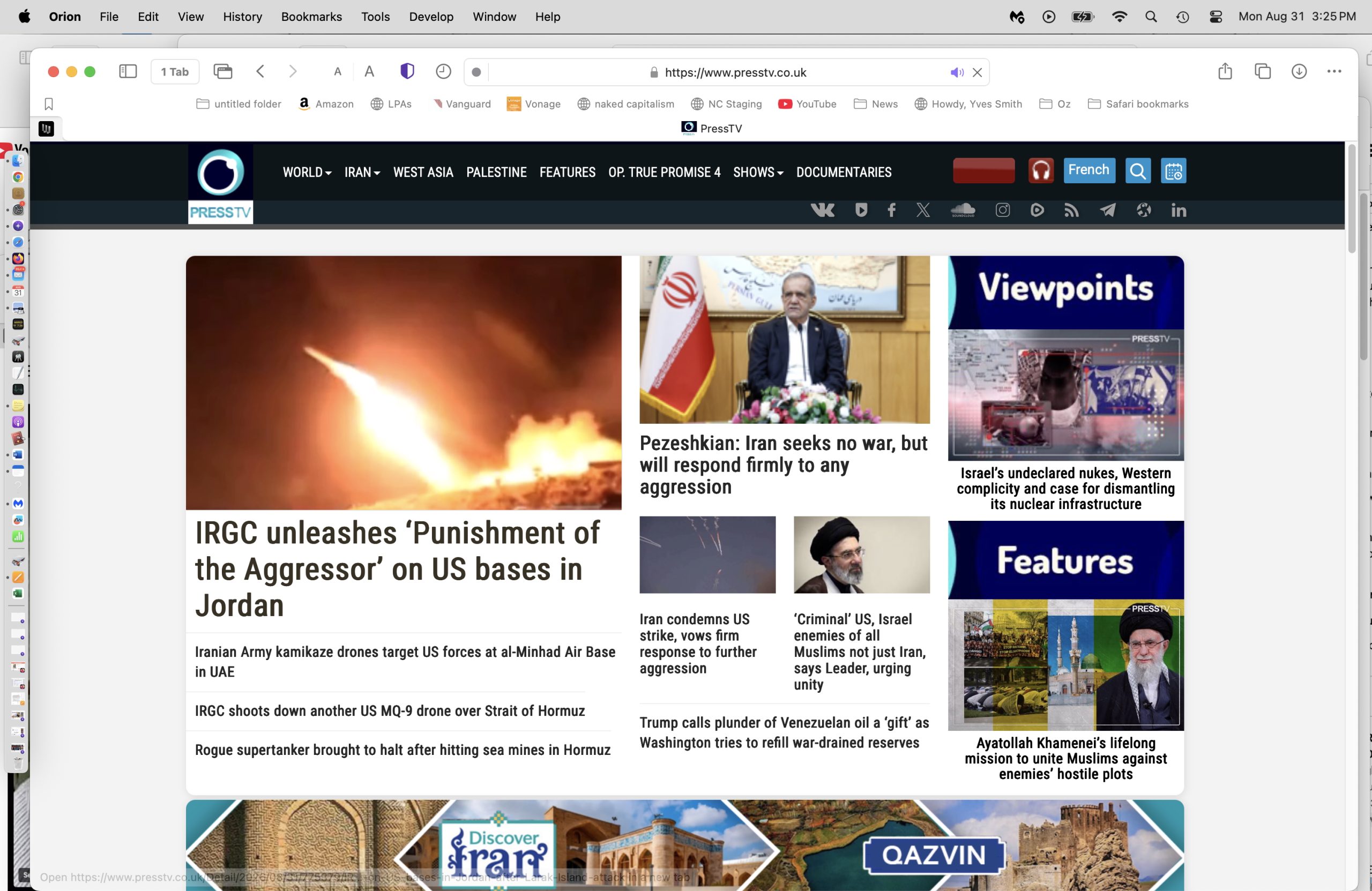
In their lead story, PressTV reports:
The Islamic Revolution Guards Corps announced it has attacked U.S. military installations in Jordan, delivering a decisive response to the U.S. airstrikes on Larak Island.
According to the IRGC, the operation targeted military bases housing U.S. personnel, inflicting substantial damage on the attackers’ resources.
This strike was described by the IRGC as a necessary and lawful response to the U.S. actions, which resulted in casualties among Iranian forces.
Additionally, a report at the bottom of the left column states that a rogue supertanker struck two naval mines in the Strait of Hormuz, igniting fires aboard the ship and immobilizing it.\
The IRGC Navy reported that a unauthorized supertanker faced catastrophic incidents after hitting two sea mines in the Strait of Hormuz.
A summary from NO1 states, “The Iran War reignited overnight after several weeks of relative calm,” and continues:
- The U.S. struck Larak Island; Iran retaliated against U.S. bases in Jordan and the UAE. This marks the first known U.S. assault on Iranian territory in approximately 30 days, targeting two IRGC missile launchers. According to reports, Iranian claims allege multiple casualties.
- Contested Base Naming: IRGC mentioned both “King Hussein” and “Muwaffaq Salti” bases, although discrepancies exist regarding the accurate names. Damage assessments remain unverified.
Further aligning with Iranian accounts, a recent account provides round-up updates:
Iran-US confrontation summary update 30-31 August
• A supertanker was struck by 2 naval mines in the southern Strait of Hormuz, caught fire and was brought to a complete halt.
• Iran shot down a USAF MQ-9A Reaper drone over the…
— Arya Yadegaar (@AryJeayBackup) August 31, 2026
More information reveals:
• Iran successfully shot down a USAF MQ-9A Reaper drone over the Strait of Hormuz.
• The Iranian Army utilized Arash-2 drones to target the Al Minhad Air Base in the UAE.
• The IRGC attacked both King Hussein and Muwaffaq Salti airbases in Jordan via ballistic missiles.
Additional confirmation has emerged regarding the tanker strike:
Kuwait tanker BURGAN was struck on Saturday during a transit in the southern Strait of Hormuz.
It seems to be the second Kuwaiti tanker affected within 48 hours.
— Martin Kelly (@_MartinKelly_) August 31, 2026
Larry Johnson discusses U.S. military actions with compelling insights in “We Own It”: The Wall of Steel Springs:
On Sunday, U.S. forces engaged Iranian launchers on Larak Island due to observed threats of rockets carrying sea mines targeting the Strait. The broader implication of this action raises questions about control of these crucial waterways.
Discussions between Iran and Oman have recently highlighted traffic regulations in Hormuz, with proposals indicating a joint management regime, potentially sidelining U.S. interests.
Additional snippets illustrate the ongoing struggle for control:
Iranian authorities detained a vessel allegedly dumping waste in the Persian Gulf, emphasizing its commitment to environmental protection.
A detailed report from The Washington Post reveals significant military concerns regarding prolonged Iran operations:
Military leadership has advised that extending large-scale operations against Iran is unsustainable and may weaken capabilities to address other threats.
Recent reports suggest that only a fraction of the U.S. Navy’s destroyer fleet is currently operational, highlighting deterioration in readiness.
This situation raises vital questions about U.S. military capabilities amid ongoing conflicts, while also underlining the complexity and volatility of the regional landscape.
In conclusion, the recent tensions between the U.S. and Iran underline a precarious balance of power in the region. The dynamics remain highly fluid, with developments occurring rapidly. The international community should closely monitor these events, as their implications extend beyond regional borders, affecting global energy prices and security.