By Dr. Regan Dunn, Assistant Deputy Director & Associate Curator of the Samuel Oschin Global Center for Ice Age Research at La Brea Tar Pits, and Adjunct Professor of Earth Sciences at the University of Southern California. Originally published at The Conversation.
Fifty-six million years ago, Earth’s forests underwent a dramatic transformation during one of the planet’s most significant greenhouse warming events. Initially thriving under dense, lush canopies, these forests faced devastating changes as temperatures soared. Recent research has shed light on how these ancient ecosystems responded to extreme climatic shifts, offering insights that resonate today.
During this period, known as the Paleocene-Eocene Thermal Maximum (PETM), global temperatures increased by as much as 11 degrees Fahrenheit (6 degrees Celsius). The combination of heat and prolonged drought severely stressed the forests, leading to the death of a vast number of trees. This resulted in the thinning of forest canopies, which had profound effects on the ecosystem dynamics below.
In southern Wyoming, ferns briefly flourished where once there were relatives of elms, walnuts, dawn redwoods, and avocados. As conditions continued to warm, palm trees and other heat-loving species migrated further north.
In our recent study published in the journal Science, my colleagues and I documented how the forests in Wyoming lost 60% of their canopy during this tumultuous period, and importantly, how they took over 100,000 years to recover fully.

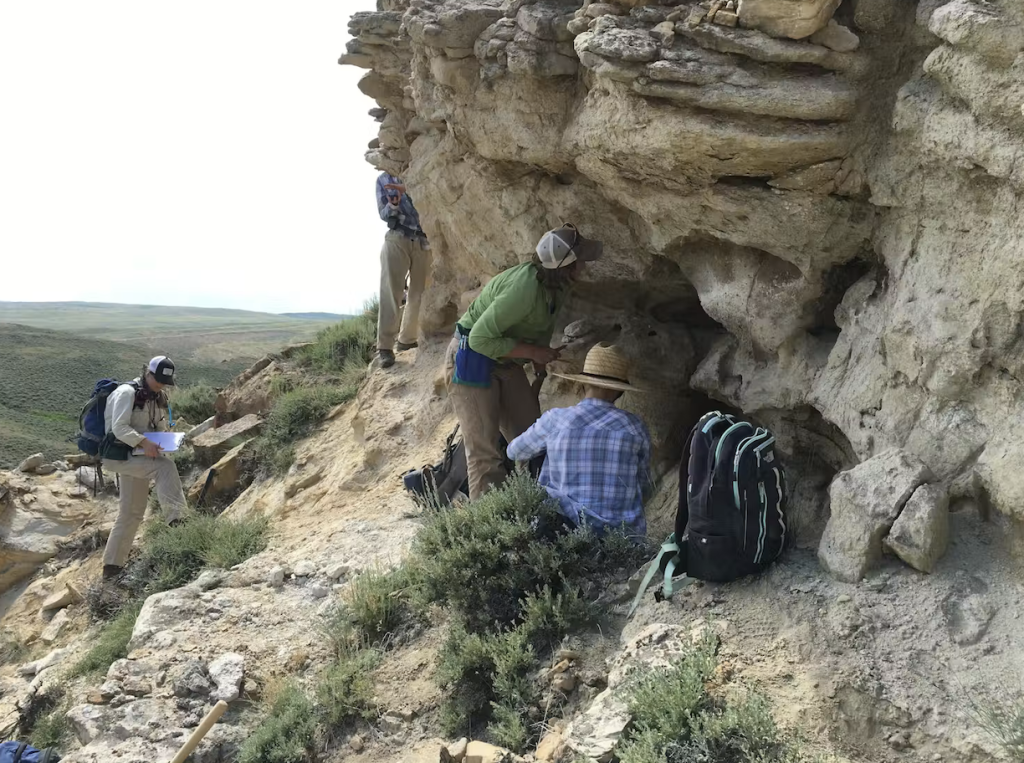
Two authors of the new study, Marieke Dechesne, left, and Ellen Currano, at center, collect fossils from a sand channel in Wyoming dated to the Paleocene-Eocene Thermal Maximum. Regan Dunn
The PETM serves as a vital natural analog for the current warming our planet faces, though it’s crucial to note that human activity is expelling carbon dioxide into the atmosphere at a rate roughly ten times faster than the natural processes that occurred during that time.
By exploring what happened to these ancient forests, we may gain valuable knowledge that can help us identify and respond to similar ecological thresholds in the future.
Reading the Forest From Fossil Leaves
As paleobotanists, my research team and I analyze plant fossils to identify the species that once populated various regions. However, our goal extended beyond mere identification; we aimed to capture the essence of the forest’s appearance and how it evolved over time.
The structure of a forest, particularly its canopy, plays a crucial role in regulating the light available to the forest floor, influencing temperature, water habitats, and the forest’s carbon storage capacity. This makes canopy density an essential indicator of ecosystem health.
But how can we evaluate the density of a forest that disappeared 56 million years ago?
Ecologists employ a measure called the leaf area index to assess canopy density. Dense forests, with their intricate layers of leaves, have higher scores, while more open canopies allow greater amounts of light to reach the ground, leading to lower scores. This index offers an insightful view into forest function, as it influences shade, temperature, water retention, and photosynthesis.
Our data on forest canopy density came from analyzing microscopic plant cuticles—the thin, protective outer layers of leaves that can endure in sediment for millions of years.
The shapes of epidermal cells within these fossilized leaf fragments provide critical information. Cells that grow in the shade tend to be elongated as they stretch toward light, while those exposed to abundant sunlight are generally rounder.

Images on the left illustrate the canopy cover that a creature on the ground would have seen looking upward. Each example corresponds with the shape of its fossil cuticle cells on the right. The more open the canopy, the rounder the cells. R. Dunn, et al., 2026
We leveraged this relationship to build a model for reconstructing ancient forests. For calibration, we gathered soil samples from a variety of forests across Central and South America, reflecting diverse canopy densities. Each sample contained cuticles from numerous plants across the canopy, reflecting the overall structural composition of the forest.

Two sets of magnified leaf cuticle cells: Fresh leaves are on the left, and fossil leaves are on the right. Comparing the two sets highlights the elongated cells in the top set, indicating more canopy cover, versus the rounder cells in the bottom set, suggesting greater sun exposure. R. Dunn, et al., 2026
The fossil record preserved a similar assortment of leaf litter. By comparing the shapes of thousands of epidermal cells to the measured leaf area index, we found a remarkably strong correlation: the greater the elongation of the cells, the denser the forest canopy above.
This allowed us to reconstruct how Wyoming’s forests transformed millions of years ago and how they adapted over time.
When Forests Reach Their Limits
One of the most unexpected findings was that the forests entered the Paleocene-Eocene Thermal Maximum in a period of growth rather than decline.
Leading up to the rapid warming, forest canopies reached peak density in hundreds of thousands of years, likely boosted by enhanced growing conditions due to rising atmospheric carbon dioxide levels. A prevalent theory suggests that volcanic eruptions were a significant source of this carbon dioxide.
This thriving forest environment was short-lived, however. As temperatures escalated, the combined effects of heat and drought negated the advantages of increased carbon dioxide. The canopy began to thin rapidly as trees died, and it remained significantly diminished for over 100,000 years.

Tree canopy is often measured using leaf area index. This chart illustrates the progression of canopy cover during the Paleocene–Eocene Thermal Maximum, showing its decline in response to rising temperatures. The timeline starts from the oldest period at the bottom. The bars on the right indicate the proportion of various plant types in Wyoming’s forests as compositions changed with canopy cover, based on fossilized pollen and other palynomorphs. R. Dunn, et al., 2026
With a severely reduced canopy, the forests operated under changed ecological conditions, significantly impacting their surroundings. Ancient soils transitioned into coarser river deposits, indicating alterations in the movement of water and sediment throughout the region.
The shifting climate transformed the forest, and in turn, the forest reshaped its landscape.
Lessons for Today
This sequence of events carries a crucial lesson for our present time.
Elevated carbon dioxide levels, similar to those we currently experience, may initially promote plant growth. However, if temperatures and water availability surpass certain thresholds, the adverse effects of heat, drought, pests, pathogens, and wildfires may overwhelm any growth stimulation.
Across the globe, numerous forests are showing indications of decline due to rising temperatures, compounded by deforestation linked to agriculture and land development, further compromising their resilience.
Forests Recovered, but It Took Over 100,000 Years
The tale of ancient forests from 56 million years ago does not conclude with their collapse.
Gradually, increased weathering of rocks in the warmer climate led to the removal of carbon from the atmosphere, storing it in marine sediments. This process ultimately facilitated climate cooling and enhanced water availability.
As a result, the forest canopies gradually rehabilitated, eventually becoming denser than they were before the warming event began. As these forests expanded, they likely regained their ability to stabilize soils, regulate the water cycle, and absorb carbon from the atmosphere, contributing to a reduction in the greenhouse effect and paving the way for the planet’s long-term recovery.
Our research demonstrates that past episodes of elevated carbon dioxide have pushed forests beyond their physiological limits, triggering consequences that reverberated across both vegetation and entire landscapes. It also underscores the remarkable resilience of forests when afforded sufficient time to recover, although ‘time’ in this context stretches far beyond a human lifespan—it encompasses thousands of generations.
Today, human-induced carbon emissions and global warming are occurring at an unprecedented pace compared to the PETM. The fossil record serves as a reminder that forests can indeed recover; however, it is imperative that humanity avoids pushing them beyond critical thresholds that necessitate tens of thousands of years for recovery.


