As tensions in the Middle East continue to evolve, the situation surrounding the Iran conflict remains complex and unpredictable. With Donald Trump leading the U.S. administration, the focus appears to be on economic warfare rather than military intervention. This article delves into the current state of affairs and examines whether the U.S. strategy can effectively pressure Iran into submission.
Under Trump’s leadership, the potential for shifts in the Iran conflict is ever-present. However, there are significant limitations to military intervention. Reports indicate that the U.S. has consistently lost war simulations regarding a conflict or invasion of Iran. The U.S. military is in a weakened state compared to its performance during the Cold War. Currently, both the Army and Navy have been reduced in size, and the available stockpiles of weapons are largely unsuitable for modern warfare, focusing instead on outdated strategies reminiscent of World War II. This means the U.S. military is not only struggling in terms of quantity but also quality.
Moreover, the prolonged deployment of the USS Abraham Lincoln has left sailors mentally and physically strained. Questions arise about how effectively they can fulfill the increasingly demanding roles in potential ground invasions given their current circumstances.
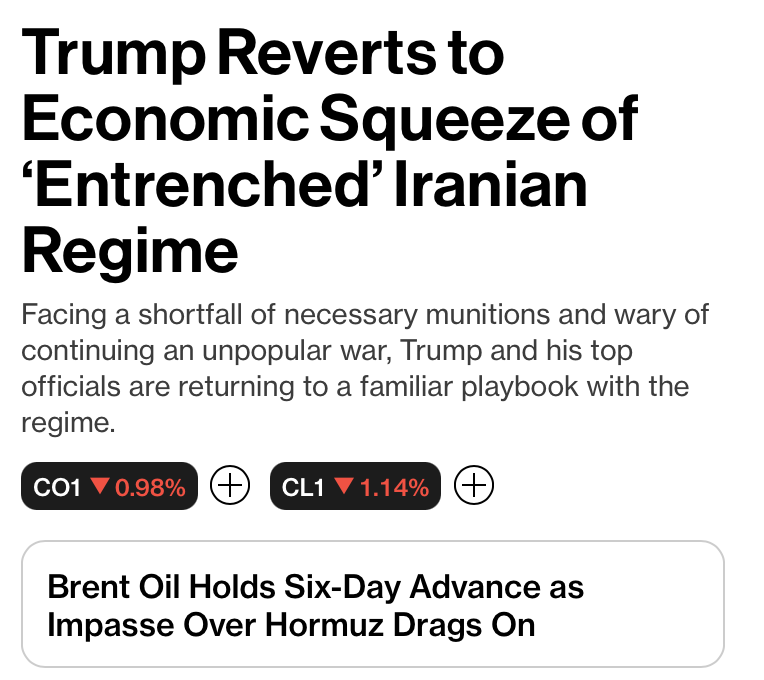
The current U.S. approach, as reported by the Wall Street Journal, is to sustain an economic war until Iran succumbs to pressure. The strategy centers on imposing strict sanctions and maintaining a naval blockade designed to cripple Iran’s oil exports. The Bloomberg lead article echoes this stance:

Highlighted from the main article:
- The U.S. military campaign against Iran has not successfully compelled the regime to give in, leading the Trump administration to rely on economic sanctions and a naval blockade aimed at hindering oil exports.
- This strategy, termed “Maximum Pressure,” is a reiteration of past tactics, with the administration asserting it will yield different outcomes than in previous attempts.
- Despite imposing additional sanctions, analysts remain skeptical about their potential to incite significant political change, arguing that the Iranian regime appears well-entrenched in its current position.
Given the history of repeated U.S. efforts to apply economic pressure on Iran, expectations for success appear low. However, commentator Brett Erickson suggests that Iran may actually be in a more favorable position than commonly believed, especially concerning government revenue.
Contrarily, countries refraining from purchasing Iranian and Russian oil, along with those relying on Chinese refined products, are experiencing adverse effects, leading to decreased energy traffic through the Strait of Hormuz. As we’ve previously noted, China’s domestic growth shows little promise, and a struggling global economy means that exports will not provide a significant boost.
In the short term, the U.S. enjoys a relatively advantageous position due to its domestic oil production levels. Nonetheless, if Iran does indeed manage to inflict economic harm on the U.S. through its actions across the Global South, it could have substantial consequences—although this remains contingent on several factors, including energy supply and demand dynamics.
Erickson presents arguments suggesting Iran possesses greater economic resilience than many have anticipated, especially given the existential stakes for the nation. Persuaded by the Iranian people’s capacity for endurance, Erickson believes that Iran’s economic structure could weather the ongoing crisis. However, he does express some inconsistency in his explanations, possibly indicative of inexperience in media settings.
According to a somewhat edited transcript of the discussion:
Hussian: Who do you believe has more endurance in this situation, and how do you anticipate the blockade strategy will unfold?
Erickson: One critical flaw of the blockade is its intent to sever oil revenues. During a previous blockade, Iran had approximately 120-140 million barrels of oil within the blockade zone. With Brent’s average price around $117 per barrel, Iranian oil was sold at a slight discount, yielding revenues that exceeded expectations. Consequently, the country’s financial performance regarding oil revenue has actually surpassed initial projections.
During the initial blockade phase, Iran managed to export an additional 80 million barrels of oil—175% of its usual levels—thanks to a signed Memorandum of Understanding (MOU). At present, the Iranian rial has maintained stability against the dollar, and inflation rates remain largely unaffected by the blockade. Data metrics simply do not demonstrate any imminent collapse of Iran’s economic framework.
Erickson continues to elaborate that many of Iran’s oil revenues could persist for several months, thanks to previously exported quantities and even reversed sanctions, which allowed for some oil exports earlier in the year. He estimates that by 2027, Iran may still be earning substantial revenues, not facing catastrophic economic decline.
It’s important to note that the high inflation rate in Iran may not warrant excessive alarm, especially in light of historical financial struggles faced by various Latin American countries, which have endured similar inflation levels without resulting from external pressures.
Furthermore, Erickson suggests that Iran’s relatively restrained action in the Strait of Hormuz may be a strategic choice to mitigate collateral damage and maintain stability. In Southeast Asia, impacts are notably sporadic, with some local markets showing price volatility but no widespread inflation.
While demand continues to surpass supply, the situation remains tenuous as escalations in energy costs could lead to an eventual crunch across inventory levels. The re-entry of increased output from the U.S. and other global producers has so far prevented drastic outcomes.
Despite the complexities in this conflict, vessels still navigate the Strait of Hormuz, albeit in reduced numbers compared to pre-war levels.
From Lloyd’s List, we find that:
- Traffic through the Strait continues despite setbacks, with 30 mainstream transits accounted for last week, including 19 VLCC movements.
- Vessels associated with Sinokor and Adnoc remain active in trade, even after previous attacks.
- The diplomatic outlook appears bleak, as Iran maintains that the strait will remain closed until it meets specific conditions.
In addition, reports of continued attacks by Ansar Allah on vessels and Saudi interests illustrate the rising intensity of the conflict.
Recent updates highlight:
🔥🇾🇪 The Houthi escalation around Bab el-Mandeb is moving onshore too.
Ballistic missiles and drones have repeatedly struck Mocha, impacting port infrastructure as Houthis perceive Saudi-backed forces preparing military operations there.
— Jack Prandelli (@jackprandelli) August 12, 2026
AlMayadeen reports concerning casualties from Saudi attacks on Saada, reflecting the ongoing violence: “Yemen’s Saada Human Rights Office stated that the attacks have resulted in 356 deaths and wounded 2,632 during the de-escalation period.”
Amidst the turmoil, censorship has emerged, with Twitter suspending accounts linked to Ansar Allah that provided updates on the conflict.
In a related report, Bloomberg portrays a somewhat optimistic viewpoint regarding Saudi operations in the region, highlighting:
- A supertanker has recently been spotted at Saudi Arabia’s primary oil export terminal, a significant occurrence after weeks of inactivity.
- Saudi Arabia has redirected much of its oil exports to its Red Sea ports, complicating tracking processes amidst threats from militants.
- Satellite imagery reveals decreased activity at the Yanan export terminals compared to previous levels.
The USS Abraham Lincoln’s troubling conditions have also come to light. Reports indicate that sailors onboard have faced severe hardships due to extended deployments, leading to attempts by crew members to leave the ship out of despair:
Two prominent military publications have reported that conditions aboard the Lincoln have significantly deteriorated, with poor morale reaching breaking points. The sailors’ extended deployment has become a cause for concern for family members, prompting emotional discussions with Navy leadership.
The growing discontent among sailors raises alarm bells about mental health and overall wellbeing, supporting arguments that continuous deployments without adequate shore leave are detrimental.
In conclusion, the unfolding conflict with Iran and the broader geopolitical landscape remains highly fluid and uncertain. As nations grapple with their strategies and the consequences of economic warfare versus military engagement, the resilience of both Iran and the U.S. will be tested in the months to come. The next developments in this situation will require close observation, as the implications extend far beyond the region.

