Hello everyone,
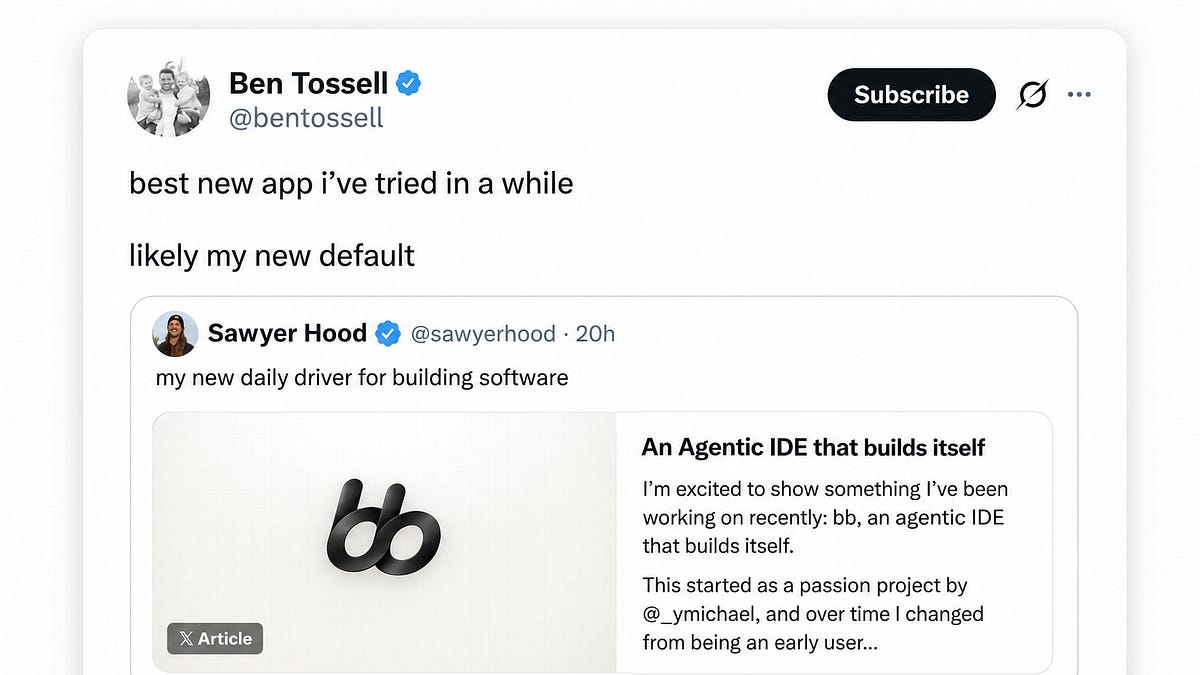
Last week, I mentioned my excitement about the app t3, which consolidates various AI chat subscriptions into a single interface. However, I’ve since discovered something even better: the app bb. It’s not just the name that has captured my attention; the functionality of the app is impressive as well.
If you utilize any AI services such as Claude, ChatGPT, Pi, or others, you can seamlessly integrate them into bb. The design resembles that of popular chat interfaces like Codex, making it very user-friendly. I was able to set it up on my mobile device in mere seconds, significantly easier than with other apps (I found t3 to be rather finicky).
One of bb’s standout features is its extensible nature. The conversation around extensible software is growing, and Pi stands out as a brilliant coding harness designed for complete customization. Companies like Prime Intellect have even leveraged Pi to develop their agents.
BB is engineered in a similar fashion. While often categorized as an ‘IDE’ (Integrated Development Environment), it’s a step beyond traditional tools like VSCode, which feel outdated now. Today’s IDEs are the desktop agent applications we’re growing accustomed to. With bb, you can extend its capabilities: need a plugin? You can ask it to create one (I had bb produce a factory plugin for me). Want a task tracker? It can handle that too.
Personally, I can’t commit to an app that restricts me to a single model or agent harness. I prefer different models for varying tasks—GPT for specific needs, Claude for others. I believe the software that will resonate with the masses, especially those looking for customizable tools without needing a coding background, consists of mini ‘widgets’ like to-do lists, email organizers, feed readers, etc. This approach aligns with my recent canvas exploration, which I’m still actively using.
The tools where we spend most of our working hours should allow for adding new features as we identify our needs and work habits evolve.
In a related vein, several posts on X have discussed the lagging adoption of agents outside of the developer sphere and early enthusiasts. A particular statement on the matter highlighted:
“You cannot make the masses desire an automation flow when they simply wish to socialize instead of focusing on work.”
I wholeheartedly agree. The emergence of a new pool of ‘builders’ is just around the corner. My definition of this group is broad, encompassing anyone interested in using agents to create tools for personal or communal use, whether for work or recreation. Where do you fit in this landscape?
I’ve believed in the potential of this builder community for over a decade. However, previous no-code solutions were often cumbersome and limited. With the rise of AI, this process has become much more intuitive and engaging. You don’t have to learn everything upfront; instead, you can immerse yourself and gradually adapt your working style, much like picking up a new language through experience.
Ben’s Bites is sponsored by Type
Work is a multi-player game. Now, so is AI.
Type consolidates your team’s top AI efforts into a shared environment. Unify your company’s knowledge, integrations, and expertise, making them accessible to everyone across models. Try it now.
Bending Spoons is acquiring Airtable, at a valuation notably lower than before. Of note, Hyperagent, Airtable’s AI-driven venture, was spun off and is not included in this acquisition. Further info can be found here, marking yet another development in the AI sector.
In trend-related news, Obsidian has launched a tool to export your Airtable content into Markdown. Additionally, there’s Cloudtable, an Airtable alternative powered by Cloudflare (see the repository).
In other news, Google’s Chief Scientist, Jeff Dean, is departing after 27 years to establish a new laboratory with three colleagues. Their new company, Discovery Loop, aims to innovate in automating machine-learning research, triggering numerous internal shifts within Google. Notably, Demis Hassabis will be stepping back from GDM’s everyday responsibilities to focus on long-term research initiatives.
Cloudflare has been releasing a plethora of agent-first tools lately: Cloudflare OS provides a collaborative AI workspace with connectors, while Agent Tracing allows for reviewing agent sessions and tracking them from initiation to model calls. Cloudflare Wallet is another initiative that endows agents with identities, spending limits, and wallets for service payments.
Gemini Notebook (known as NotebookLM) has now streamlined the creation of various supported artifacts (quizzes, slide decks, etc.) right from the chat interface, eliminating the need for the side panel.
Meta has announced Muse Code, a CLI coding tool backed by Muse Spark 1.2, which boasts significant coding-related enhancements comparable to Grok 4.5 levels of performance.
Goodfire AI has made its interpretability and training tool, Silico, available to the public for $1000/month targeted at individual researchers. They experimented with Silico while teaching a 30B model to play a board game, which makes for an insightful read.
-
Capsule: Offers video skills and agents geared towards enterprise teams that prioritize brand quality.
-
Atlas by WorkOS – operates as an AI colleague in Slack, providing answers, executing tasks, and learning the workings of your organization.
-
Context.dev – this API converts real-time web data into structured, continuously updated information for agents.
-
Notion recently revealed results from a comprehensive survey involving 6,000 professionals across 10 markets about AI utilization at the workplace.
-
givemeanode, created by SF Compute – provides Claude, Codex, or any agent access to H100s for training, benchmarking, and batch processing, billed by the minute.
-
Power 2026 – a comprehensive guide to pricing and insights regarding power and datacenters, providing clarity on AI’s energy challenges.
-
Not Diamond Code – a model router designed for coding agents, offering claims of 20-65% reduced costs in long-duration tasks.
-
Recursive self-improvement is constrained by verification, rather than computation itself.
-
Running Streaks – Opus 5 transformed runners’ datasets into an engaging D3 visualization using a specific prompt.
-
NYC AI Atlas – an open-source 3D map identifying leading AI startups in New York City.
-
Recent cybersecurity incidents involving OpenAI were highlighted in external cybersecurity evaluations.
-
Mistral has launched Shieldstral – a compact 3B open-weight model focused on content safety, easily operable on standard laptops.

Ashwinn@Shwinnabego
The reason agents haven’t taken off is because they are still waiting for their “desktop” metaphor and a UI that isn’t merely an open-ended chat interface.
Using AI is now part of my daily routine; I create websites, conduct analyses, and perform research. I have repetitive tasks that I know could benefit greatly from an effective agent.

Ben Zhang@un1c0rnioz
Out of ideas, I consulted Claude for assistance on locating it. It proposed tracking the Bluetooth signal strength and even generated a rudimentary meter for me in under a minute. I was able to walk around and monitor the signal.
5:03 PM · Aug 4, 2026 · 2.83M Views
721 Replies · 3.46K Reposts · 41.1K Likes
Finally, a quirky tip from Mckay Wrigley: consider using “You are AGI-pilled.” in your system prompts for agents to enhance their responsiveness and engagement. By shifting their operability perception, agents begin to function more like AGIs.
As we move forward, the exploration of AI applications in our daily tasks continues to evolve. The potential for enhanced productivity and creativity through tools like bb and the evolving landscape of AI agents holds exciting promise ahead.