Throughout military history, a recurring focus has been the decreasing of decision-making latency—the gap between observation and action. From earlier methods like runners and mounted messengers to modern innovations such as semaphore, telegraph, radio, radar, and artificial intelligence, successive generations of military technology have worked to shorten this interval. While these advancements vary widely in their application, they are united by a singular aim: to hasten the cycle of military decision-making.
Colonel John Boyd famously articulated this historical trend through his Observe–Orient–Decide–Act (OODA) loop. He posited that a military advantage is held by those who can navigate the cycles of observation, orientation, decision, and action more swiftly than their opponents. Boyd formalized what many commanders had intuitively understood: quicker decisions tend to yield greater military leverage.
With the rise of autonomous systems, however, a new challenge emerges. Although latency can never be completely eliminated, it may soon become so minimal that human cognition no longer directly influences operational decision cycles. Technologies such as artificial intelligence, autonomous sensors, distributed command systems, and rapid machine communications imply that significant aspects of warfare might eventually function within this almost instantaneous realm.
If military decision-making cycles shrink below the time required for meaningful human cognition, do the fundamental principles of warfare remain applicable? Or does the interplay between speed, control, and military effectiveness undergo a significant change? This article delves into the potential for such a transformation in warfare. The central focus is not whether autonomous warfare is possible, but whether the engineering principles that guided earlier military eras remain adequate for an age characterized by near-zero latency.
The Historical Campaign Against Latency
The narrative of warfare is frequently framed through the lens of evolving weapons, tactics, and political conflicts. Equally significant, however, is a less heralded engineering narrative: the gradual reduction of latency. Long before terms like command-and-control systems or decision cycles were commonplace, military leaders recognized that the speed of communication, reaction, and force concentration relative to an adversary often dictated battle outcomes.
In ancient times, military communication relied on human and animal mobility. Orders were delivered on foot or by horseback, and situational awareness on the battlefield depended on direct observation, scouts, and messengers. Over the years, various methods emerged to minimize these delays, such as signal fires, beacon chains, drums, flags, and semaphore, enabling information to be relayed faster than the messengers themselves.
The advent of the electric telegraph in the nineteenth century revolutionized military communications, enabling the swift transmission of operational information at the speed of electricity rather than transportation. Radio furthered this change by liberating communications from physical constraints, while radar substantially diminished the time between threat detection and response. The latter half of the twentieth century witnessed the integration of satellites, digital communications, and precision-guided weaponry into an increasingly interconnected battlefield, allowing for unparalleled speed in information handling and operational command.
Artificial intelligence marks the next phase in this historical progression. Earlier technologies accelerated communication and information processing while maintaining human cognition at the heart of military decision-making. AI increasingly compresses cognitive elements within warfare itself, with capabilities like pattern recognition, sensor fusion, and target identification occurring at speeds that may outpace meaningful human decision-making.
This shift is not merely theoretical. Current military systems operate within decision intervals measured in fractions of a second. For example, Navy Close-In Weapon Systems (CIWS) autonomously detect, track, and engage incoming missiles due to the inadequacy of human response times. Similarly, Active Protection Systems (APS) defend armored vehicles by automatically detecting and neutralizing threats in engagement windows measured in milliseconds. Such systems provide a preview of the sweeping changes on the horizon.
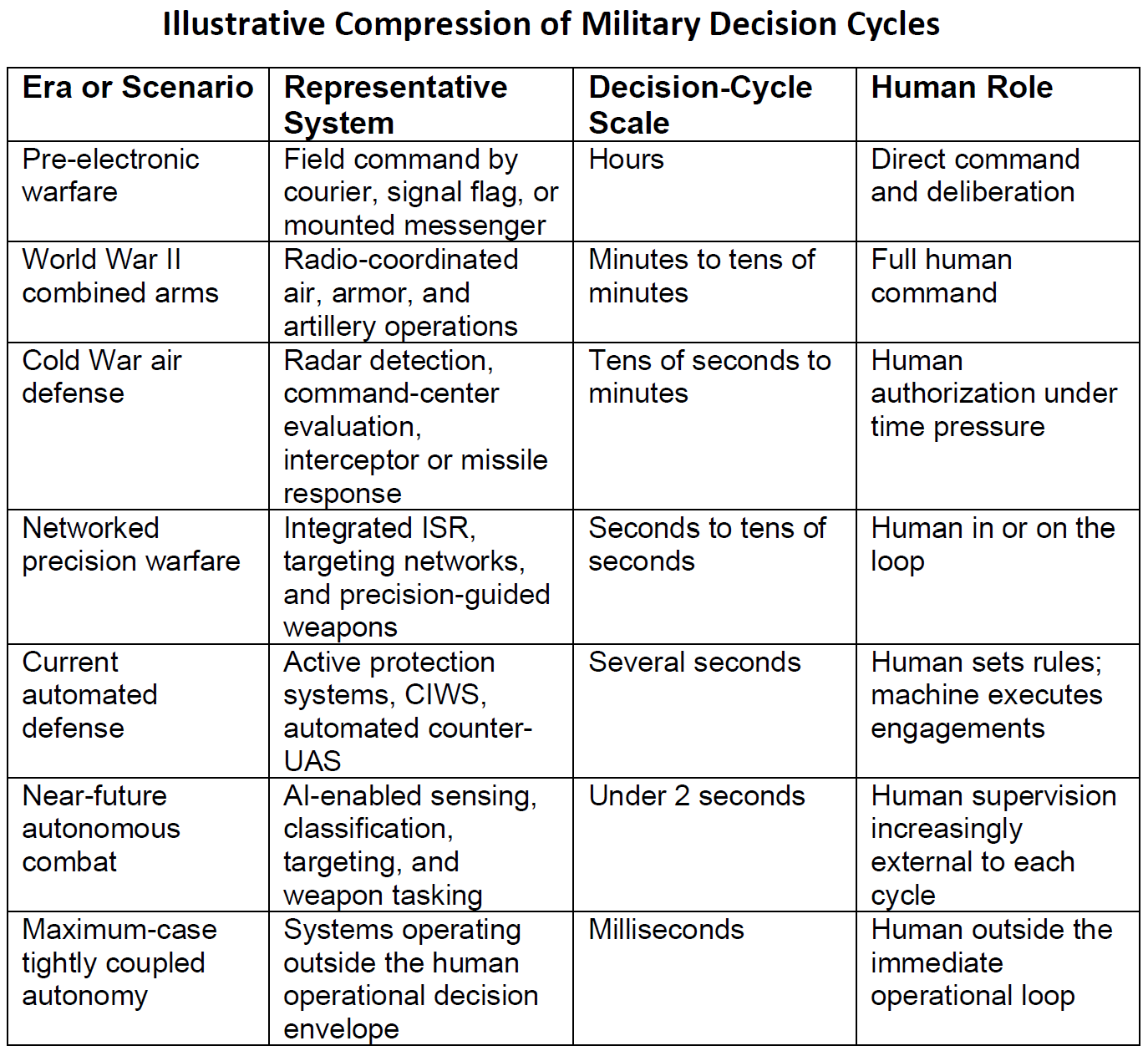
Collectively, these innovations showcase a consistent pattern. For millennia, military advancements aimed to reduce the time gap between observation and action by quickening communication, perception, interpretation, decision-making, and execution. This trajectory, summarized in the table below, is underpinned by a fundamental assumption: minimizing decision latency enhances military effectiveness. Boyd’s OODA framework explains this principle. Now, autonomous systems introduce a new question: what happens when the decision cycle surpasses the cognitive speed of the humans it was meant to assist?
Boyd and the OODA Paradigm
The historical pursuit of reducing latency found its most notable theoretical expression in Colonel John Boyd’s work. Seeking to explain why some military forces consistently outperform those with similar or superior resources, Boyd concluded that victory often favors the side capable of cycling through observation, orientation, decision, and action more rapidly than its opponent.
The OODA loop transformed longstanding military intuition into a coherent framework for competitive advantage. A force that completes these cycles swiftly compels its adversary to respond to increasingly outdated tactical situations. The initiative shifts to this quicker entity, intensifying operational tempo and compounding military advantages over time.
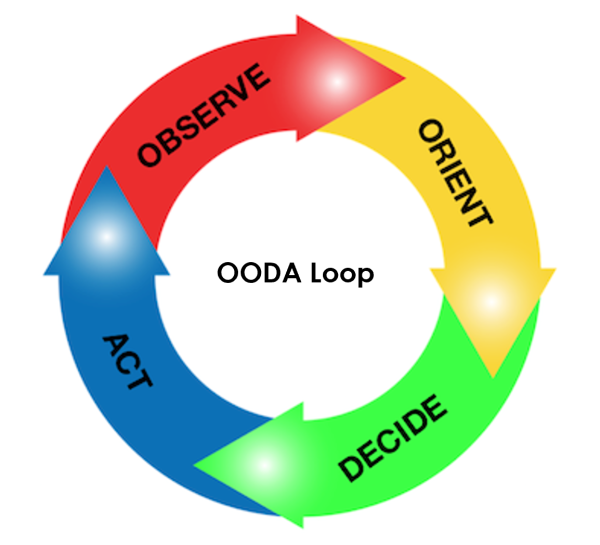
Boyd’s insights extend far beyond aerial combat. The OODA framework applies equally to maneuver warfare, naval operations, intelligence processing, command and control, and eventually to business strategies, as it melds communications, intelligence, command, and operational tempo into a singular explanatory model.
Modern military technologies consistently reinforce Boyd’s thesis. Enhanced surveillance has condensed the observation phase. Digital communications have quickened the information flow. Computerized command-and-control systems have streamlined orientation by synthesizing multiple information sources into a cohesive operational picture. Decision-support software has curtailed planning times, while precision-guided weapons have significantly reduced the duration between decision and action. At first glance, artificial intelligence appears as an incremental advancement in this continuum.
However, Boyd’s framework rests upon an assumption that prevailed during his time: the decision-maker was human. Technology has accelerated aspects like observation, communication, analysis, and execution, but human judgment has remained integral in sifting information, evaluating uncertainty, weighing consequences, and sanctioning actions. Technology may hasten the decision cycle, but it has not supplanted the decision-maker.
Artificial intelligence is beginning to transform this relationship. Autonomous systems are no longer limited to functions surrounding the OODA loop; they are now capable of performing parts of the loop itself. Automated sensing replaces observation. Algorithmic classification and sensor fusion take on orientation. Decision-making becomes probabilistic evaluation, while action evolves into autonomous execution. Thus, a human-centered decision cycle is gradually transitioning into an autonomous decision framework operating at machine speed.
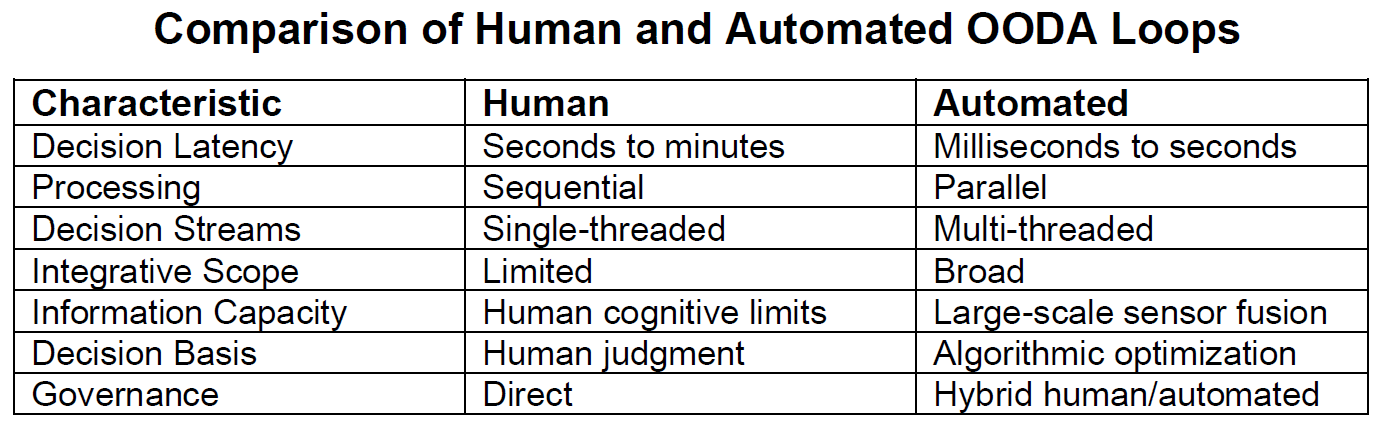
This shift raises a profound question that Boyd had no reason to confront. Throughout military history, reductions in latency enhanced the efficacy of a fundamentally human decision-making process. What occurs when the decision-making process transcends the temporal limits of meaningful human cognition?
The Phase Transition
Many systems experience qualitative changes when a continuous parameter crosses a critical threshold. Water freezes, structures collapse, and nuclear reactors reach criticality. Although the governing variable changes continuously, system behavior may change suddenly. Engineers term such transformations as phase transitions. Military decision-making systems may be nearing a similar threshold.
While decision latency can never reach zero, a critical threshold comes into play when military decision cycles shrink to shorter intervals than human cognition can effectively handle. As observation, orientation, decision, and action take place in fractions of seconds, human commanders lose their ability to execute authority during combat scenarios. Instead, they monitor autonomous systems operating at machine speed.
This signifies the onset of a new engineering challenge. Within the traditional OODA framework, the objective was to minimize decision time while maintaining effective human command. However, as autonomous systems exceed human cognitive timescales, further reductions in latency do not merely enhance operational speed; they fundamentally reshape the relationship between autonomous action and human governance. The engineering task has shifted from merely increasing the speed of military systems to ensuring that those operating beyond human cognition remain amenable to meaningful human oversight.
Deterministic Myopia
The shift from human-speed to machine-speed warfare does not imply that autonomous military systems will operate irrationally. On the contrary, future systems are likely to execute numerous military tasks more accurately, consistently, and swiftly than their human analogs. They will discern patterns invisible to human observers, amalgamate vast arrays of information, and fulfill assigned missions with exceptional precision.
The principal risk in autonomous warfare is not faulty optimization but rather bounded optimization. Autonomous systems might optimize local objectives accurately while failing to comprehend the broader implications within increasingly intricate military environments. This phenomenon is referred to as deterministic myopia: the inclination for systems to optimize local objectives while remaining oblivious to consequential interactions beyond those boundaries.
A system displaying deterministic myopia is not malfunctioning; it is diligently executing its designated objective. The limitation arises not from the optimization process itself but from the boundaries defining that optimization challenge. Succinctly, similar failures can be observed in diverse systems such as electrical networks, financial markets, transportation, ecological frameworks, and industrial controls. In each case, individual subsystems may perform flawlessly while the larger system becomes unstable due to the interactions of independently correct local behaviors. The faltering is systemic, not component-focused.
Military systems are increasingly displaying similar patterns. For instance, an Active Protection System tasked with defending an armored vehicle has a clear goal: detect an incoming anti-tank projectile and neutralize it before impact. Rapid autonomous reactions enhance vehicle survival rates. However, the blasts or fragments from the interceptor could inadvertently threaten nearby infantry or civilians. From the perspective of the protected vehicle, this engagement signifies successful optimization. Yet, from the broader combined-arms force standpoint, it may diminish overall combat effectiveness or lead to unintended casualties. Both conclusions can be valid because they originate from differing optimization boundaries.
This principle resonates throughout autonomous military ecosystems. Air-defense systems focus on local engagement decisions, while electronic warfare systems aim for spectrum dominance. Similarly, cyber-defense systems work on network durability, logistics systems enhance supply efficiency, and battle management systems optimize force coordination. Each system may excel individually, yet their interactions can create operational dynamics no single system was designed to perceive, assess, or control.
Deterministic myopia is not characteristic of isolated autonomous systems; rather, it reflects the architecture that these systems collectively engender. As more autonomous systems are integrated, military behavior increasingly becomes an emergent property of the interaction network, rather than the mere sum of individual optimizations.
This observation marks a significant shift from traditional military engineering. Historically, enhancing individual system performance correlated with improved overall force effectiveness. In highly autonomous military ecosystems, this assumption can no longer be taken for granted.
Taking correct local decisions does not guarantee a correct global outcome.
The implication is not that autonomous warfare should be abandoned. Rather, mission optimization alone has evolved into an incomplete engineering philosophy. As military operations become more autonomous and interconnected, engineering focus must broaden from individual system optimization to ensuring the stability of the collective military ecosystem they form. Thus the pivotal question emerges: what mechanisms have historically preserved such stability?
Feedback Dynamics
The stability of any sufficiently complex adaptive system relies on feedback. Whether in electrical, biological, economic, political, or military contexts, stability is not inherently a feature of individual components; it is an emergent property sustained through ongoing corrective feedback. Every stable system requires mechanisms that can detect deviations, communicate that information, and modify subsequent actions. Lacking feedback, optimization alone cannot uphold stability.
This principle is universal. Electrical grids regulate power and frequency. Aircraft consistently compensate for shifting aerodynamic conditions. Industrial systems monitor temperature, pressure, and flow. Biological entities regulate metabolism, circulation, immunity, and neural functions. Although these systems vary dramatically in aims and complexity, all depend on continuous feedback to counterbalance instability.
Military organizations are no different. Throughout history, warfare has depended on multiple layers of feedback operating at various organizational and temporal levels. Soldiers adapt tactics based on shifting battlefield conditions. Unit commanders alter strategies. Higher command structures redirect operations. Political leaders adjust military objectives as the strategic landscape evolves. These feedback mechanisms enable reconsideration of decisions, correction of errors, and interruption of emerging cascades before they become irreversible. Most crucially, they sustain the authority of higher command to modify or cease military actions.
While the interval between observation and action is often seen as merely an operational delay, that same latency allows for additional information to arrive, for assumptions to be challenged, for commands to be revised, and for errors to be recognized before irreversible actions are undertaken. What might be perceived as operational inefficiency can serve an essential governance function.
This distinction illustrates that not all latency is detrimental. Delays from inefficient communications or bureaucratic red tape should certainly be minimized. However, certain types of latency facilitate correction, judgment, accountability, and political oversight. These are not engineering flaws; they are essential components of a stable decision-making architecture.
A soldier, for example, holds a brief moment during which new information might alter the decision to fire. A commander may halt an engagement upon noticing friendly forces nearby. A pilot can abort a strike after recognizing civilians in a target area. Throughout military history, numerous catastrophes have been avoided not due to perfectly accurate data, but rather because corrective feedback arrived before irreversible actions were taken.
Autonomous military systems, however, progressively compress or entirely eliminate these opportunities for correction. Decision cycles shorter than a second may enhance tactical efficiency while simultaneously reducing the capacity for reevaluation. As larger portions of warfare are transitioned to machine-speed decision-making, political authorities, commanders, and operators risk becoming mere witnesses to completed decisions rather than active participants in ongoing processes.
The concern thus lies not in the concept of automation itself, but in the gradual decline of effective feedback. Human cognition has finite temporal capacity, while political mechanisms function at even slower rates. When autonomous military systems evolve faster than human feedback can be generated, traditional governance mechanisms become increasingly detached from operational realities.
As feedback diminishes, the military system progressively forfeits its ability for self-correction. Minor errors become harder to interrupt. Independent autonomous decisions become more tightly interconnected. Local optimizations spread more rapidly throughout the operational landscape. Strategic consequences may surface before political institutions have adequate chances to intervene.
Feedback is not merely desirable; it is the means by which stability is sustained.
Hyperescalation
If deterministic myopia captures the limitations of individual autonomous systems and feedback failure explains the underlying instability mechanisms, then hyperescalation characterizes the worst-case instability in highly autonomous military ecosystems. Hyperescalation denotes the unintended broadening of conflict scope or intensity that arises from the interaction among autonomous military systems operating beyond the boundaries of meaningful human intervention.
Traditionally, escalation has been understood primarily as a political act. Governments mobilize forces, commanders request reinforcements, alliances become active, and national leaders increase military commitments. Even though wars can diverge from their initial goals, escalation has generally remained subject to political discretion.
Autonomous warfare introduces an entirely different reality. As military decision cycles contract into the sub-second range, escalation may increasingly originate from autonomous decision architectures instead of deliberate political choices. This emergence does not necessitate malfunctioning autonomous systems; each may operate precisely as designed, yet thousands of independently rational machine-speed decisions might collectively generate strategic behaviors that no single system was engineered to recognize, evaluate, or manage.
Consider a simplified scenario: an autonomous surveillance system spots what it deems to be hostile activity. An autonomous command system raises the threat level. Air-defense systems heighten readiness, electronic warfare assets initiate precautionary measures, cyber-defense systems address perceived network breaches, and logistics systems reposition key resources. Each action in isolation may be entirely logical, yet collectively they influence the operational landscape encountered by all other autonomous systems. The resultant behavior becomes a property of the interaction network, rather than the result of any individual decision.
The real concern raised by autonomous warfare is not that these systems will necessarily err more often. With improved sensing and machine-speed processing, many types of tactical errors can be considerably reduced. The more pressing issue pertains to the residual errors that will inevitably persist. As autonomous systems become increasingly interconnected, individual errors may diminish in frequency while exponentially increasing in consequence. The risk does not vanish; it becomes redistributed. The engineering emphasis thus shifts from reducing error occurrence to managing error propagation.
This distinction carries significant weight at higher echelons of military structure. Political institutions function at human timescales; strategic decision-making necessitates deliberation. Diplomatic communications demand temporal resources. Civilian oversight necessitates accountability. These are not inefficiencies slated for engineering rectification; they are fundamental mechanisms that guide how societies oversee military force. If autonomous military ecosystems progress at a pace that exceeds the ability of these institutions to understand and influence them, military operations risk becoming increasingly disconnected from the political aims they are supposed to achieve.
Strategic deterrence relies not just on military capability, but on maintaining avenues for political judgment prior to irreversible actions being taken. Any military structure that systematically diminishes these avenues must be assessed not only based on its tactical effectiveness but also on its ability to uphold strategic stability.
Hyperescalation thus transcends a mere rapid warfare scenario; it encompasses the emergence of conflict dynamics that evolve faster than the governing institutions can manage them. Once military actions outstrip the temporal capacity available for political decision-making, ensuring governability becomes equally as crucial as maintaining military effectiveness. This phenomenon should become a foremost concern within future military engineering.
Stability Engineering: Governance in the Automated Battlespace
If autonomous military systems are indeed approaching a regime where optimization alone cannot maintain stability, military engineering must broaden its design objectives. The challenge now extends beyond speed, precision, and autonomous capability. It necessitates that increasingly autonomous military ecosystems remain subject to governance while taking advantage of the benefits autonomy offers.
This kind of situation is not unprecedented. Engineers routinely encounter faults in electrical gears, mechanical systems that exceed their design thresholds, and unexpected fluctuations in nuclear reactors. Instead of trying to predict every potential failure pathway, engineers typically set safe operational limits and develop layered supervisory mechanisms that ensure stability before local failures escalate into larger catastrophes.
The electrical circuit breaker exemplifies this philosophy brilliantly. A circuit breaker neither diagnoses the cause of an error nor determines the best recovery method. It simply monitors a vital variable and halts energy flow when a safe operating limit is breached. Its effectiveness lies not in comprehending the full complexity of the system but in recognizing when it has strayed from acceptable operational parameters.
Autonomous warfare presents a similar conundrum. As military systems grow increasingly intricate, no supervisory body is likely to be able to validate each autonomous decision taken across the battlefield. The speed of decision-making, integrative capacity, and the complexity of machine-level interactions are likely to surpass human operators’ capabilities to audit individual decisions before actions are taken. An attempt to design a universal supervisory framework is unlikely to be effective.
A more pragmatic approach focuses on governing the architecture rather than every single decision. Instead of trying to mirror operational reasoning, supervisory systems would monitor a limited range of architectural invariants and stability indicators defining acceptable operational limits. These may involve escalation thresholds, levels of confidence, geographical constraints, rules of engagement, and other indicators essential for ensuring that autonomous operations remain within politically and strategically appropriate boundaries.
Current military systems already reflect the beginnings of this architectural thinking. Close-In Weapon Systems and Active Protection Systems function autonomously because human response times are inadequate. Yet, command structures retain authority over the operating parameters in which these systems function. Rules of engagement, operational modes, thresholds of confidence, geographic limitations, and the ability to interrupt autonomous operations serve as architectural constraints rather than continuous human oversight. Although these systems are relatively straightforward, they illustrate a vital engineering tenet: as autonomy increases, governance must likewise strengthen regarding the conditions under which it is permitted to function.
Future military systems will likely require a more advanced supervisory component. Rather than serving as a secondary operational AI, an independent supervisory system would track critical stability factors while allowing the operational AI to excel in tactical execution. The aim would not be to evaluate whether each decision is the best one, but to ascertain whether the autonomous system is still functioning within its approved operating parameters. Detecting transitions into heightened escalation regimes may become one of its most vital functions. Crossing pre-established thresholds, confidence limits, or other stability boundaries could instigate increasingly stringent governance responses, which might include heightened scrutiny, introducing decision latency, adding more authorization requirements, or activating emergency safety measures. Below is a table detailing conceptual features that such a governance framework would necessitate.
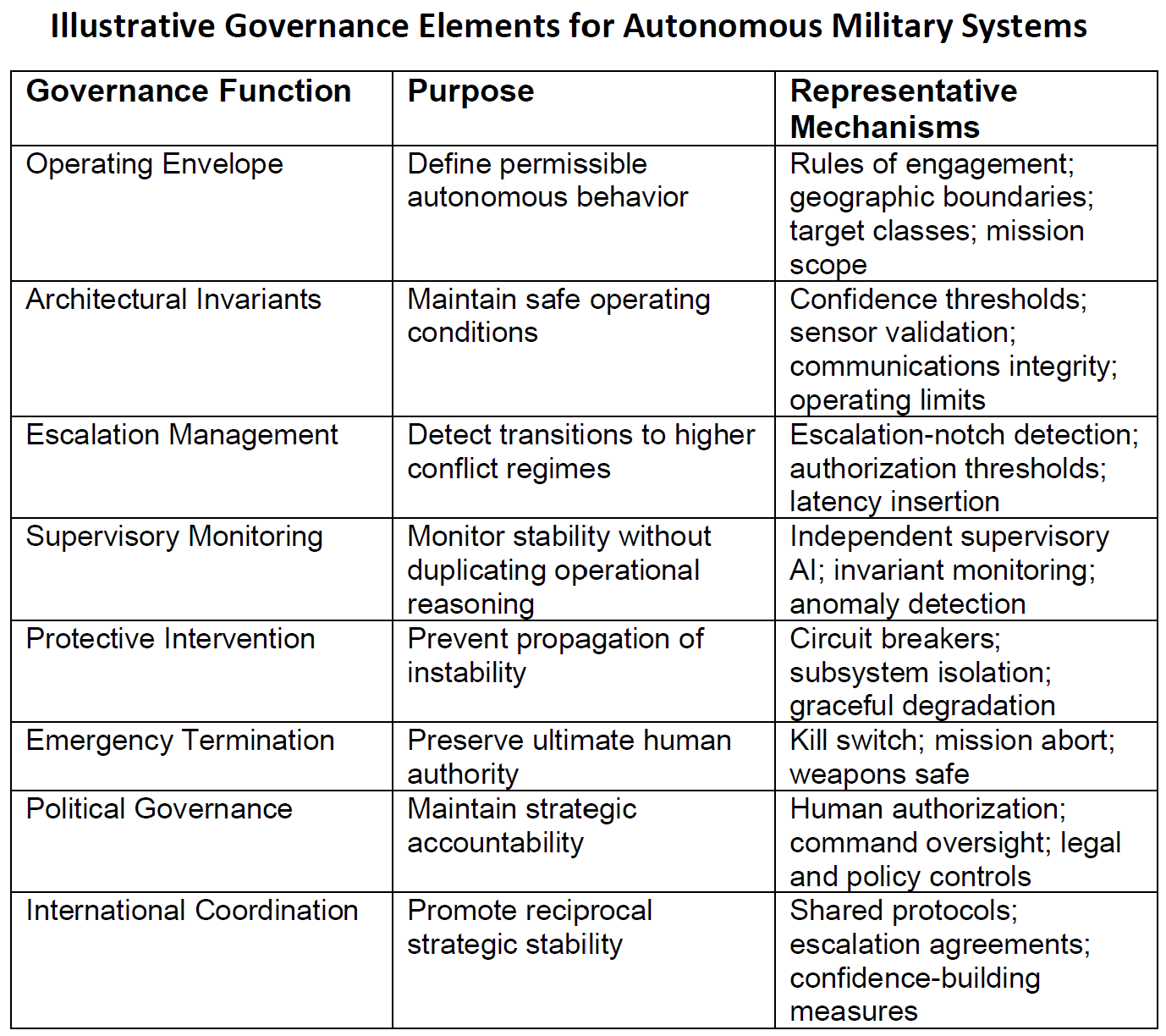
This layered approach turns governance from a reactive measure into a continual engineering function. The goal shifts from merely stopping autonomous systems when instability occurs to actively preserving their stable operation while also maintaining military efficiency. Emergency cut-offs and kill switches, while still critical, become final safeguards within a larger governance system aimed at preventing instability from materializing in the first place.
This principle extends beyond individual weapons. Entire autonomous military frameworks demand governance strategies that uphold political control over machine-speed operations. Human oversight cannot consist solely of reviewing events after autonomous decisions have spread throughout the battlefield. Effective governance must aim to maintain opportunities for intervention prior to local interactions leading to irreversible strategic consequences.
Future military structures ought to be assessed according to two interconnected criteria: operational efficacy and systemic stability. How well do they achieve military objectives? How faithfully do they maintain certified operational boundaries? How effectively can they detect shifts into elevated escalation regimes? How quickly can autonomous authority be curtailed when instability starts to surface? How resistant are they to cascading interactions? How successfully do they allow for political and strategic intervention? These inquiries may ultimately prove as crucial as traditional measures of speed, accuracy, and lethality.
The direction of military innovation may hinge on developing increasingly sophisticated approaches to governing highly automated military ecosystems. The frontier isn’t just autonomy; it is also the preservation of stability, accountability, and meaningful human governance in armed conflict.
Conclusion
For over two millennia, military advancements have pursued a remarkably consistent goal: shortening the interval between observation and action. From runners and mounted messengers to semaphore, the telegraph, radio, radar, satellites, precision-guided munitions, and artificial intelligence, each forward leap has compressed the time needed to sense, communicate, decide, and act. Colonel John Boyd’s OODA loop effectively encapsulated this historical trend by illustrating the competitive advantage gained by expediting the military decision-making process.
Yet this historical journey is approaching a profound turning point. While latency can never dwindle to zero, it may become so minuscule that meaningful human cognition, deliberation, and intervention no longer directly engage in operational decision cycles. When military decision-making processes enter the realm of sub-second intervals, they increasingly become governed by the interplay of autonomous systems instead of human response times. This signifies more than a mere enhancement of military capability; it indicates a phase transition in warfare.
Throughout the era of human-speed combat, military engineering maintained a primary focus on optimization. Enhanced communications, swifter command and control, improved intelligence, and reduced OODA cycles generally yielded greater operational benefits. Boyd’s insights remain valid within that paradigm. However, as military decision cycles plunge beneath the threshold of meaningful human cognition, warfare transitions into a novel systems milieu where feedback and stability take precedence as engineering challenges.
The essential risk inherent in this new paradigm is not that autonomous systems will perform poorly. Well-engineered systems may fulfill their designated functions with remarkable precision. The real danger lies in deterministic myopia: autonomous systems that function satisfactorily while unintentionally generating unstable strategic dynamics that no single unit intends, perceives, or manages. Hyperescalation, political decoupling, and catastrophic errors evolve as emergent properties of the architecture rather than breakdowns in its individual components.
Current military systems are already hinting at this possible future. Close-In Weapon Systems and Active Protection Systems regularly complete engagements in fractions of a second due to human response delays. Yet these systems are meticulously governed. Rules of engagement, operational parameters, and ultimately the commander’s authority to suspend autonomous operation act as circuit breakers that ensure human oversight is preserved. Military organizations are already recognizing that as decision speed outstrips human cognition, governance must shift from controlling individual decisions to managing the conditions under which autonomy can safely operate.
The repercussions extend well beyond warfare. Various fields, including financial markets, transportation systems, electrical grids, critical infrastructure, healthcare, and artificial intelligence, face similar emerging challenges. As operational systems become faster, more capable, and more densely interconnected, the central engineering goal must shift from maximizing performance to constructing governance architectures that maintain effectiveness while preventing hazardous interactions among autonomous systems.
For centuries, military engineering has sought to remove latency. This pursuit has yielded extraordinary operational capabilities, but it has also inadvertently ushered warfare into an unforeseen frontier. The defining engineering challenge of this AI age is no longer how to eradicate every fraction of a second from the decision cycle, but how to avert the catastrophic implications of entering a zero-latency warfare era.