As the economy grapples with soaring inflation, concerns about its impact on American households are becoming increasingly pressing. In light of this, many are left questioning why President Trump’s approval ratings continue to decline. His administration has shown little regard for how the ongoing war is straining household budgets. Officials and allied media outlets seem to suggest that consumers should endure what they label a temporary hardship, particularly with rising gas prices, all in the name of a broader geopolitical goal. Yet, as Wolf Richter highlights, inflation is now a multifaceted issue that extends far beyond just energy prices.
By Wolf Richter, editor at Wolf Street. Originally published at Wolf Street
Today, the Bureau of Economic Analysis released significant data, including quarterly inflation metrics across various GDP categories. This data encompasses price fluctuations for all goods and services consumed by participants in the US economy—this includes consumers, businesses, and government sectors. These broader inflation rates provide a more comprehensive view than typical consumer price indices like CPI and PCE. As we delve into Q2, the inflation figures without the influence of energy costs reveal alarming trends.
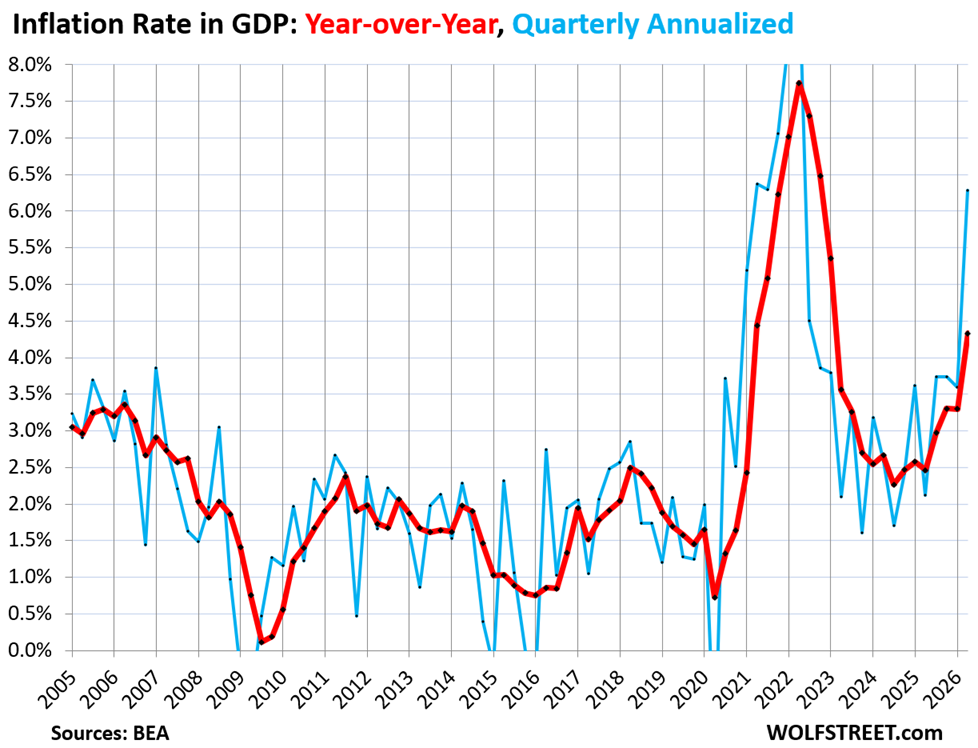
Overall inflation in GDP (known as the “GDP deflator”) surged by 6.3% in Q2 compared to Q1 on an annualized basis—marking the most significant rise since Q2 2022 (as illustrated by the blue line in the chart below).
Looking at year-over-year data, GDP inflation increased by 4.3%, the highest since Q1 2023 (reflected in the red line). Indeed, energy prices did spike in Q2, though they began to decline midway through. However, the inflation measure that excludes energy and food also experienced a marked increase, presenting the most substantial rise since Q2 2023.
When excluding energy and food, the GDP inflation rate climbed by 4.4% in Q2 compared to Q1, with this being the worst figure since Q1 2023 (indicated by the blue line in the chart below).
Year-over-year, the GDP inflation rate sans energy and food rose by 3.8%, the highest level since Q2 2023 (shown in red in the chart below).
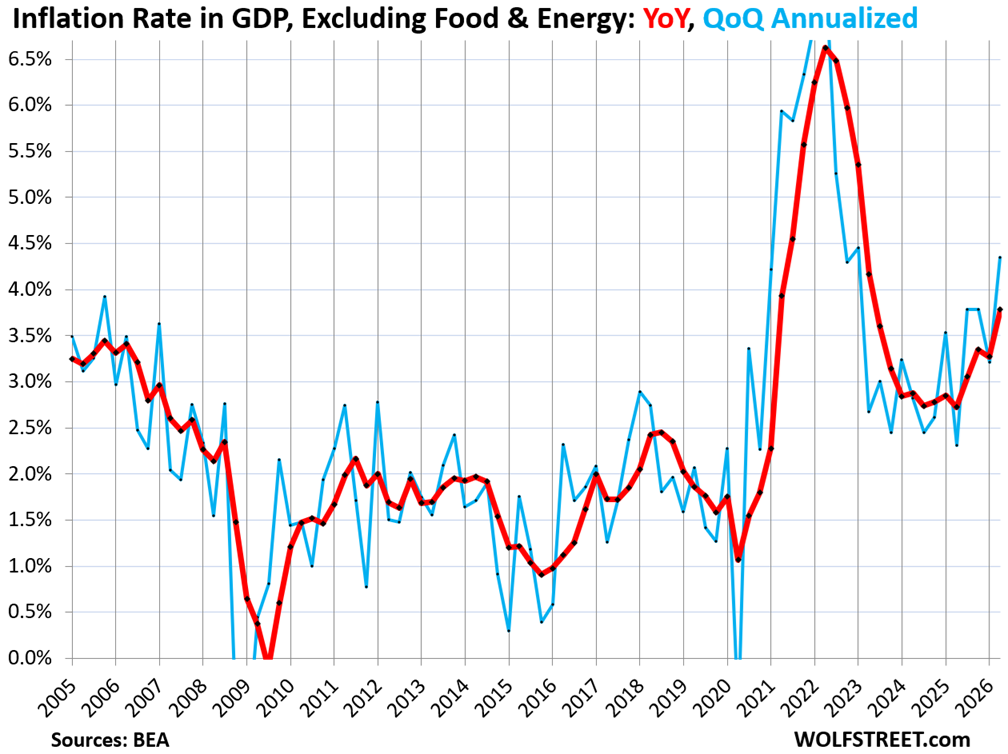
Both measures—overall GDP inflation and core GDP inflation—indicate that inflation is surging throughout the US economy, impacting every participant. Moreover, these inflation rates have been on a steady upward trajectory for four consecutive quarters, demonstrating that this is not merely a recent development linked to the war in Iran.
The Federal Reserve typically does not use these comprehensive inflation measures to gauge its 2% inflation target; instead, it relies on the PCE price index, which focuses on consumer price inflation. Yet, the quarterly PCE price index released today reflects a similar trend and intensity.
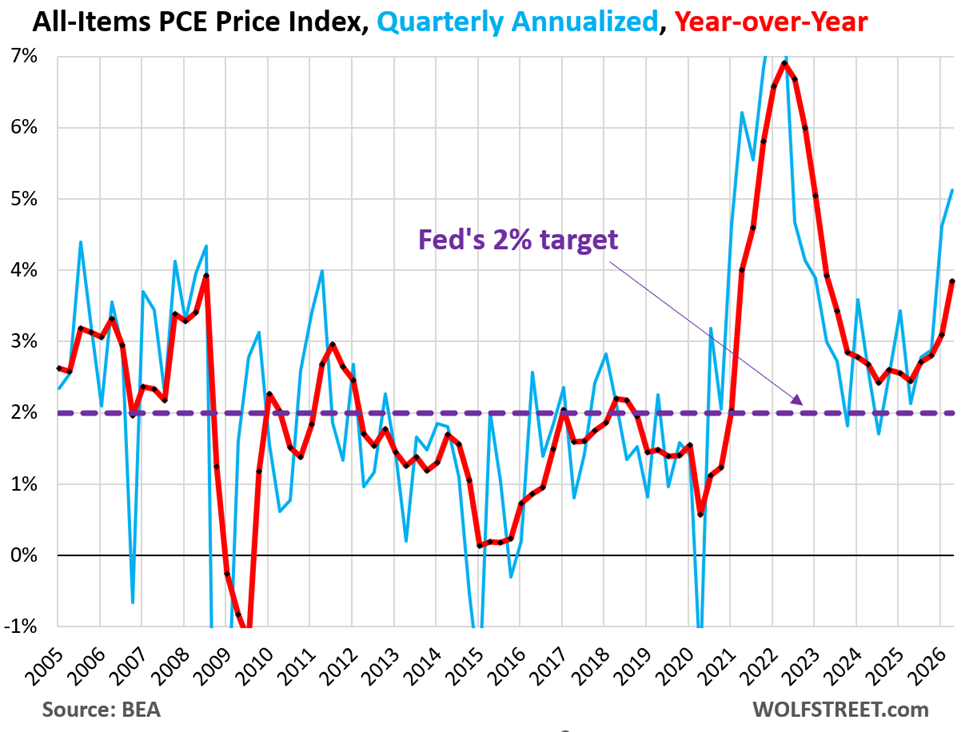
The quarterly PCE price index, oriented toward consumers, rose by 5.1% on an annualized basis in Q2 compared to Q1, marking the second-worst increase since Q1 2022, according to BEA data. This index is a component of the broader GDP inflation data and focuses specifically on the prices consumers encounter.
On a year-over-year basis, the quarterly PCE price index increased by 3.8%, the highest rate since Q2 2023.
While energy prices contributed to this rise, they began to decrease during the latter part of Q2. However, the rising costs of non-energy factors remain a significant concern, as evidenced by the “core” PCE price index, which excludes energy. The steady acceleration away from the Fed’s 2% target began a year ago.
The quarterly “core” PCE price index, which excludes both energy and food, increased by 3.4% on an annualized basis in Q2—the second-highest quarter-to-quarter rise since Q1 2024, with the prior quarter holding the record for the highest increase.
On a year-over-year basis, the “core” PCE price index rose by 3.3%, the highest increase since Q2 2023.
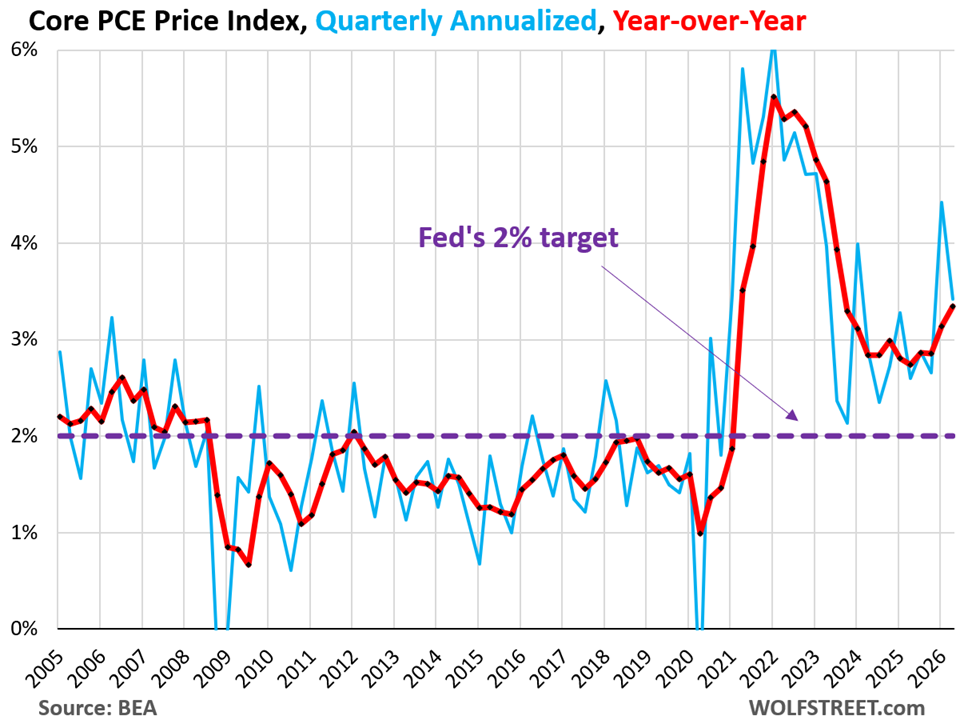
This quarterly consumer price inflation is alarming, even when removing energy costs from consideration. Businesses and governments are facing even steeper inflation rates, resulting in overall inflation levels for the US economy being higher than consumer inflation rates.
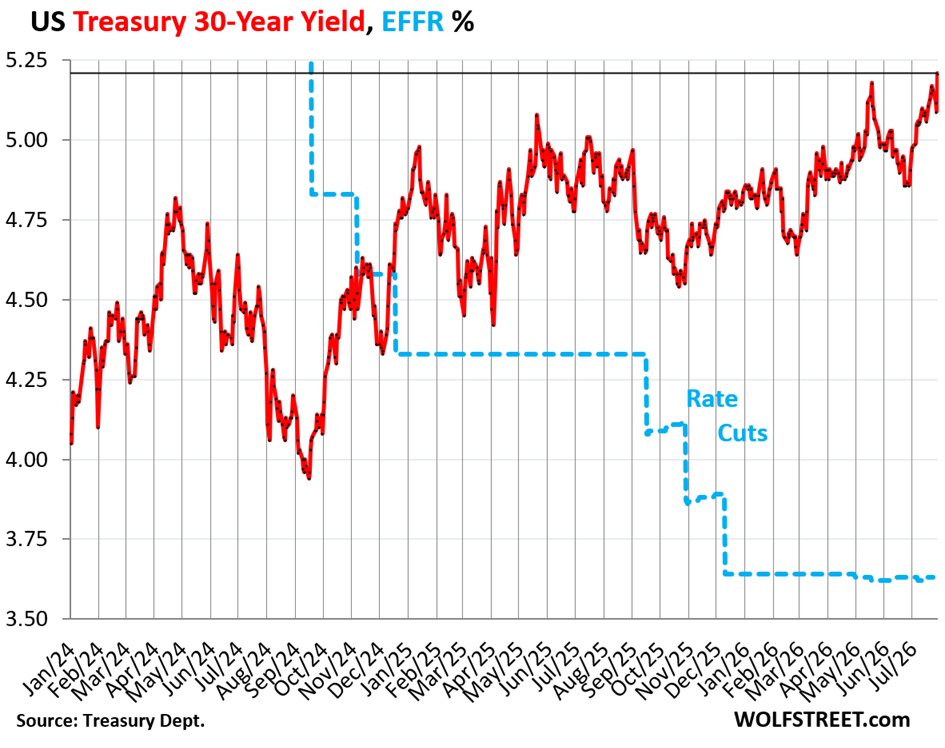
The Federal Open Market Committee (FOMC) members must stop taking a laissez-faire approach and unite to address this situation decisively, lest the bond market begins to express its concerns—evidenced by the recent surge in the 30-year Treasury yield, the highest since 2007.