As the conflict in Ukraine escalated in 2022, the Starlink satellite communication system emerged as a crucial asset for maintaining communication in wartime. With many traditional networks damaged, thousands of Starlink terminals enabled military forces, emergency services, hospitals, and civilians to stay connected in challenging conditions. The swift deployment of Starlink showcased exceptional engineering, transforming satellite communications into a global utility designed to provide high-speed internet. This situation redefined expectations of commercial space systems in times of international crisis.
However, the success of Starlink also unveiled unexpected challenges. As the system became integrated into military operations, decisions regarding network access and geographic coverage began to have significant strategic and political implications. The evolution of Starlink serves as more than just a tale of technological advancement; it highlights the complex convergence of engineering and governance in modern warfare.

Starlink satellite – one of thousands in low Earth orbit.
Engineering Triumph
SpaceX initiated the deployment of the Starlink constellation in 2019, aiming to provide high-speed broadband internet worldwide. Traditional satellite internet faced numerous issues, including high latency and limited bandwidth. Starlink changed this dynamic by launching thousands of small satellites into low Earth orbit and connecting them using laser data links, effectively revolutionizing satellite communications.
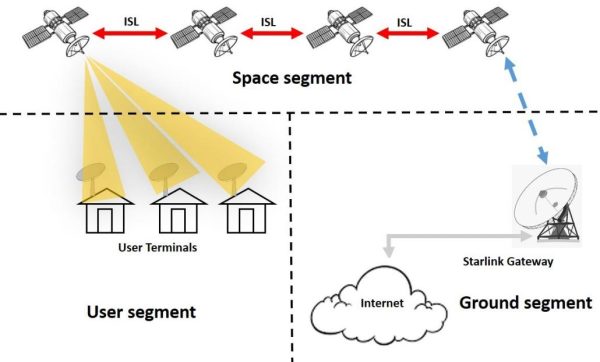
Starlink achieves high-speed global internet communication by connecting satellites with laser data links (ISL).
The engineering feat was monumental. Rather than relying on a few large geostationary satellites positioned 35,786 kilometers above Earth, Starlink utilized thousands of satellites orbiting at approximately 550 kilometers. This lower altitude minimized signal latency, bringing it closer to terrestrial broadband levels and allowing continuous global coverage through a dynamic orbital constellation. Advanced phased-array antennas automatically track multiple satellites overhead, ensuring a smooth handover of communications. Laser connections enable efficient routing of data to ground stations, linking them to the terrestrial internet.
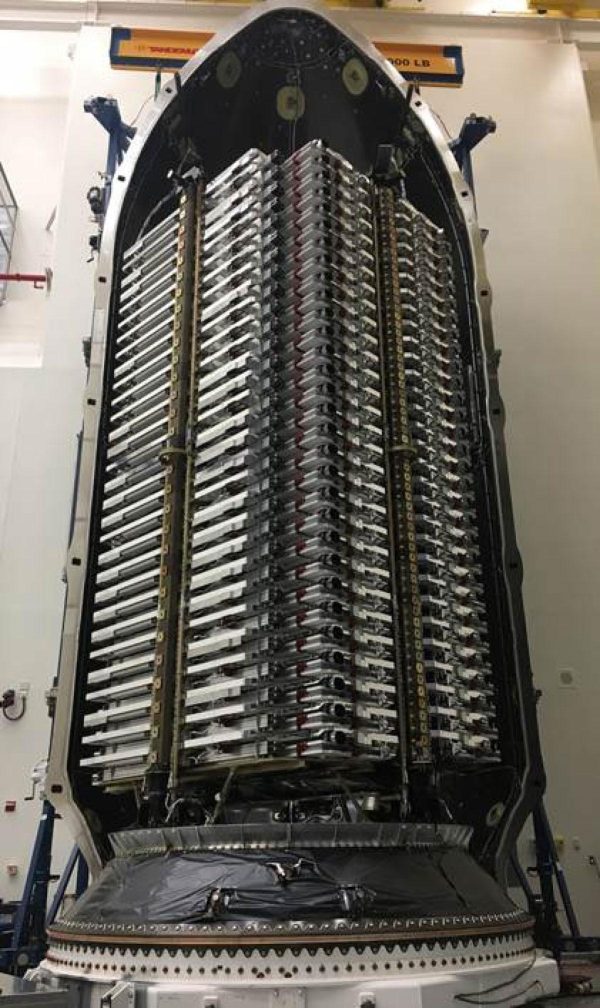
Starlink satellites stacked for launch aboard a Falcon 9 rocket. Launching 60 satellites at a time allowed SpaceX to build the constellation with unprecedented speed.
The scale and pace of this initiative were extraordinary. SpaceX evolved from being merely a launch provider to operating the largest satellite constellation ever built. Continuous launches, rapid iterations of satellite design, reusable Falcon 9 rockets, and automated manufacturing transformed traditional aerospace engineering into a scalable industrial process. The constellation is continuously enhanced through regular hardware and software upgrades, eliminating the delays associated with lengthy satellite replacement cycles.
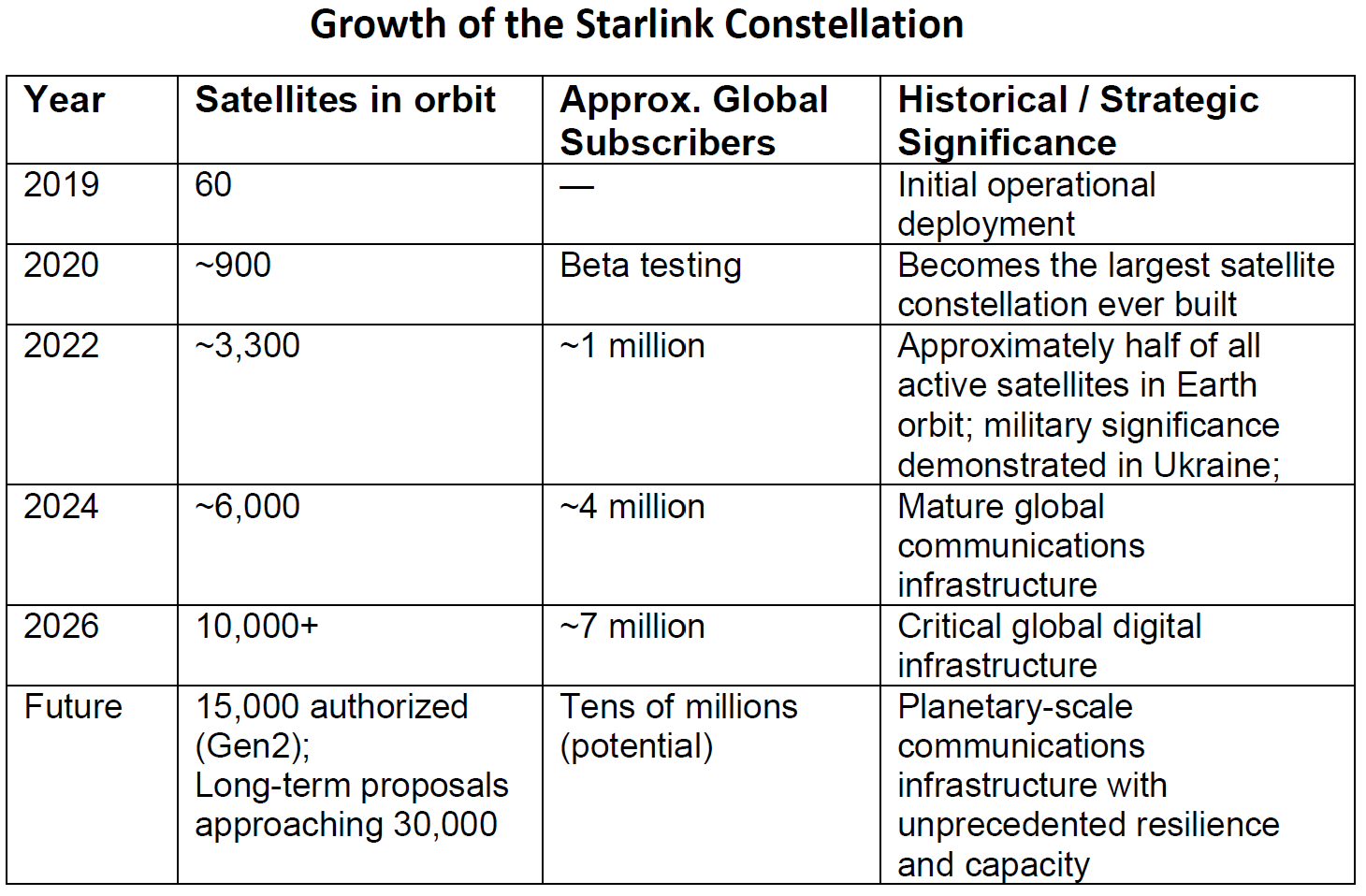
Equally notable was the architecture of the system. Starlink emphasizes resilience through a distributed infrastructure rather than a centralized one. Users only need a terminal with a clear view of the sky, allowing multiple communication pathways that ensure the system remains operational even if certain satellites or terrestrial networks go down. This design prioritizes reliability through redundancy and scale rather than depending on a few critical nodes.
These features highlight an impressive engineering accomplishment independent of military applications. With low latency, broad global reach, quick deployment, and adaptable networking, Starlink is among the most advanced communication systems created. However, the same characteristics that contributed to its commercial success also rendered it strategically valuable, revealing a swift transition from engineering achievement to geopolitical importance.
Starlink in the Kill Chain
When Starlink terminals first reached Ukraine, their primary aim was to restore communication lines disrupted by the Russian invasion. This deployment was mainly seen as a humanitarian effort to replace destroyed civilian infrastructure. Hospitals, emergency responders, and journalists rapidly benefited from a communications network that could be set up almost instantly and operate independently of the damaged terrestrial systems.
Yet, the humanitarian mission marked just the initial phase of Starlink’s involvement in warfare. In contemporary military doctrine, the kill chain refers to the entire process of gathering intelligence, making decisions, coordinating forces, and executing military actions. Effective communication integrates every facet of this process, making a resilient network an essential element of combat capability.
The line between civilian and military use quickly blurred. Modern armed forces require secure, low-latency communications for operations ranging from command and control to battlefield coordination. The same features that made Starlink crucial for disaster recovery—mobility, resilience, and ease of deployment—also rendered it ideally suited for network-centric warfare. This transition required no reworking of the technology, only an adaptation in its operational context.
Starlink’s purpose extends well beyond mere internet provision for troops. It supplies the bandwidth and low-latency communication necessary to manage unmanned systems operating beyond traditional radio limits. Ukrainian maritime drones and other unmanned vehicles use Starlink connections for command and control, real-time video transmission, and navigation over vast distances. Effectively, Starlink became integral to the command-and-control framework guiding modern weapon systems.

Starlink antenna on military drone.
Because of its effectiveness, Starlink attracted attention from electronic warfare units. Russian forces have frequently sought to disrupt its connectivity through specialized electronic warfare systems aiming to interfere with satellite communications. This ongoing struggle highlights that Starlink has transitioned from being a commercial service to a contested military infrastructure.
As Ukrainian military operations increasingly involved Starlink, SpaceX and Elon Musk faced dilemmas never anticipated in the system’s initial design. Questions arose about service availability in contested regions, equitable support for offensive and defensive operations, and whether a privately-operated network could become an essential part of a nation’s military capabilities.
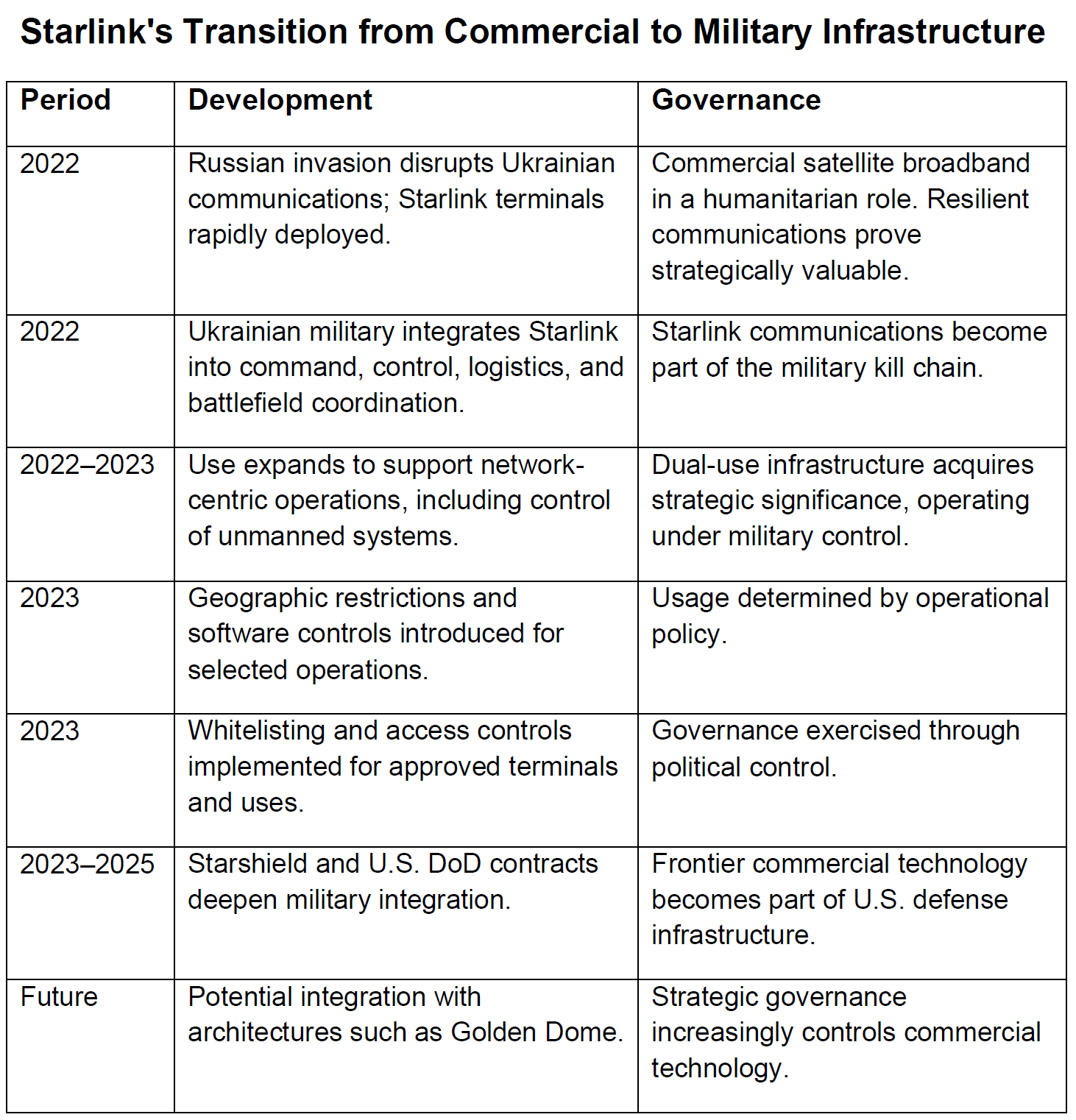
This transition unfolded gradually. What began as humanitarian support evolved into complex decisions regarding acceptable military applications. Reports surfaced that certain offensive operations would be restricted, particularly where Starlink might facilitate attacks outside predefined operational boundaries. Geographic limitations, software controls, and whitelisting policies became methods for translating technical configurations into policy choices. Control over access turned from a network management task into a governance instrument. Engineers resolved the technical challenges, but the remaining inquiries were political: who decides operational parameters, user authorizations, and acceptable use? These questions pertain to governance, not just engineering.
The Technology Governance Challenge
The shift from a commercial platform to military infrastructure exposes challenges that extend far beyond Starlink’s involvement in Ukraine. It demonstrates how quickly advanced technologies can assume strategic roles, often leaving their creators unprepared. What began as an engineering triumph evolved into a governance challenge.
Engineering and governance are fundamentally distinct areas. Engineering strives to optimize performance and reliability, focusing on technical success. In contrast, governance involves questions about who controls powerful technologies, how they are utilized, and how to balance competing political, military, and ethical interests when no clear technical solution exists.
The Starlink case illustrates how technological success can inadvertently impose governance responsibilities. Once integrated within the military framework, decisions about software configurations and geographic access began to carry weighty consequences beyond technical performance. Geographic limitations and access controls shifted from being technical features to mechanisms of public policy. The network’s architecture remained unchanged, but its institutional role transformed.
None of these issues can be resolved solely through engineering. Engineers can assess the reliability of communications links or the feasibility of software functions, but they cannot determine the appropriate balance between military utility and humanitarian aid, or establish the legitimacy of operational restrictions. Addressing such questions requires governance due to the need to reconcile competing societal values.
The pressures associated with strategic military competition further complicate this challenge. In an arms race, there is a tendency to prioritize rapid deployment of advantageous technologies over a thorough evaluation of their governance implications. Nations that take the lead can gain significant operational benefits, urging others to hasten their own deployments despite unresolved governance questions. Consequently, there is a pattern of governance lagging behind innovation instead of guiding it, enabling technologies to become entrenched in military and political contexts before society can fully assess their ramifications.
This explains why the Starlink experience illustrates a broader trend rather than an isolated wartime adaptation. SpaceX developed one of the world’s most proficient communication networks, only to find itself making decisions typically reserved for governments. Engineering entities are increasingly producing capabilities with far-reaching geopolitical consequences beyond their initial design goals. The issue does not stem from engineering failures; rather, it arises from the rapid success of engineering outpacing governance frameworks.
Starlink thus exemplifies a growing characteristic of frontier technologies. As systems advance in capability, autonomy, and integration into essential infrastructures, the division between engineering and governance becomes increasingly challenging to navigate. Technologies such as artificial intelligence, autonomous weaponry, and biotechnology are poised to follow similar paths, transitioning from commercial innovations to significant military applications with remarkable speed.
The core issue is no longer simply whether a technology functions effectively. It revolves around who dictates the terms of its use, based on what principles, and under whose authority. Developing transformative technologies presents significant engineering challenges; governing their use has become an equally critical institutional challenge.
The Next Frontier
The military implications of Starlink extend beyond the conflict in Ukraine. The war has highlighted the strategic value of commercial space infrastructures and hastened their integration into national defense strategies. What started as a broadband constellation is now shaping the design of future military communication and missile defense systems.
One key development in this transition is SpaceX’s Starshield, a satellite business focused on defense applications. Built on the engineering foundations laid by Starlink, Starshield is specifically tailored for government and national security purposes. This shift marks a significant change; the evolution from a commercial platform to defense infrastructure has shifted from being a reaction to wartime necessity to a clear organizational goal.
Similar trends can be observed in proposals for expansive missile defense architectures like Golden Dome. Whatever the final configurations of such systems, they are expected to rely heavily on commercial capabilities in various domains, such as satellite constellations and secure communications. The line separating commercial innovation from national security infrastructure is becoming increasingly indistinct. This should not be interpreted as a criticism of engineering advancements; rather, the extraordinary capabilities displayed by Starlink elucidate why governments are eager to incorporate commercial technologies into their strategic frameworks. The primary challenge lies within the realm of political governance.
Conclusion
The narrative surrounding Starlink transcends satellite communications, Elon Musk, or the war in Ukraine. It represents the accelerating migration of advanced technologies from innovative commercial applications into critical strategic infrastructures. What commenced as a bold initiative to offer global broadband connectivity rapidly evolved into a vital component of contemporary warfare and governance on an international scale.
This transition was not a sign of engineering failure; it was the remarkable success of Starlink’s engineering that led to such strategic reliance. The system functioned as designed, but the context of its deployment changed dramatically. Engineering considerations gave way to geopolitical realities, and technical decisions began to carry military and diplomatic weight.
The experience with Starlink portends a larger transition unfolding across various technological domains. Technologies such as artificial intelligence, autonomous systems, and biotechnology are likely to traverse similar trajectories as they become more integrated into vital national and international infrastructures. Creators of these technologies may increasingly find that their engineering triumphs impose governance responsibilities extending far beyond their original intentions.
Starlink embodies dual aspects that are not at odds with one another but represent successive phases in the evolution of transformative technologies. The first facet is engineering innovation; the second is governance. Engineering entities excel in expanding technological possibilities; however, governance structures have not evolved at the same velocity. The premature or improvised military adoption of groundbreaking technologies may lead to significant consequences that existing governance frameworks are ill-equipped to manage. As frontier technologies become more embedded in military, economic, and political systems, bridging this institutional gap may emerge as one of the defining challenges of the twenty-first century.