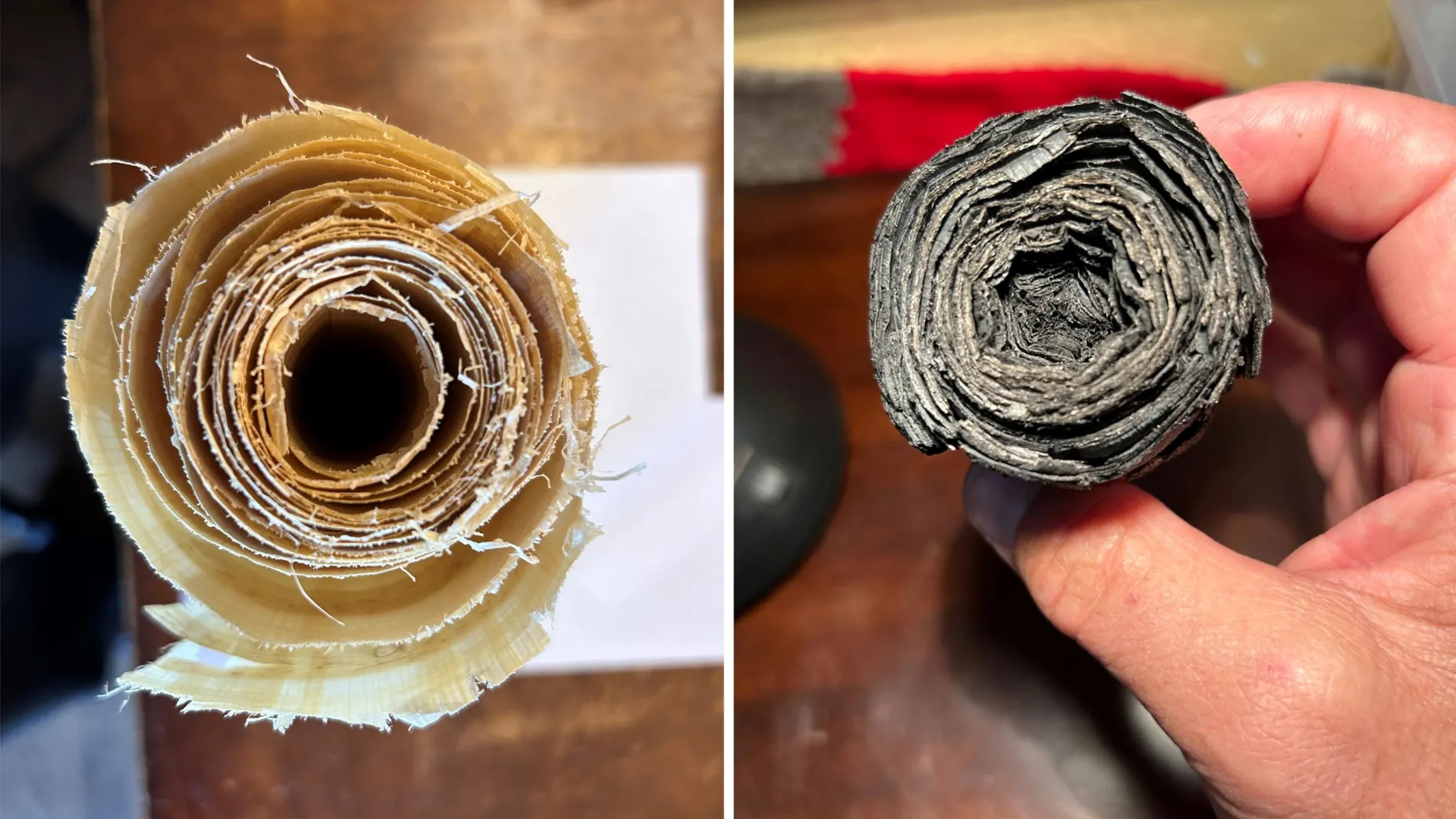
Douglas Seiler undertook a unique project to mimic the destruction and preservation caused by the eruption of Mount Vesuvius in 79 C.E. at Herculaneum, an ancient Roman city. He aimed to investigate whether it’s possible to read writings from charred papyrus scrolls without physically unrolling them, which risks damaging them.
Key Aspects of the Project:
-
Materials and Methodology:
- Seiler sourced papyrus and ink materials, including traditional ink from Japan. High school students were enlisted to write excerpts from various texts, such as “Star Wars” and the Bible, on the papyrus.
- The scrolls were burned in a controlled environment until fully carbonized to simulate the Herculaneum scrolls.
-
Research Goal:
- The primary objective was to find a method to recover writing from these carbonized scrolls using X-ray imaging techniques. Seiler posited that if the ink contained lead, it would absorb X-rays more effectively than the surrounding carbonized papyrus, thus creating a detectable contrast.
-
Findings:
- The study revealed that even minute quantities of lead made the written characters visible through X-ray tomography. The lead ink showed up to 25 times brighter in X-ray images than the surrounding material, highlighting the text effectively.
- A handheld X-ray fluorescence scanner could also detect lead ink, offering a practical approach to identifying scrolls worth further investigation.
-
Significance of Herculaneum’s Scrolls:
- Herculaneum’s library is unique, as it is the only known intact library from antiquity. The scrolls could potentially hold lost works that are significant to literature and philosophy.
-
Expert Collaboration:
- The project included experts from various disciplines, including archaeologists and chemists, to gather insights on the chemical properties of ancient inks.
- The approach to digitally “unroll” the scrolls is similar to technology used in other scientific fields, highlighting an interdisciplinary collaboration.
-
Challenges and Future Directions:
- Previous efforts to physically open the scrolls led to their destruction; hence, this non-invasive method could enhance the study of lost texts.
- The research aims to continue exploring different chemical signatures in ancient inks to advance recovery techniques.
Overall, Seiler’s project represents a significant scientific crossover, merging ancient history with modern technology to recover voices from the past.


