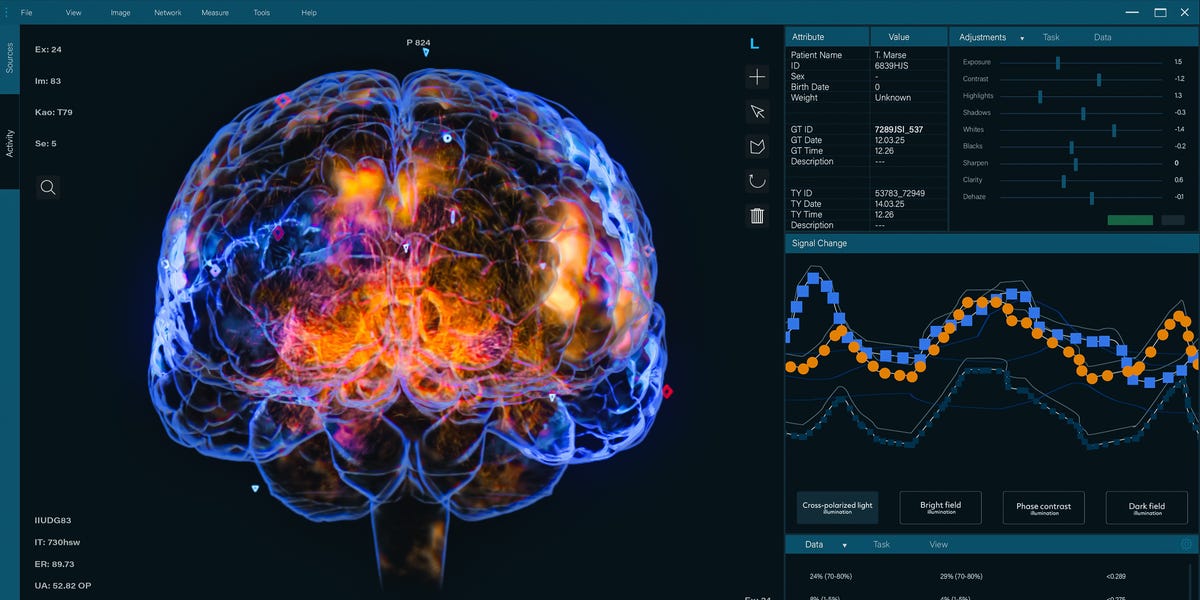
Breakthrough AI Tool Decodes Brain Activity to Reconstruct Images
Here’s what you’ll learn:
- Scientists have been training AI to interpret fMRI scans for years.
- A new model, Brain-IT, uses a Brain Interaction Transformer (BIT) to accurately recreate images from brain scans with minimal training data.
- This technology could enable communication for those with severe paralysis and enhance our understanding of the brain’s visual processing.
The Power of Pattern Recognition
The rapid advancements in AI have sparked debates about its capabilities compared to human intelligence, often referred to as the AI Singularity. However, AI has consistently excelled in pattern recognition, which is crucial in fields like medical diagnostics.
Recent research from the Weizmann Institute has unveiled Brain-IT, an AI model that reconstructs images with high accuracy from fMRI data. Michal Irani, the lab leader, stated that current models often struggle with basic features like color and composition, but Brain-IT surpasses these limitations.
Innovative Training Method
The training of Brain-IT faced a significant challenge: the scarcity of fMRI data paired with visual images. Scientists used the Natural Scenes Dataset, which included limited scans from only eight individuals. Despite the small dataset, the researchers devised a method to enhance their training. By using a decode/encode approach, the model could generate its dataset by translating images to brain scans and vice versa.
Implications for the Future
Decoding fMRI scans is a perfect task for AI, and the potential applications of Brain-IT are vast. It could significantly aid individuals with paralysis in communication and provide new insights into human consciousness, including previously unidentified brain regions involved in image processing.
Irani notes that while advancements have been made, challenges remain, particularly in decoding video and rapid changes in imagery. The dream of ultimately being able to “read dreams” may one day become a reality if these obstacles can be overcome.
Conclusion
With innovative tools like Brain-IT, we stand on the brink of remarkable breakthroughs in understanding the human mind and improving communication for those in need. The intersection of AI and neuroscience could define a new era for both fields.


