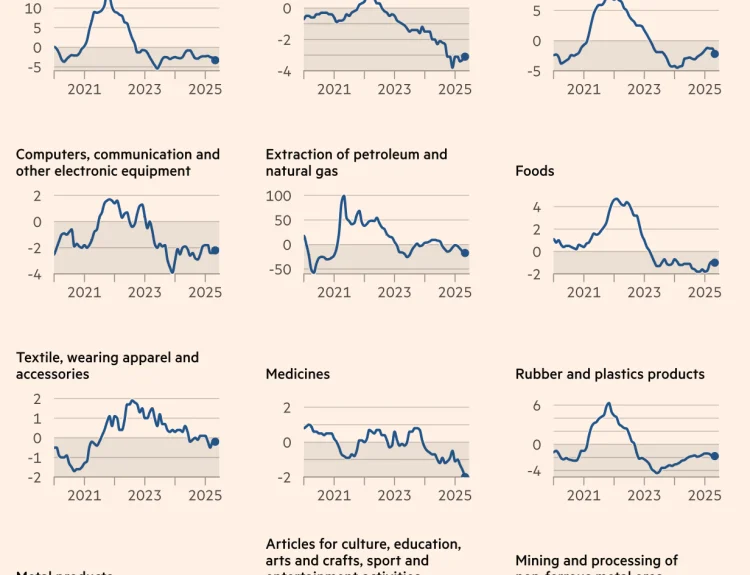
In recent discussions, it has become strikingly clear that American consumers are feeling the brunt of the oil shock sparked by the ongoing conflict in Iran. This situation presents an ironic twist of fate, as many Americans unwittingly ride the wave of President Trump’s contentious foreign policy. This backdrop sheds light on the rising inflation rates within the United States. Surprisingly, inflationary pressures appear to be more restrained in Southeast Asia.
A significant factor contributing to these dynamics is America’s deep-seated reliance on automobiles, coupled with the extensive trucking requirements due to the vast distances across the country—traveling from ports to urban areas and beyond, as well as the diesel demands of agriculture, construction, and warehousing.
President Trump has been vocal in suggesting that elevated oil prices are ultimately beneficial for the U.S.
President Donald Trump contends that the U.S. is reaping substantial revenue from high crude prices, all while asserting that lowering fuel costs for everyday citizens remains his foremost objective. https://t.co/qaLiSDtxak
— Al Arabiya English (@AlArabiya_Eng) October 14, 2026
Recently, Trump reiterated this stance:
President Donald Trump claims that rising oil prices are enhancing America’s wealth. Economists, however, note that these benefits primarily benefit producers and investors, while consumers are grappling with increasing costs. | LINK IN BIO https://t.co/v4kFv5ApV2
— WMTW TV (@WMTWTV) October 27, 2026
This raises an important question: Whose interests are truly being served?
By Irina Slav, an experienced journalist covering global energy markets since 2007, with a focus on the oil and gas sector, energy security, and the evolving energy landscape. Originally published at OilPrice
- Americans are projected to face the highest price impacts from fuel inflation linked to the Middle East conflict, with their share approximately $160 billion out of a global increase of $468 billion, according to the Centre for Research on Energy and Clean Air (CREA).
- U.S. fuel consumption patterns and reliance on gasoline-powered vehicles exacerbate the situation, with additional expenses estimated at $471 per American.
- Other regions, including Europe and Asia, are also facing significant energy costs, particularly for electricity and imported fuels, challenging the assertion that Americans are suffering the most.
According to a report from a Finnish energy and climate organization, Americans are bearing the brunt of the global energy price inflation triggered by the ongoing conflict in the Middle East. The CREA estimated the total fuel inflation worldwide at $468 billion, with the U.S. accounting for $160 billion of that total.
On a per-person basis, Americans are indeed facing the highest burden, with CREA estimating an additional cost of $471 per individual compared to a global average of $60. However, it is vital to note that comparing a global average with a national average may not paint the complete picture.
Furthermore, although CREA focuses on fuel costs specifically, the conflict has also influenced electricity prices, revealing that other nations reliant on imported energy are enduring worse consequences than the U.S., which benefits from being the world’s largest natural gas producer.
For instance, Japan, heavily reliant on energy imports, has seen its electricity prices skyrocket due to the war, reaching record highs this month after the government could no longer afford its subsidies. European nations have similarly suffered, with fuel prices in the EU significantly surpassing those in the U.S. Germans, for example, are paying an average of 2.30 euros per liter of diesel, equivalent to around $9.73 per gallon, while diesel vehicles dominate European roads.
The Finnish CREA attributes much of the high costs facing Americans to their driving habits, explaining, “This [the financial impact] arises from America’s outsized oil consumption linked to a strong reliance on inefficient, oil-driven personal vehicles, coupled with a slow shift away from gasoline and diesel—leaving households, truckers, and farmers particularly vulnerable to global fuel market fluctuations.”
In contrast, many European countries have experienced a surge in electric vehicle sales in response to the rising fuel prices. However, this transition has not alleviated energy costs for residents in these nations, as evidenced by widespread protests associated with surging living expenses. The shift toward electric transportation has not translated to lower bills in many European countries pursuing this route.
This year, the EU’s solar industry lobby group claimed that the bloc saved approximately 37.4 billion euros ($41.76 billion) in energy costs directly attributable to solar power. This claim is based on projections suggesting that these countries would have needed to import more natural gas to generate electricity without their solar capacity. However, amid competition and fluctuating wholesale electricity prices, one could argue that this claim does not tell the entire story of the solar industry’s current struggles.
Currently, fuel prices in the U.S. remain significantly higher compared to last year. While being the leading producer of oil and gas provides some advantages, it also means the U.S. is the largest exporter of both resources, which influences domestic prices. Nonetheless, asserting that Americans bear the heaviest energy costs due to the conflict overlooks significant factors affecting regions outside North America, such as Europe and Asia—areas grappling with their energy transitions and challenges, including the world’s largest EV market, China.