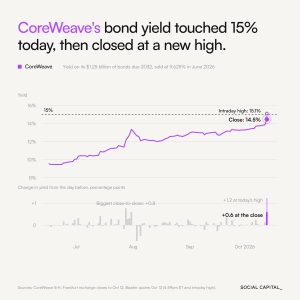
Recently, CoreWeave, a cloud computing firm that manages 51 data centers, faced a tumultuous day in both the stock and credit markets, raising concerns for the wider AI industry. The turmoil began with a sharp increase in yields on their corporate debt.
Venture capitalist Chamath Palihapitiya shared his thoughts with his 2.4 million followers on Twitter:
His comments resonated even more when Elon Musk responded with a brief “Yikes.”
This situation is illustrated in an essay titled “Deep Dive: Is the AI buildout creating a private credit bubble?”
The AI expansion is increasingly funded through debt, with private credit becoming a significantly larger contributor compared to just a year ago.
In the second quarter of 2026, Apollo and Blackstone led a $35 billion deal to procure chips and lease them to Anthropic, marking the largest private credit transaction on record. For context, during the same quarter, direct lenders provided about $23 billion in loans to private-equity-backed U.S. companies. Just one AI financing surpassed the total amount of traditional private equity-backed direct lending recorded by PitchBook in that period.
This is further complicated by the borrowing structures. CoreWeave secured a five-year loan based on customer contracts that average around three years, whereas Meta’s Hyperion bonds extend to 2049 against leases that are renewed every four years.
The market is already differentiating these types of deals: Apollo acquired debt financing for chips leased to xAI at a price of 99 cents in December 2025, while after SpaceX acquired xAI, it traded as high as 106 cents. Project Jupiter, which involves an $18 billion AI data-center financing, later traded between 89 to 91 cents as investors reevaluated its credit risk.
Instead of questioning whether AI is itself a bubble, our team at Social Capital investigated a different issue: Is private credit, significantly financing the AI expansion, creating a bubble?
Curious readers should check the full report to learn about Palihapitiya’s conclusions. However, it’s evident that the impact on CoreWeave’s stock was both immediate and severe:

According to Yahoo! Finance, CoreWeave’s debt has more than tripled over the past year:

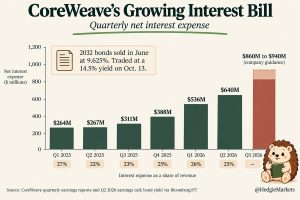
Market analyst Hedgie shared this graph on Twitter:
CoreWeave’s stock plummeted roughly 13% on Wednesday after its bonds due in 2032 traded at an astonishing yield of 14.5%. Those bonds were sold in June at 9.625%, meaning that in just four months, the cost of unsecured borrowing increased by about five points. Chamath Palihapitiya used the yield chart to illustrate concerns regarding a potential private credit bubble tied to AI.
I argue that the AI bubble is more present in debt than in demand, and CoreWeave illustrates this perfectly. This year, it raised over $35 billion and now holds around $52 billion in debt and lease obligations, while having incurred $640 million in net interest last quarter—about a quarter of its total revenue. While the reported backlog of $104 billion sounds impressive, it doesn’t cover the interest costs until the data centers are completed and the clients begin paying.
Palihapitiya’s figures indicate that private lenders are charging AI borrowers nearly the same risk premium as other sectors, 6.2 points compared to 6.1. It seems that the bond market has reassessed that risk for AI companies. I suspect CoreWeave’s next funding round will be more costly, possibly requiring collateral or leading to shareholder dilution, a challenge likely shared by Nebius and other AI cloud firms. For those managing private credit funds, it’s crucial to assess the amount of AI and software debt held, as these loans aren’t repriced daily like CoreWeave’s bonds.
A Brief Overview of CoreWeave
This Wired feature from 2024 outlines the journey of CoreWeave as they prefer it to be told.
Initially, a group of friends pooled their money from fantasy football to buy GPUs as a joke, but when cryptocurrency prices skyrocketed in 2016, they pivoted to take it seriously. However, they had to readjust their strategy as cryptocurrency values plummeted:
When crypto prices dropped towards the end of 2019, Venturo and his team shifted focus. They acquired GPUs at a discount from struggling crypto miners, rebranded as CoreWeave, and began offering their surplus GPUs as a specialized cloud service for various businesses, including visual effects studios and AI startups. These GPUs are vital for machine learning tasks, such as training algorithms for image and text processing. Although CoreWeave was relatively unknown at the time, they quickly earned clients’ trust by prioritizing rapid customer support. “We would resolve issues within 15 minutes,” one manager recalls. “Our commitment to customer satisfaction was exceptional.”
The landscape changed after OpenAI introduced ChatGPT in late 2022, igniting a surge of interest and investment in generative AI, which consequently led to GPUs, especially Nvidia’s, becoming scarce. Because CoreWeave had data centers brimming with GPUs and a long-standing partnership with Nvidia, it found itself at the forefront of the escalating AI excitement. It began acquiring significant clients, including Microsoft, a major supporter of OpenAI, and Stability AI, a startup focusing on image generation, according to former employees. Venturo’s only regret is not ordering more Nvidia chips when he had the chance. “If I had infinite stock, I could sell it all in two weeks,” he stated.
As demand for CoreWeave’s GPUs soared throughout 2023, the company reinvested its profits into purchasing more chips and expanding its data centers. A startup that began as a side project is now completely focused on cloud computing, having steered clear of cryptocurrency. In the past year, CoreWeave secured a $2.3 billion loan, using GPUs as collateral, along with nearly $2.2 billion in investment funding—including $1.1 billion just announced this week—from investors like Nvidia. This latest funding boosted the company’s valuation to $19 billion.
By year’s end, CoreWeave anticipates operating 28 data center campuses across multiple U.S. states, Europe, and possibly Asia, leading to an increase in footprint by more than nine times from the beginning of 2023.
Note, however, that while expanding their data center count, their debt has also tripled.
As of June, the founders had sold $2.3 billion in stock following their IPO, according to Bloomberg.
Now, back to discussing their debt.
Insights from Ed Zitron
In his October 6 article, “Credit Crunch,” Zitron explores:
CoreWeave has spreads ranging from 672 basis points to 882 basis points, with the effective yield on its [shortest-term debt] (four years) at 11.53% and its [longest-term debt] (only six years) at 13.49%.
There are, of course, ways to circumvent relying solely on your credit profile. For instance, when CoreWeave secured an $8.5 billion delayed draw term loan facility in March 2026, it managed to classify it as investment-grade, receiving terms at SOFR (the overnight rate banks use) plus 2.25%, largely due to the counterparty being Meta, thus ensuring the underlying payments were viewed as “safe.”
This method may appear as a workaround to avoid extremely unfavorable rates; however, analysts from UBS project that CoreWeave will need to raise $102 billion in debt by 2030, meaning it must continue these transactions independently.
However, challenges are emerging.
He also references observations from The Information, indicating early signs of trouble within the AI data center debt boom:
Bond markets are tightening for lower-rated borrowers. A case in point is CleanSpark, which is developing a data center for Meta Platforms and had to offer significant concessions to secure financing earlier this month.
This deal serves as a clear indicator that securing funding for data centers is becoming increasingly costly, with investors becoming more selective about which new projects they support. The bank loan market is also showing signs of strain, as lenders like Société Générale, Sumitomo Mitsui Banking Corp., and Mitsubishi UFJ Financial Group are becoming more discerning in their lending to data center initiatives. These trends could hinder companies from financing their intended data centers, posing a risk to the broader AI industry’s growth.
Zitron further elaborates on CoreWeave in “The Hater’s Guide to Junk” dated the 9th:
The industry is in dire need of hundreds of billions of dollars to fund the projected buildout of numerous data centers—CoreWeave alone must secure $102 billion in debt through 2030, an amount without historical precedent. Even the railway bubble of the 1800s involved only about $250 billion in total investment when adjusted for inflation, a stark contrast to the anticipated $400 billion in financing from hyperscalers expected in 2027.
He quotes Standard & Poor’s insights concerning CoreWeave’s material accounting weaknesses:
CoreWeave’s attempts to address material weaknesses in its internal controls over financial reporting are progressing as expected, but will continue to pose a rating constraint until resolved. The company is actively working to remediate these weaknesses through IT risk assessments, enhanced control frameworks, and by increasing its finance and accounting personnel. Additionally, it has engaged external advisors, completed an enterprise and IT risk assessment, and is adding experienced senior leadership to bolster oversight and execution.
While we believe CoreWeave’s progress aligns with our expectations, potential credit risks may persist until these weaknesses are resolved. This is critical as the company must submit a management report on internal controls starting with its 2026 Form 10-K, which may raise concerns regarding the reliability of its financial reporting and the risk of financial restatements or non-compliance with covenants in its credit agreements.
However, we are optimistic that management’s remediation efforts throughout 2026 will meet the necessary timeframe.
…
NVIDIA’s $2 billion equity investment in CoreWeave in January 2026 nearly doubled its ownership stake and further fostered commercial and technological integration. This includes priority access to next-generation GPUs, utilizing its financial capacity to facilitate a multiyear AI factory expansion targeting over 5 GW of incremental capacity by 2030, as well as the integration of CoreWeave’s Mission Control and SUNK software into NVIDIA’s reference architectures.
We regard the software integration as highly significant, as it underscores CoreWeave’s proprietary capabilities, enhancing differentiation among new cloud providers and presenting opportunities for incremental, higher-margin, asset-light software revenue in the future.
Zitron continues:
CoreWeave holds a B+ rating, placing it in the lowest tier of junk bonds, and has reported losses every quarter since its inception. It retains its B+ rating primarily because it “has broadened its customer base and reduced concentration through recent contracts with Meta and OpenAI, along with targeted outreach to enterprises and AI labs.”
While S&P may assert that its judgments are market-informed, it is largely basing its “positive” outlook on hype, perceiving NVIDIA’s circular financing—where the firm effectively rents its own GPUs—as a positive sign.
This perspective is largely unfounded and fails to provide adequate assessments of CoreWeave’s actual capabilities, revenues, or underlying technology. It would be enlightening to hear from someone at S&P regarding what SUNK entails or who uses it—since it appears to be a specialized AI model training environment (making it improbable that major AI labs would utilize it, as they typically have their own setups), with the only identifiable customer being Impossible Inc, a company about which not much is readily available aside from Naval Ravikant’s rather unclear comments.
Moreover, NVIDIA’s $2 billion equity investment wasn’t merely to “enhance commercial and technological integration” but also an obvious attempt to ensure that the company remained well-capitalized enough to retain its current rating and continue raising debt. Furthermore, it’s questionable that NVIDIA’s backing of CoreWeave’s data center leases was accounted for in the evaluation.
This level of reasoning seems reflective of potential creditors’ approaches, as, to quote a colleague in fixed income, nobody knows what they’re truly investing in.
Perhaps CoreWeave is receptive to some of Ed’s critiques.
CoreWeave Seeks “Unlimited” Insurance Capital
According to the Financial Times:
CoreWeave is pursuing insurers’ “unlimited” capital pools as the Nvidia-backed AI cloud provider seeks cost-effective methods to fund the tens of billions being spent on chips and AI infrastructure.
…
Brannin McBee, a co-founder overseeing CoreWeave’s financing efforts, stated that achieving investment-grade ratings for more of its chip-backed debt, and ultimately for the company itself, would permit it to borrow from insurers with “unlimited capital. Essentially, that’s all the money in the world situated in the insurance domain.”
…
Earlier this year, CoreWeave secured an $8.5 billion loan backed by chips and a long-term agreement with Meta—an arrangement identified in the industry as an offtake. This was the very first of its chip-backed loans to receive an investment-grade rating.“Proving that we can successfully perform in that marketplace is extremely crucial for our future,” McBee articulated in an interview. The next step involves engaging insurers to consider loans backed by lower-rated borrowers, like AI labs. “I don’t believe that our non-investment-grade offerings are yet suitable for the insurance category, but I think it’ll reach that point soon,” McBee added, expressing confidence that upcoming IPOs from significant AI labs will aid this transition.
…
The financing for the hundreds of thousands of Nvidia AI chips supporting its operations has transformed CoreWeave into a significant financing entity. This year alone, it has secured over $35 billion from chip-backed loans, high-yield bonds, convertible bonds, and equity offerings, resulting in a total debt and lease obligation of approximately $52 billion by the end of June.McBee, previously in natural gas and electricity trading, sealed the first deal in 2023, a $2.3 billion loan led by Blackstone backed by Nvidia GPUs and an offtake contract with Microsoft.
Though this deal carried an effective interest rate of roughly 15%, significantly higher than conventional junk bond yields, it opened a new frontier for chip-backed borrowing. The total value of these chips is allocated to subsidiaries, with initial earnings directed towards covering interest, principal, and operational costs, while the remaining 20% is allotted to the parent company. Since then, CoreWeave has finalized five more such loans at more favorable rates, accumulating approximately $27 billion in total.
Well, that’s somewhat reassuring.
For more updates, follow my work at NatWilsonTurner.com
Related Posts