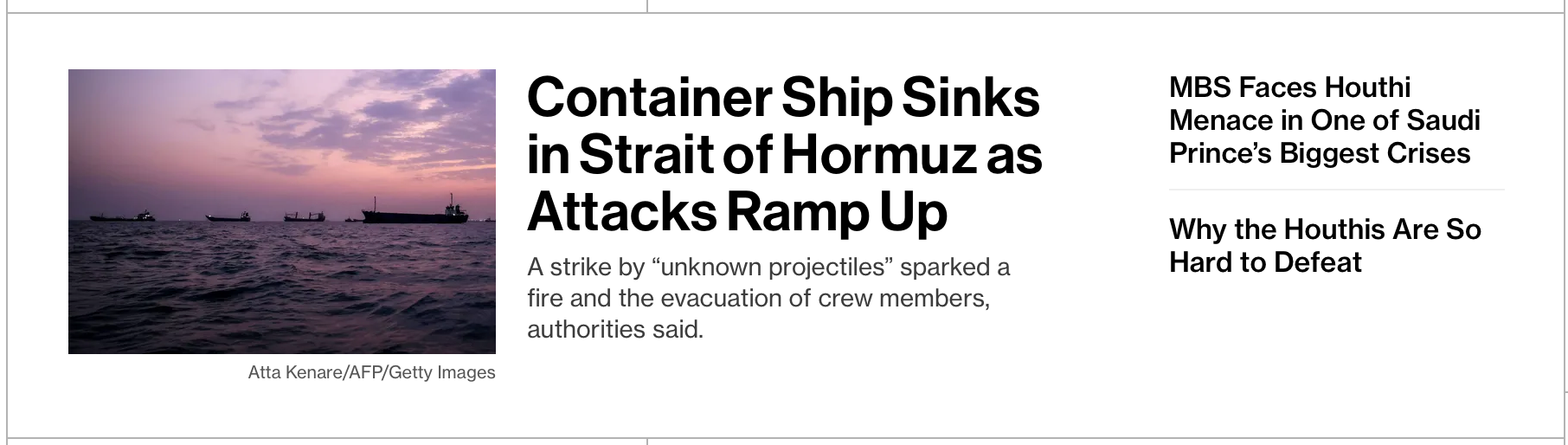
Recent developments in the Strait of Hormuz have seen both Iran and Ansar Allah significantly ramping up their attacks against opposing forces. Iran has reportedly damaged two vessels in this strategic area: one was hit by a missile, while the other was struck by a naval mine. Over the past week, Iran has markedly extended the reach of its military actions, targeting a tanker approximately 500 kilometers west of the Strait, off the coast of Qatar. The frequency and intensity of these assaults have escalated dramatically, leading to strikes on engine rooms that necessitate prolonged repairs, and even sinking a cargo ship. The following details are reported by Lloyd’s List in their article, “Containership sinks in Strait of Hormuz as attacks on shipping intensify”:
- The AD Ports-operated containership GFS Pride sank after suffering a projectile strike and an onboard fire while transiting through Hormuz.
- The bulk carrier Cape Dao, which was attacked in September, is now reportedly sinking following unsuccessful salvage attempts, highlighting the long-lasting repercussions of recent assaults.
- In recent weeks, container ships, bulk carriers, and tankers have all come under fire, raising new alarms about the deteriorating security conditions in the Strait.
Some related visuals:
BREAKING: Iran announces that a large UAE-owned container ship carrying over 2,500 containers struck a naval mine, exploded, and sank this morning in the US-backed southern Omani corridor of the Strait of Hormuz.
This marks the first vessel sunk by a mine in the ongoing conflict.
Initial reports suggest that the cargo ship was transporting luxury perfumes and iPhones from Dubai.
— The Hormuz Letter (@HormuzLetter) October 14, 2026
According to Al Jazeera’s live updates:
Surge in attacks in the Strait of Hormuz as Iran increases surveillance, disrupting oil supply
Iran has dispatched new naval units to enhance monitoring of the Strait of Hormuz, coinciding with a spike in attacks on commercial vessels, the highest since the US-Israeli conflict began in February.
The Iranian navy stated that the new deployment allows for “real-time surveillance of enemy activities and maritime traffic” across the strait, the Sea of Oman, and the Arabian Sea, according to state media reports.
Maritime tracking company Kpler indicates that from September 28 to October 4, ten tankers were struck in the strait, with another assault occurring on October 5.
The UK Maritime Trade Operations (UKMTO) center has recorded 15 additional attacks between October 6 and October 14, with 11 of these occurring in the last four days.
This escalation has severely impacted oil shipments through this vital waterway. According to Kpler, only 2.9 million barrels passed through Hormuz on October 11, a sharp decline from approximately 20.8 million barrels on October 8.
The pattern of attacks does not appear to be waning:
BREAKING: Iran is reportedly launching multiple anti-ship missiles from southern Iran toward vessels escorted by the US Navy in the Strait of Hormuz, with multiple loud explosions reported in the waterway.
This follows 26 confirmed attacks by UKMTO between September 30 and October 14. Reuters has reported at least five maritime incidents around Hormuz within the last 48 hours.
Two senior Iranian officials told Reuters that Tehran’s maritime assaults aim to keep oil prices elevated and influence the upcoming US midterm elections. One noted, “Just when they think they are getting close to the point where prices will fall, we will push them away from it. This is a game of chess.”
— The Hormuz Report (@HormuzReport) October 14, 2026
Iranian officials have made provocative statements directed at the US:
🎥 IRGC Navy Commander General Azmaei: If Americans want to test whether the Strait of Hormuz is open or closed, they should enter the field. IRGC Navy fighters and all armed forces are ready to confront offenders.
— Middle East Observer (@ME_Observer_) October 14, 2026
As for the US response, actions have been somewhat limited. According to Al Jazeera’s updates, CENTCOM reported damaging a dhow involved in surveillance in the Gulf of Oman on October 6, along with unconfirmed reports of explosions in southern Iran. However, indications suggest that more significant actions may be forthcoming:
BREAKING: The U.S. is reportedly preparing for the possibility of a renewed wave of attacks against Iran, indicated by a notable increase in C-17 military cargo flights over the past 36 hours compared to previous weeks.
The majority of these flights appear to be landing in Israel, as Iranian assaults have damaged facilities associated with American interests in the region.
This buildup coincides with the Pentagon’s decision to send a third carrier strike group and an estimated 9,000 to 10,000 additional troops to the Middle East. The USS Theodore Roosevelt and Makin Island Amphibious Ready Group are expected to join the existing forces in the region.
Iranian authorities believe that a joint U.S.-Israeli attack is highly probable.
— The Hormuz Report (@HormuzReport) October 14, 2026
In light of the current geopolitical tensions, the U.S. appears to be weighing a more aggressive response:
The likelihood of renewed military action against Iran is a serious concern. Reports indicate the U.S. is preparing operational plans for a new round of strikes.
Axios notes that the Pentagon has ordered U.S. Central Command (CENTCOM) to finalize preparations for possible action.
The Israeli publication *Kipa*, citing *The New York Times*, mentions plans for an intensive military operation lasting about three days. Furthermore, unnamed Arab sources reported that U.S. regional partners have been informed that Washington is ready to initiate conflict immediately.
While the U.S. might aim for a brief and decisive strike, the actual course and duration of the conflict will depend on Iran’s response. No military plan can assure that hostilities will conclude according to the schedule set by Washington.
— 𝕊𝕡𝕣𝕚𝕟𝕥𝕖𝕣 𝕻𝕣𝕖𝕤𝕤 (@SprinterPress) October 14, 2026
As the situation evolves, it is essential to consider that the U.S. has bombarded Iran for 40 days previously, and the nation continues to maintain its ground while exerting dominance in the escalation. In any renewed offensive, the U.S. could primarily target Iran’s energy infrastructure or critical civilian assets, despite Iran’s firm warnings against such actions, stating it would severely damage Gulf energy production.
With time on their side, Iran has likely developed counter-strategies that could inflict more harm on the United States and neighboring oil states, potentially targeting American businesses in the region and crucial technological infrastructure:
BREAKING: Iran is looking to enforce regulations on undersea internet cables running through its territorial waters in the Strait of Hormuz, requiring companies like Google, Meta, Microsoft, and Amazon to obtain passage permits and pay jurisdictional fees.
Several significant cable systems, including FALCON and Gulf Bridge International, are located directly in Iranian waters. Iran contends that their placement establishes the right to impose its own regulations and standards for environmental and seabed monitoring.
Moreover, Iran has warned that if hostilities resume, the region’s undersea cables, data centers, and AI facilities could face destruction, with the total value of these assets exceeding $2 trillion.
— The Hormuz Letter (@HormuzLetter) October 12, 2026
In regional updates, Middle East Eye reported on the deteriorating situation for Saudi Arabia:
Saudi Arabia’s strategy to “contain” the Houthis in Yemen while fostering economic growth has faltered, presenting one of the most significant challenges for Crown Prince Mohammed bin Salman since his ascent to power. In just the past week, the Houthis targeted Riyadh’s international airport on three consecutive days. An attack on Saturday resulted in at least 13 fatalities and around 300 injuries. The group’s targeting precision became evident when they struck the headquarters of state oil giant Aramco in Dhahran.
Such events raise questions regarding Saudi Arabia’s military capabilities, despite being a substantial purchaser of American weaponry, including Patriot and Thaad air defense systems.
“It’s quite remarkable that the Houthis can strike these critical facilities at will while the Saudis fail to protect them,” commented Gregory Gause, a Gulf expert at the Middle East Institute.
The market response to these escalating tensions has been somewhat muted. Oil prices briefly touched $106 per barrel before retreating to just over $104, while Bloomberg’s coverage suggests that tech and AI news has overshadowed the conflict situation. Nonetheless, a downturn is evident:
Asian markets have plummeted following sharp declines in U.S. chip stocks overnight, heightening investor concerns over inflation and the future profitability of AI companies.
The Kospi index in Seoul dropped by 7.7%, with leading companies SK Hynix and Samsung Electronics down 11% and 9.3%, respectively.
In Tokyo, the Nikkei 225 slid by 4.5%, with major investors feeling the pressure.
“There’s a palpable sense of panic in the market at the moment,” noted Song Zhe from BNP Paribas Asset Management.
For further coverage, Bloomberg’s Middle East conflict news highlights key developments.
For insights into the ongoing Ansar Allah-Saudi conflict, CBS reports:
- Explosions were heard in Saudi Arabia’s capital on Wednesday morning as hostilities intensified between Saudi-supported forces in Yemen and the Iran-aligned Houthis. A missile launched by the Houthis was intercepted over Riyadh, according to a Saudi military spokesperson.
- The Houthis pledged to continue targeting Saudi international airports and oil infrastructures in retaliation for “Saudi aggression” against Yemen’s capital, Sanaa.
- President Trump has indicated that he is contemplating military action against the Houthis due to their continued assaults on Saudi Arabia and threats to global energy supplies. The Houthis warned they would target U.S. interests throughout the Middle East should Mr. Trump carry out these strikes, potentially drawing the U.S. deeper into the ongoing conflict sparked by the joint U.S.-Israeli strikes on Iran over seven months ago.
Analyst Olivier Boyd-Barrett has elaborated on the situation:
The Saudi-led coalition has launched retaliatory airstrikes targeting Houthi military and oil facilities across western Yemen, including Sanaa, Dhamar, and Saada, in an effort to disrupt supplies fueling attacks on maritime routes. Saudi air defenses, supported by regional partners, have intercepted incoming Houthi missiles targeting Riyadh and other critical infrastructure.
However, sustained Houthi resilience complicates U.S. and Gulf strategies, making direct large-scale military intervention seem increasingly risky and potentially overextending resources away from the Strait of Hormuz.
Signs suggest the MBS-led Riyadh regime is fragmenting as rival factions seek power amid increasing pressure from the Houthis. Although support from MECCA allies remains limited to the protection of holy sites, they lack military presence near Yemen’s borders.
The Houthis’ air campaign has systematically crippled Saudi commercial aviation, with multiple missile strikes notably impacting King Khalid International Airport, causing extensive damage and fatalities.
Bloomberg has further highlighted how Crown Prince Mohammed bin Salman is confronting a significant crisis:
Crown Prince Mohammed bin Salman faces one of the most severe challenges of his leadership as the Houthis retaliate against Saudi Arabia with effective strikes, while his allies remain reticent. The ongoing drone and missile attacks have resulted in numerous casualties and the shutdown of key airports, stretching Saudi defenses thin.
With hundreds of flights grounded and a shift to remote work in the capital’s financial sector, MBS finds himself in need of allies like never before. His diplomatic efforts to secure U.S. military support and new defense partnerships with Turkey and Pakistan have met limited success, leaving him in a precarious position ahead of an upcoming major investment summit in Riyadh.
Despite the gravity of the situation, there has been little indication that Crown Prince Mohammed bin Salman is willing to make concessions to the Houthis to bring about peace. Reports suggest that MBS remains resolute in his intention to reclaim lost territory and continue the conflict.
In a continued show of defiance, the Houthis have posted updates on their military actions:
Yemen’s Iran-backed Houthis targeted facilities belonging to Saudi Aramco, the Ras Tanura refinery, and King Khalid International Airport with ballistic missiles and drones, reported military spokesperson Yahya Saree.
Saree emphasized that the group intends to persist in attacks on Saudi airports and oil facilities in the upcoming days.
— Iran International English (@IranIntl_En) October 14, 2026
In conclusion, the ongoing conflict in the region reveals escalating tensions that threaten not only regional stability but also global energy supply. The actions and counteractions between Iran, Ansar Allah, and Saudi Arabia underline a complex geopolitical landscape that may have far-reaching consequences for all parties involved. Continuous monitoring and diplomatic efforts will be essential in addressing these volatile dynamics.