The Witkar: Amsterdam’s Early Car-Sharing Experiment
Amsterdam has gained a reputation not just for its iconic canals and cultural landmarks, but for its groundbreaking approach to urban transportation. In the 1970s, like many congested cities, Amsterdam sought alternatives to car-centric environments, leading to innovative solutions like the Witkar—a pioneer in car-sharing services.
The Rise of Alternative Transportation
Historically, Amsterdam struggled with heavy traffic due to increasing car use. To combat this, city planners began transitioning towards public transportation and cycling, establishing a framework that made the city more livable and sustainable. This transition made way for the creation of the Witkar in 1968, designed by Dutch industrial designer Luud Schimmelpennink.
What is the Witkar?
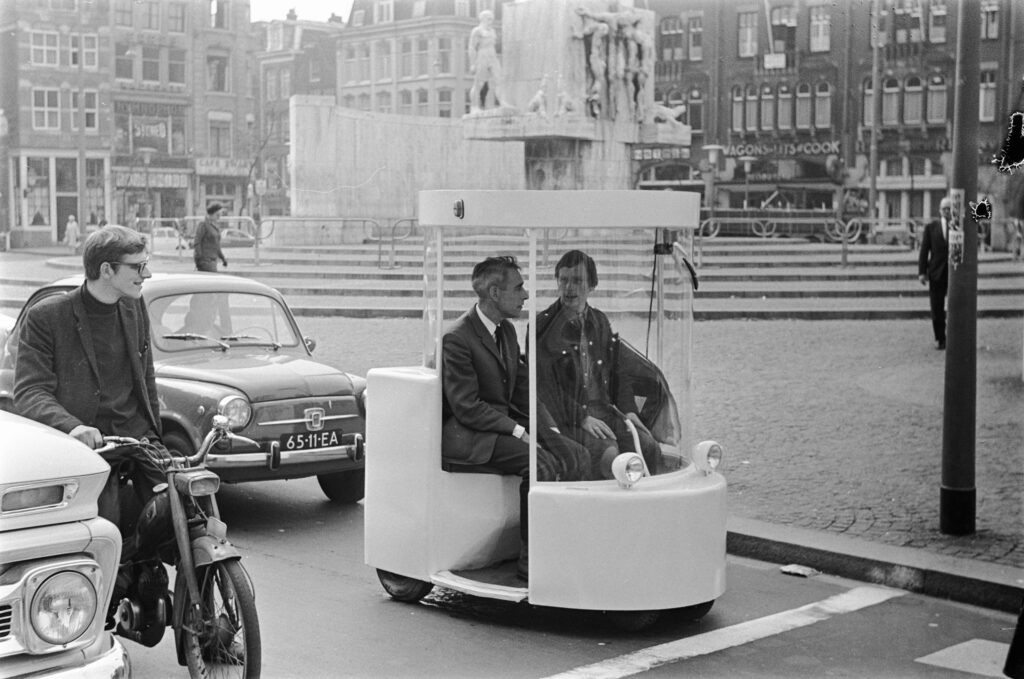
The Witkar, translating to “white car” in Dutch—due to its distinct color—was launched as an innovative, two-seat, all-electric microcar intended for shared use.
-
Design & Functionality: The Witkar was notably tall and narrow, housing passengers in an upright position, creating a unique driving experience. Weighing around 1325 pounds, it featured a range of 6.2 miles and a top speed of 20 mph.
-
Membership & Accessibility: Launched in 1974, more than 4,000 residents paid a nominal membership fee for the convenience of this electric vehicle. Users accessed the cars using a plastic key embedded with a sensor, tapping into a digital network to reserve their trips.
Community and Challenges
Despite its innovative design and the growing membership, the Witkar faced significant challenges:
- Limited Infrastructure: Initially, there were only five stations for all the cars, which hampered usability.
- Public Perception: Reviews on the driving experience were mixed. Some noted the car’s unstable feel and sensitivity, which could deter potential users.
Witkar’s Decline
By the late 1980s, as public transit infrastructure expanded and cycling became increasingly favored, the Witkar program dwindled. Despite initial promises of expansion, the fleet was never significantly increased beyond its original scope.
Legacy and Modern Analogues
Today, while the Witkar itself may no longer be in use, its spirit lives on in Amsterdam’s embrace of microcars and electric vehicle options:
-
Microcars in Amsterdam: The rise of modern microcars, such as the Canta, reflects a continuation of the Witkar’s ethos. These vehicles navigate the same urban environments and are particularly popular for their compact design and ease of use.
-
Current Trends: As cities worldwide strive for sustainability, sharing economy models similar to the Witkar are reemerging in various forms, exemplified by services like ZipCar and Getaround.
As we witness the ongoing evolution of urban mobility, the Witkar remains a fascinating chapter in the history of transportation, illustrating the challenges and potential of innovative shared mobility solutions.