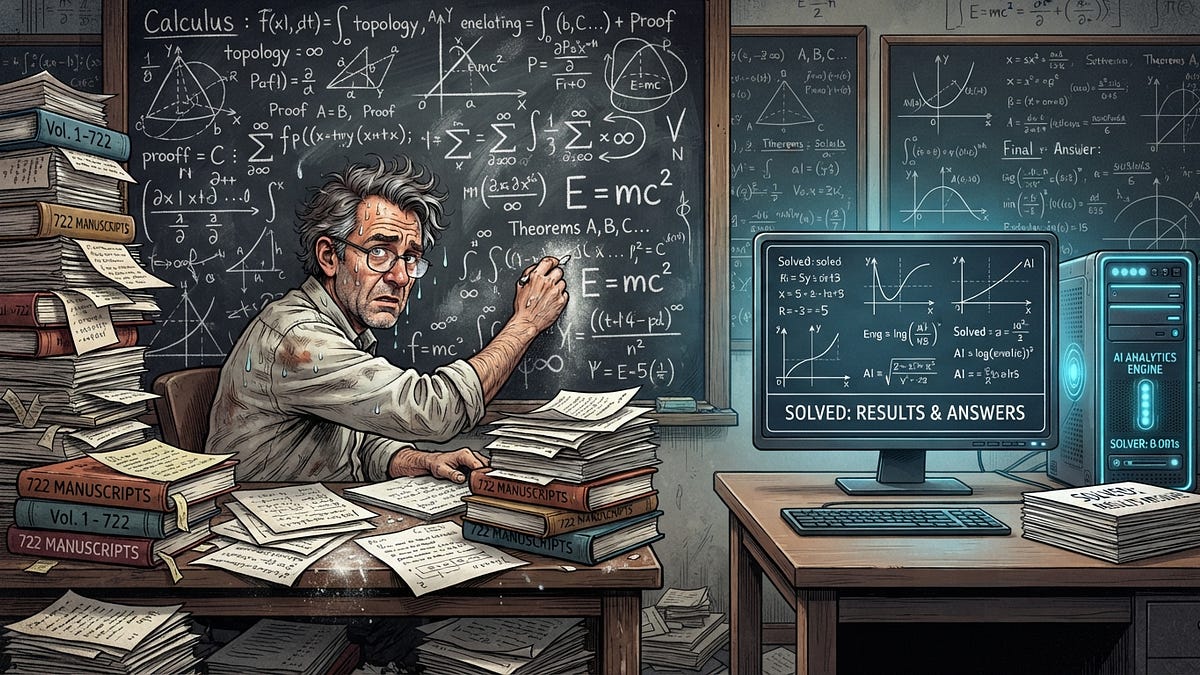
OpenAI has unveiled an impressive collection of 722 mathematical manuscripts generated by an unreleased frontier model, covering diverse areas such as number theory and mathematical physics. Each manuscript reflects approximately three hours of reasoning by ChatGPT Pro.
### A New Era of Discovery
We might be on the brink of a “math singularity,” where machine-assisted discovery surpasses human ability to reproduce or validate results. This shift redefines the role of mathematicians, who will increasingly become guides and interpreters, focusing on which questions are significant and which results can be trusted.
### Beyond Mathematics
This acceleration of research may soon extend to all scientific fields, where AI could test hypotheses and connect findings across disciplines. In medicine, for instance, AI might revolutionize drug design and treatment personalization, while in climate science, it could foster breakthroughs in energy and carbon management.
### The New Bottleneck
Despite faster discoveries, translating these breakthroughs into practice will face new challenges, such as validating ideas and conducting tests. This could lead to an oversupply of hypotheses that exceed current research capabilities, necessitating improved systems for verification, collaboration, and prioritization.
### Conclusion
OpenAI’s work not only showcases the potential of AI in generating knowledge but also highlights the necessity for humans to determine the significance and practical application of these advancements. Instead of relegating human inquiry to history, we stand at the threshold of a new chapter of exploration where machines augment our understanding, and human judgment remains paramount.


