This week marks the Naked Capitalism fundraising campaign, with 1,309 supporters already backing our mission to fight against corruption and exploitative practices, especially within the financial sector. We invite you to join us by visiting our donation page, which provides options for contributions via check, credit card, debit card, PayPal, Clover, or Wise. You can read about the purpose behind this fundraiser, our achievements over the past year, and our current objective: more original reporting.
This time, the weak link could be France.
Just when you thought the situation in Europe couldn’t deteriorate further, the European Debt Crisis may be resurfacing after a 14-year break. This time, however, the spotlight is on France, the Euro Area’s second largest economy, rather than the usual periphery countries.
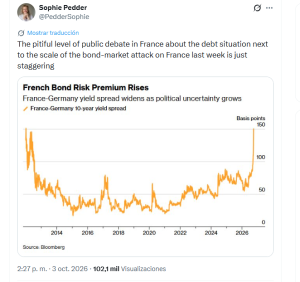
Worryingly, France’s risk premium—the additional interest its government must pay over benchmark German Bunds—has recently climbed to its highest level since the first Euro Area debt crisis. Alarmingly, the potential crisis already has an acronym…
France’s 10-year bond yields have surged recently, inching close to the critical 5% mark. For context, Italian bond yields peaked at 7.5% during the height of the previous sovereign debt crisis on November 11, 2011, before stabilizing. Interestingly, Italian 10-year bonds currently yield 20 basis points less than France’s.
The data reveals that France’s public debt is now higher than it was during the peak of the COVID-19 crisis, when economic activity plummeted due to lockdowns, leading to a dramatic increase in debt-to-GDP ratios. In contrast, Spain’s debt-to-GDP ratio is nearing its pre-COVID level of 97%. Even Italy has managed to reduce its ratio by 18 percentage points, yet it still stands at a staggering 136%.
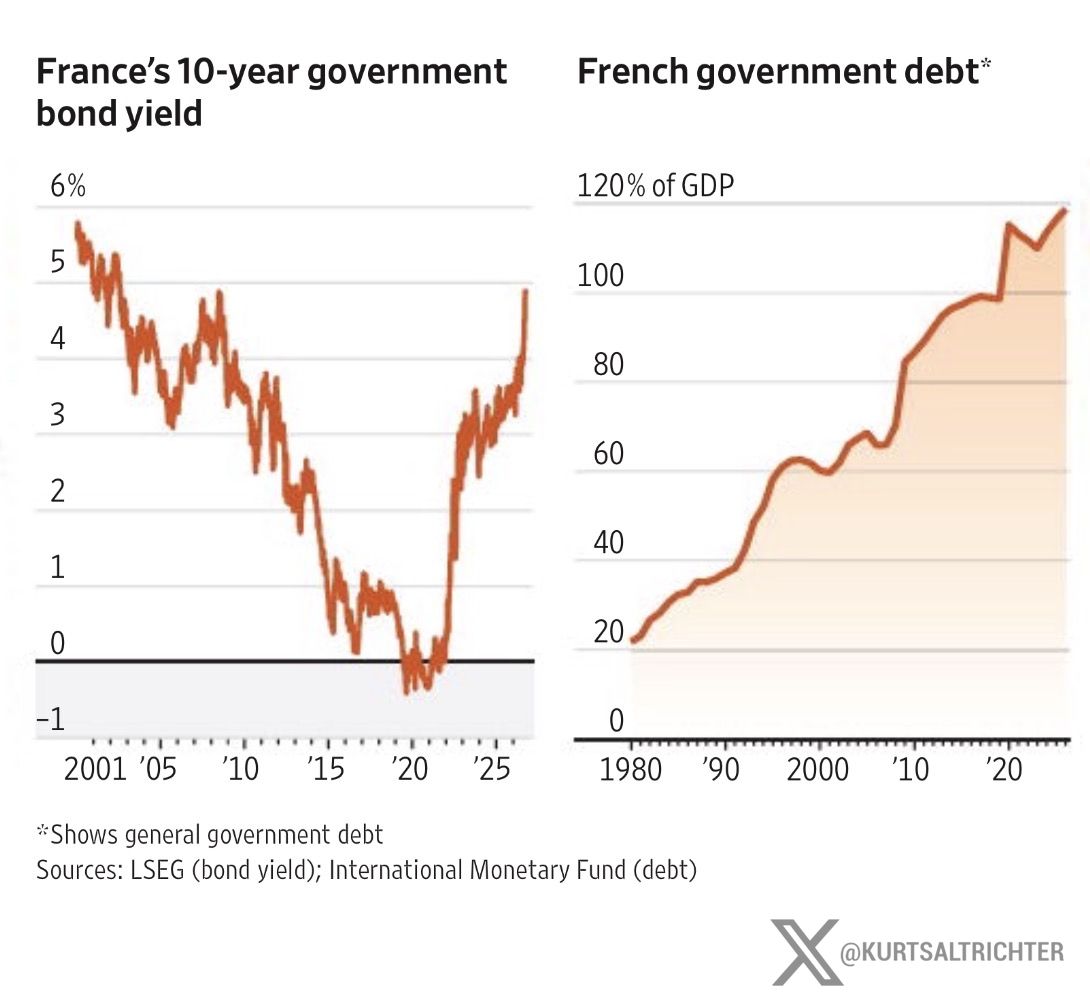
It’s worth noting that both Spain and Italy greatly benefitted from the ECB’s sovereign debt purchasing during nearly a decade of quantitative easing. Since the pandemic, Spain’s economy has grown significantly faster than the Euro Area average. In contrast, Italy consistently posts primary surpluses—indicating that government revenue exceeds non-interest spending—while France hasn’t recorded one since 2001.
Another red flag is the predominance of foreign investors holding French debt. As highlighted by Eurointelligence, around 57% of French debt is owned by non-residents—the highest percentage among advanced economies—making it especially susceptible to sudden capital outflows, increased costs for refinancing maturing debt, and sharp spikes in government bond yields:
French debt is predominantly held by foreign investors. According to the Banque de France, 57% of French debt is held by non-residents. Amongst the advanced economies, France has the highest proportion of foreign debt holders. The share is much lower in countries like Spain with 42%, the UK with 32%, Italy with 27%, or the US with 23%. The fate of French debt is thus very much in the hands of asset managers outside France, a fact that may not be well understood by French political parties.
This does not necessarily imply that France’s current debt issues will evolve into a full-blown crisis, but the global economic environment is hardly encouraging. The UK, for example, has narrowly avoided bond market turmoil on multiple occasions, notably during the 2022 UK Gilt Crisis triggered by Liz Truss’ controversial “mini-budget,” which led to plummeting government bond prices and soaring yields.
Alarmingly, concerns about France’s rising debt are voiced not just by fringe commentators:
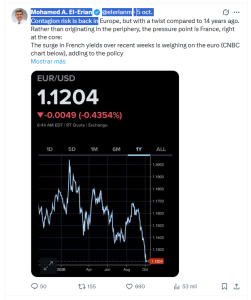
A key factor contributing to France’s predicament is political instability. Emmanuel Macron’s government faces increasing difficulty in passing budgets. In its 2027 budget proposal, the government aims to reduce the deficit to 5% of GDP through €43 billion in spending cuts.
Proposed measures—including freezing the employment bonus and the civil service pay index, capping pensions above €1,260, and reducing the 10% tax allowance on pensions—will further diminish the purchasing power of low- and middle-income households, likely slowing down France’s economic growth.
This, of course, assumes the budget proposal passes in any form resembling its current structure. As warned by Eurointelligence:
The government lacks a majority and must negotiate with opposition parties to pass the budget. In the past two years, these negotiations have often been fraught with tension, culminating in high-stakes drama ahead of deadlines in December. The amended budget was then adopted without a vote via Art 49.3.
This scenario is complicated further by impending presidential elections. Candidates are keen to resolve the 2027 budget prior to the April elections, but they face a dilemma; no one wants to appear as a supporter of a centrist government. All opposition parties have firm positions, and the budget’s limited flexibility makes it challenging to accommodate their demands.
Meanwhile, the proposed austerity measures have triggered a classic public backlash…
Political instability has marked the end of Emmanuel Macron’s term, with three French governments collapsing in less than a year. Budgetary disputes toppled both Barnier and Bayrou’s governments, and Lecornu resigned after less than a day, only to later be reappointed.
Furthermore, budgetary strains extend beyond the central government, as reported by Le Parisien:
For several years, departments in the Île-de-France region have been raising alarms about their fiscal struggles. Essonne, Yvelines, Seine-et-Marne, Val-de-Marne, Seine-Saint-Denis… Everyone is sounding the alarm.
“Departments in Île-de-France are facing a crisis; their revenues, especially from real estate, are declining while the expenses for social support continue to rise,” lamented Pierre Bédier, president (DVD) of the Yvelines departmental council and the Association of Île-de-France departments.
As France stares down the prospect of a future without its deeply unpopular centrist president, instability appears poised to increase at the most inopportune time—when global economic uncertainty is on the rise and interest rates are climbing.
A full-blown sovereign debt crisis might characterize Macron’s exit—a fitting end for the former investment banker who stepped into political life from the luxurious corridors of Rothschild & Co. Yet, this would spell disaster for the French populace. Recent polling suggests that the president elections on April 18, 2027, could culminate in a runoff between the far-right’s Marine Le Pen and the far-left’s Jean-Luc Mélenchon.
Current polls indicate Le Pen’s National Rally likely to defeat both Mélenchon’s La France Insoumise and Edouard Philippe’s centrist Horizons party in such a scenario. Between these two candidates, the choice is clear for France’s financial and business elite, particularly as Mélenchon has called for the cancellation of 18% of France’s national debt held by the Bank of France.
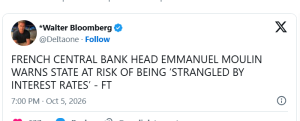
That may represent the sole exit strategy from the looming crisis. As Michael Hudson often points out, “debts that cannot be paid will not be paid.” Unsurprisingly, Emmanuel Moulin, the head of the Bank of France, views Mélenchon’s proposal as “illegal, dangerous, and futile.” However, he too acknowledges the impact of rising interest rates.
With six months remaining until France’s elections, numerous developments can transpire, particularly in financial markets. The global scene is currently fraught with challenges, including two regional wars, an escalating energy crisis, rising stagflationary pressures, a bursting AI bubble, and increasing political instability.
Just yesterday, Spain’s Prime Minister Pedro Sánchez announced early elections for mid-November as tensions mount in the Euro Area’s fourth-largest economy. Simultaneously, as Europe grapples with economic decline, French and German leaders have discovered a “solution” for the continent’s woes: cutting ties with China. A strategy that seems ill-timed for Europe’s struggling economy.
Concerns are escalating regarding the possible spillover effects of Europe’s sovereign debt issues on the balance sheets of European banks. Notably, France is home to more Systemically Important Banks (G-SIBs) than any other Euro Area country, totaling three. According to Bloomberg:
The costs of insuring French banks’ bonds against default have surpassed those of other European lenders amid rising concerns about France’s fiscal and political landscape impacting credit markets. The annual cost for protecting €10 million ($11.2 million) of Société Générale’s bail-in senior debt reached €103,000 on Monday, roughly €16,500 more than similar debt from Deutsche Bank. Only a month ago, these insurance costs were identical.
The credit-default swap spreads for BNP Paribas and Crédit Agricole are likewise significantly higher than those for major banks in the UK, Germany, Switzerland, and Spain.
The broader concern is that France’s persistent debt difficulties may foreshadow a more extensive crisis affecting not only Euro Area economies but also the West in general. Many nations face similar issues such as over-indebtedness—both public and private—inflation spurred by wars in West Asia and Ukraine, stagnant economies, and a declining manufacturing base.
Euro Area economies are especially susceptible due to their inability to print their currency or devalue it, making them vulnerable to reinforcing “doom loops” between weakened banks and sovereign debt. As Robin Brooks of Brookings states in a recent substack, the Euro zone sovereign debt crisis never truly ended.
It has merely been concealed by an ECB utilizing German fiscal space to mask the insolvency of many Euro zone nations. As I’ve argued before, this tactic is inherently doomed. Europe requires more than just a prevention of fiscal crises; it needs real fiscal space. The avoidance of debt crises alone will not suffice—it merely allows Europe to inch along, while resentment within Germany grows. The current Euro—if maintained in its existing form—will not endure.
Brooks cautions that while the ECB may once again take substantial action to suppress rising yields, the usual approach of relying on German fiscal space to alleviate market pressures on public finances may reach a dead end, especially given the rapid ascendancy of the AfD and Germany’s own economic troubles:
The demand for German fiscal space is clearly unsustainable politically; this reality is often obscured. However, the rise of the AfD will bring much-needed awareness to these issues and foster necessary change.
What this change will entail is uncertain, but a smooth transition is improbable.