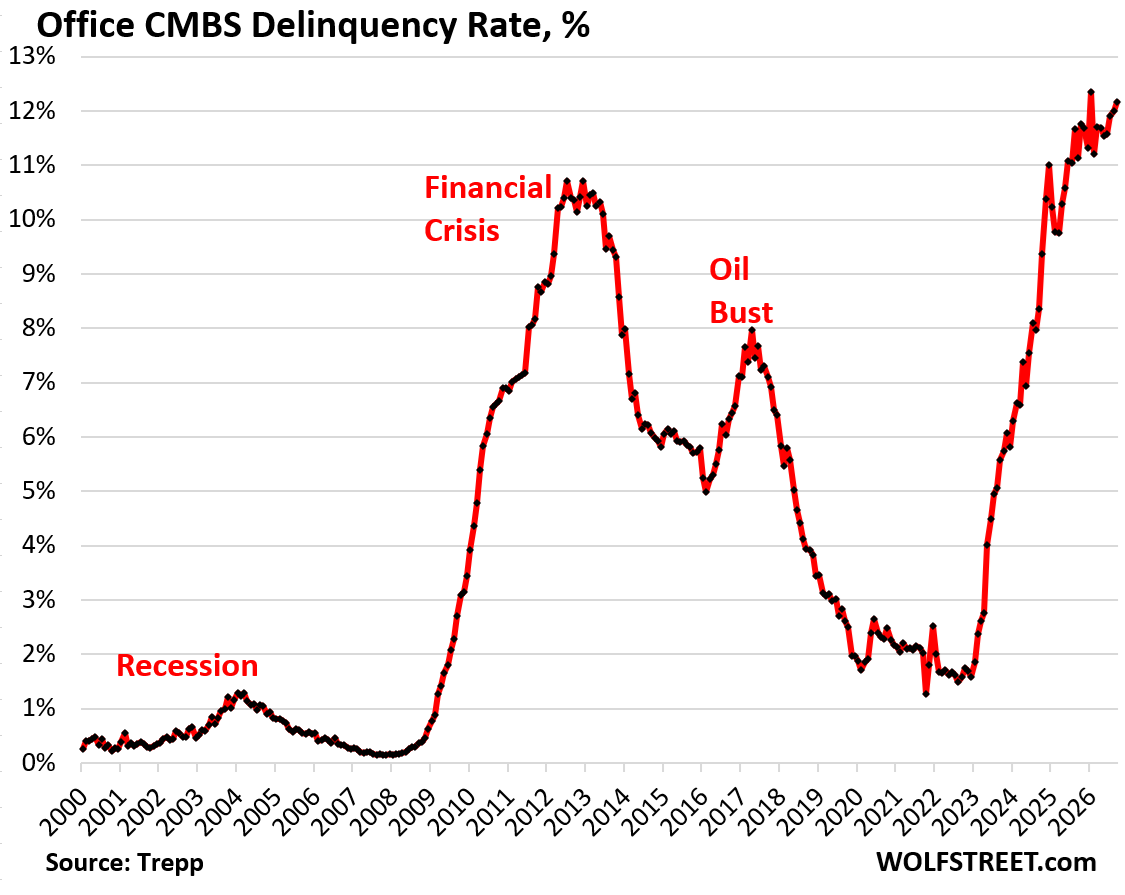
In recent months, the delinquency rate for office mortgages securitized into commercial mortgage-backed securities (CMBS) has experienced a notable resurgence, rising to 12.2% in September. This marks the second-highest rate on record, surpassed only by January 2026’s rate of 12.3%, and is 1.5 percentage points higher than the peak levels seen during the Financial Crisis. This information comes from Trepp, an organization that monitors and analyzes CMBS data.
The primary factor contributing to the spike in September was a maturity default on a $1.1 billion loan that did not get settled when it matured in August. This loan, securitized in 2021, had its various tiers sold to institutional investors worldwide. As a result, the originating banks are not liable for this default.
This loan is secured by a portfolio of eight office and film-studio properties totaling 2.2 million square feet in Hollywood, where the major tenants include Netflix and 20th Century Fox. However, two leases held by Netflix and one by 20th Century Fox, which account for 30% of the net rentable area, are nearing expiration, and discussions regarding their renewal are still ongoing.
Extend and Pretend Forevermore?
The $1.1 billion loan from Hollywood that entered default in September was handed over to special servicing in July 2026. It encompasses five Class A office towers and three film-studio properties, all situated within a mile of each other in Hollywood, spanning 2.2 million square feet. The borrowers are influential landlords, namely Blackstone Property Partners and Hudson Pacific Properties.
Currently, the loan is managed by SitusAMC, the largest special servicer in terms of unpaid principal balance, which stood at $111 billion as of January.
Netflix occupies 57.8% of the net rentable area (NRA), with one of its leases expiring in January 2027 (7.0% of the NRA) and another in June 2028 (17.2% of the NRA), totaling a significant 24.2%. According to SitusAMC, discussions surrounding lease renewals with Netflix are in progress, as reported by Fitch Ratings, the agency responsible for rating the CMBS.
20th Century Fox, the second-largest tenant, has a lease that accounts for 6.4% of the NRA, expiring in December 2026. The decision on whether to renew this lease hinges on the continuation of studio productions, and the outcome will play a pivotal role in lease extensions, as noted by Fitch.
Recent modifications to the loan include a 14-month maturity extension until November 9, 2027, at a fixed interest rate of 4.435%, which is considerably below current market rates. In exchange for this extension, Blackstone and Hudson Pacific committed to contributing $20 million to a leasing reserve sourced from outside property cash flow. Fitch identified that the loan would face a “full cash trap” until it is repaid completely, directing all excess cash flow toward the leasing reserve.
Since there is uncertainty regarding the renewal of the Netflix and 20th Century Fox leases, Fitch has adjusted its rating outlook to “negative,” indicating a potential downgrade if market conditions, valuations, or portfolio performance deteriorate further, particularly concerning upcoming lease expirations.
The occupancy rate of the properties was recorded at 84.9% in July, down from 91% in September 2025. The anticipated lease expirations of 30% of the NRA could lead to nearly half of the available space being vacant if not successfully renewed.
A $470 million loan secured by office properties in downtown Houston also contributed significantly to the rising default rate, having missed its maturity payoff, as reported by Trepp.
This loan, initiated and securitized into a single-borrower CMBS in 2021, is backed by the 34-story, 1 million sq. ft. One Allen Center and the adjacent 50-story, 1.2 million sq. ft. Three Allen Center, completed in 1980, along with a six-story parking garage featuring a health club. Brookfield Properties is the property owner.
With a floating interest rate of SOFR plus 3.08%, the loan’s current interest rate has escalated to around 6.96% following recent hikes by the Federal Reserve. If rates rise again, it could reach approximately 7.2%. This increase follows a period when SOFR was nearly at 0% upon the loan’s origination.
Currently, the property has an occupancy rate of 71%. Major tenants include Freeport LNG, Motiva, and Plains Marketing, as highlighted by Trepp.
S&P Global, which assesses the CMBS, expressed concerns as early as March regarding whether Brookfield Properties would settle the loan by the final maturity date in April. That date has passed without any payoff.
Trepp indicated that the loan’s transition to non-performing status in September may be a sign of ongoing negotiations regarding its terms.
The prevailing strategy appears to revolve around extending payment deadlines in hopes that interest rates will eventually decrease, making refinancing feasible.
Extend-and-Pretend Not Forevermore
The current reality of “extend and pretend” was a central theme in a recent edition of First Draft, a publication from CRE outlet Bisnow. While the tone may be somewhat humorous, the underlying issues are quite serious:
“One of this industry’s long-standing traditions is its reliance on slogans. Over the years, we’ve heard sentiments like, ‘Survive until ’25,’ which has evolved into ‘bliss in ’26,’ and recently transformed yet again into ‘heaven in ’27.’ This phrase seems increasingly like a distant hope rather than a solid prediction.”
Mark Bonner, the editor-in-chief of Bisnow and author of the note, adds:
“AEW’s Lauren O’Neil described the situation as ‘a shift back to fundamentals,’ essentially signaling when creative financial strategies cease to be effective.
“Meanwhile, KBS’ Sondra Wenger remarked that current distress lies within structural issues, meaning the physical assets may be fine, but the acquisition prices are not.
“Poverni Sheikh Group’s Eugene Poverni indicated that buyer expectations have shifted, as they now seek greater value for lower risks. This could lead to a downward trend in prices.”
“As it stands, refinancing options are almost nonexistent.”
“This situation means that even well-operating properties may face challenges due to prior overvaluation. For instance, a property purchased at a 3-cap rate in 2021 is now under significant pressure. Just five years later, the 10-year yield has jumped from 1.52% to 5.29%.”
Bonner concluded:
“Recently, the reality for capital holders has settled in, and it appears that ‘survive until ’25’ has a new successor, one that stresses the urgency of action: Sell at today’s price, or face intervention from lenders.”