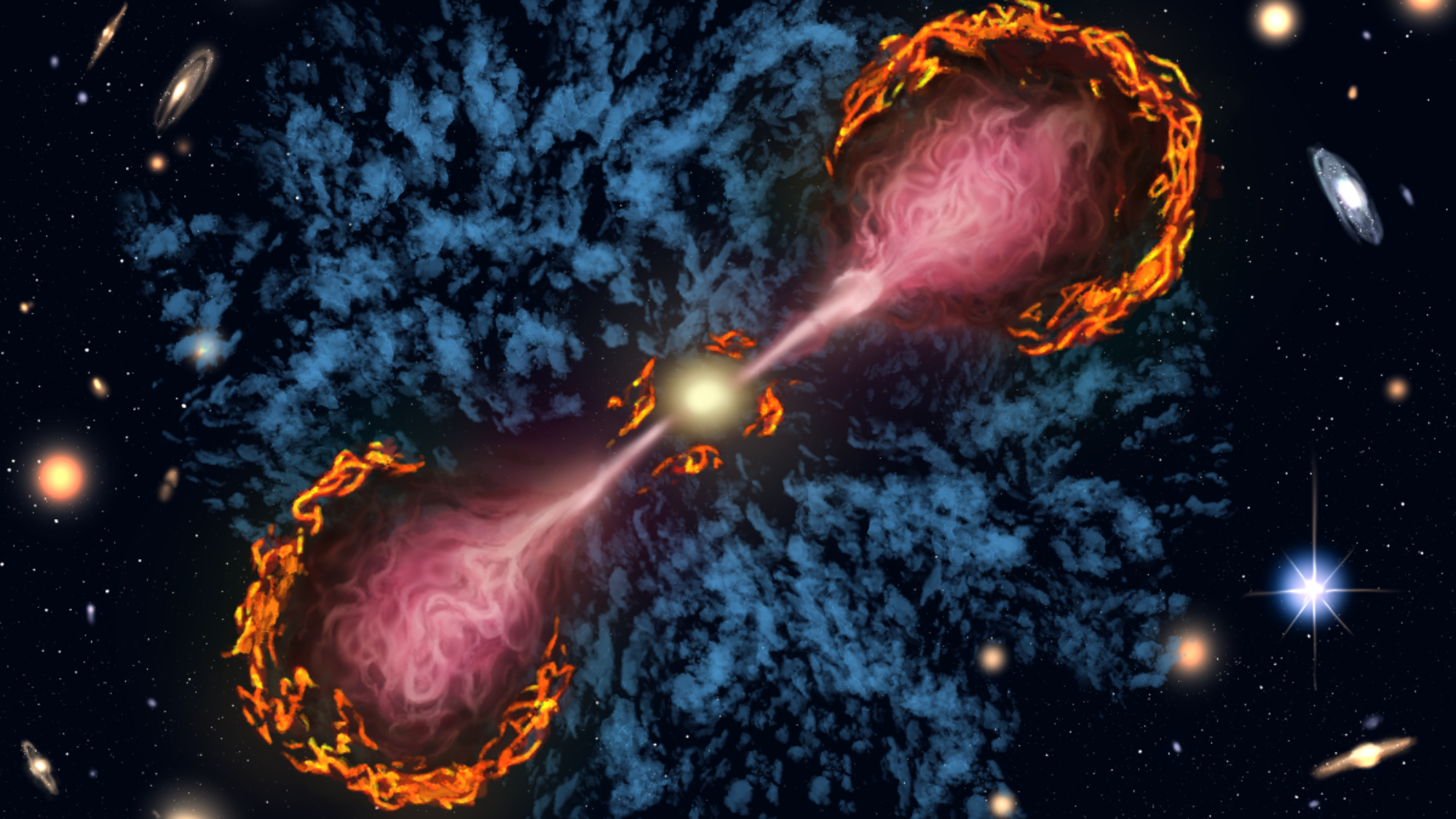
Scientists have made significant strides in understanding how jets emitted by supermassive black holes influence the “death” of their host galaxies. This research addresses why galaxies do not produce more stars, despite having ample gas and dust available in their circumgalactic medium.
During periods of intense star formation, gas from these surrounding materials enters galaxies, fueling star creation. However, this process eventually halts, leading to the galaxies’ decline—referred to as their “death.”
The study indicates that when supermassive black holes expel jets of plasma, they extend well beyond the galaxy’s center, disrupting the surrounding gas. This disruption plays a crucial role in limiting star formation and thus affects the growth and evolution of galaxies.
Co-leader Sanchayeeta Borthakur from Arizona State University emphasized that this research uncovers the intricate relationship between black holes and galaxies, offering insights into the broader implications for cosmic evolution.
In their investigation, Borthakur and co-leader Namrata Roy focused on galaxies with active jets, utilizing data from the Dark Energy Spectroscopic Instrument (DESI) and the LOFAR Two-meter Sky Survey (LoTSS). They discovered that the jets interact with clumps of surrounding gas, energizing it, but not uniformly. The most significant effects were observed at the edges of galaxies and in the outer circumgalactic medium, where the jets release substantial energy.
These findings highlight the extensive influence of black hole jets, which extend energy across vast distances—up to hundreds of thousands of light-years—affecting regions far from their points of origin. This research offers a new framework for scientists to explore the connections between black holes and galactic evolution further, as published in the Astrophysical Journal Letters.


