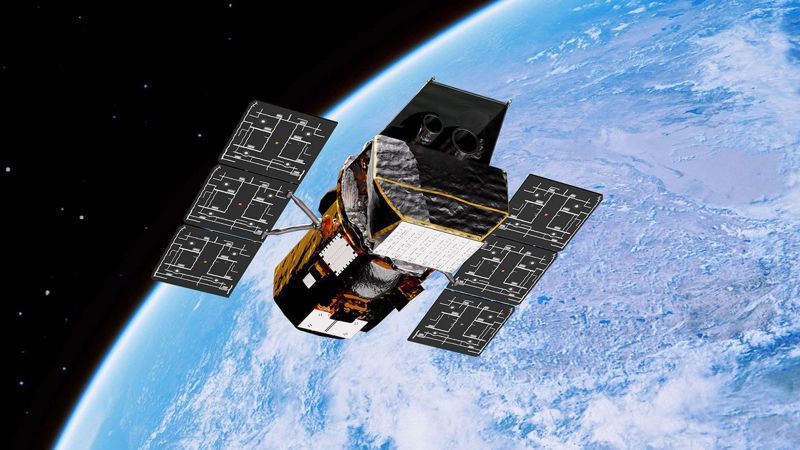
Swift Observatory’s Descent: A Legacy in Space
A celebrated space telescope, the Neil Gehrels Swift Observatory, is nearing the end of its mission as it rapidly tumbles from its once-stable orbit, just shy of the 22nd anniversary of its launch. The observatory, designed to monitor cosmic events, will soon be unable to conduct scientific observations following a failed attempt to boost its orbit over the summer.
Swift, named after fast-flying birds, was originally intended to study the most powerful explosions in the universe—gamma-ray bursts. Over the years, it has contributed to understanding various cosmic phenomena, including asteroids and comets. Currently situated about 200 miles above Earth, Swift is expected to struggle operationally as it drifts below 185 miles in early to mid-October. After that, re-entry into the atmosphere is anticipated, where it may burn up.
According to space-tracking company LeoLabs, while some hardware might survive re-entry, the likelihood of causing significant damage is low, and debris will likely fall into uninhabited areas or oceans. NASA did not provide comments on the potential risks associated with Swift’s impending re-entry.
A Failed Rescue Mission
The potential for rescue was heightened with the deployment of LINK, a satellite designed to grapple Swift and restore its orbit. Developed by Katalyst Space Technologies in just nine months, LINK’s mission ultimately failed as it spun out of control shortly after launch in July. Despite this, Shawn Domagal-Goldman, Astrophysics Division director at NASA, acknowledged the high-risk nature of the mission, noting that Swift was destined to re-enter the atmosphere without intervention.
Both NASA and Katalyst expressed that the effort was not in vain, as important lessons learned could pave the way for future advancements in spacecraft servicing technology.
LINK’s Demonstration Mission
Despite the issues, Katalyst decided to proceed with LINK’s demonstration mission in August. This involved close encounters with Swift, showcasing potential future servicing missions, although LINK ran out of fuel before completing the planned objectives. It managed to come within 7.5 to 9 miles of Swift while practicing maneuvers that could be crucial for future satellite repairs.
“LINK was built to take on a problem that did not have an easy solution,” said Ghonhee Lee, CEO of Katalyst Space. The data obtained from LINK’s mission will inform the design of future spacecraft meant for servicing existing missions in space.
Swift’s Impact and Future
The Swift Observatory has served as a versatile tool in low-Earth orbit since its launch in 2004 and has been pivotal in advancements within the field of astrophysics. As the mission nears its conclusion, scientists have begun powering up Swift’s instruments to collect data, further accelerating its decline.
The observatory has been losing altitude due to atmospheric drag, exacerbated by solar activity at its peak. This increase in atmospheric expansion is leading scientists to predict a fall towards Earth in the coming months.
When Neil Gehrels, the namesake of the observatory, designed Swift, it revolutionized space observation. According to S. Bradley Cenko, Swift’s principal investigator at NASA, the efforts to boost Swift’s orbit are part of its legacy, embodying the spirit of experimentation even in uncertain outcomes.
Conclusion
While Swift’s scientific contributions come to an end, the knowledge gained from both its mission and the attempted rescue will inform the future of space exploration. As the field evolves, spacecraft that can perform multiple functions will be crucial, a vision that Katalyst is keen to deliver on as they build towards this new frontier.
For further insights into cosmic discoveries and advancements in science, sign up for CNN’s Wonder Theory science newsletter.


