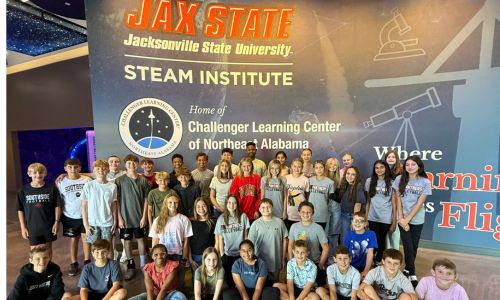
Seventh-Graders at Rainbow Middle School Engage in NASA-Funded Space Agriculture Program
RAINBOW CITY, AL. – Seventh-grade students at Rainbow Middle School are participating in a two-semester space agriculture research program through a new partnership with the Challenger Learning Center of Northeast Alabama.
The program, Growing Beyond Earth, is a NASA-funded initiative developed by Fairchild Tropical Botanic Garden in collaboration with NASA. Starting this week, 40 students from Ben Simmons’ science class will conduct plant-growth experiments in tabletop growth chambers installed at the Challenger Learning Center.
Students will gather measurements and research data that will be submitted to NASA scientists at Kennedy Space Center. This initiative is modeled after the Veggie plant-growth system used aboard the International Space Station. Since its launch in 2015, more than 80,000 students across over 450 schools worldwide have participated in the program.
To date, students have tested over 275 varieties of edible plants for potential use during long-duration space missions. Notably, 40 varieties have been selected for further testing in space, and five have been successfully grown aboard the International Space Station. A vegetable-harvesting protocol, developed through this student research, has also been integrated into procedures used in orbit.
Students will monitor the growth chambers weekly, with each visit anticipated to take about 20 minutes. The entire seventh-grade class participated in the program’s kickoff and training, including students from Austria, Slovakia, and Taiwan.
In the first semester, Rainbow Middle School students will utilize a NASA-developed research protocol. The second semester will allow them to design and conduct original experiments, submitting research proposals akin to professional scientific research.
Dr. Farrah Hayes, executive director of the Challenger Learning Center, emphasized the significance of this partnership: “Growing Beyond Earth positions our students at the forefront of actual NASA research, not just simulations.” She noted that contributions from students could play a role in research related to upcoming missions to the Moon and Mars.
Chad Strawn, education coordinator at the Challenger Learning Center, added, “This program empowers students to actively engage in the scientific process, from forming hypotheses to collecting data, knowing their efforts impact real-world missions.”
Rainbow Middle School Principal Allison Lee expressed excitement about the program: “We are thrilled to give our seventh-graders the chance to be part of active NASA research. Our partnership with the Challenger Learning Center is invaluable, and Growing Beyond Earth furthers that connection.”
Participation in the program is free for Rainbow Middle School students. The Challenger Learning Center is covering costs related to growth chambers and supplies, while Fairchild Tropical Botanic Garden and NASA provide equipment, curriculum materials, and ongoing training.
Participants will also have the chance to engage in monthly “Chat with the Scientists” sessions and present their research at the annual Growing Beyond Earth Student Research Symposium.
Looking ahead, the Challenger Learning Center plans to expand participation in Growing Beyond Earth to additional classrooms and schools in future years. The center offers various space and STEM education programs for students in Northeast Alabama, including simulated missions, school outreach, summer STEM camps, and professional development for educators.


