New Sea Spider Species Discovered in the Salish Sea
Key Findings:
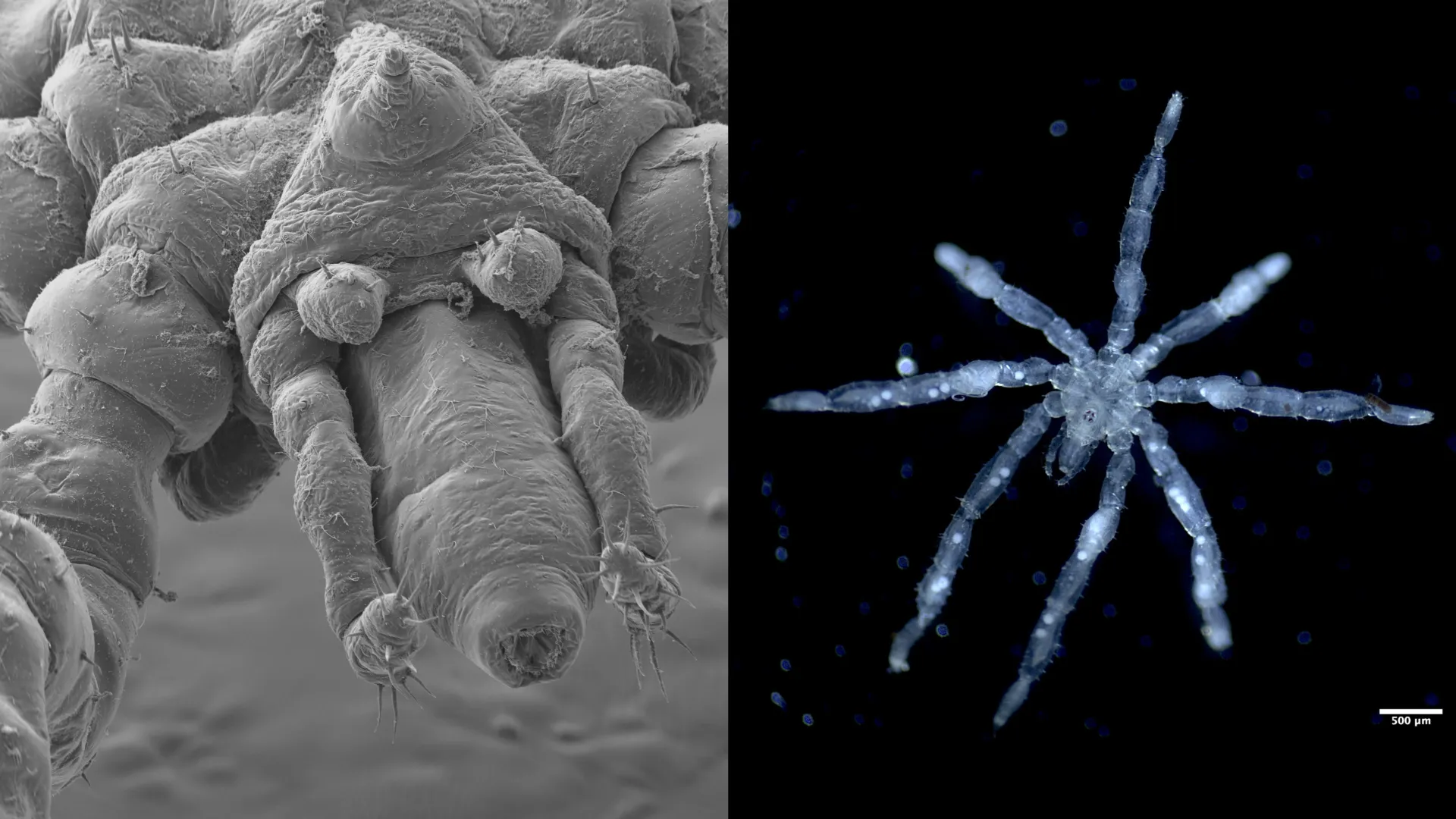
- Researchers at the University of British Columbia (UBC) have identified two new species of sea spider in the Salish Sea, with one featuring hairy legs and striking red eyes.
- This marks the first formal description of new sea spider species from this region in nearly a century.
Research Background:
- Lead author Cormac Toler-Scott highlighted a gap in knowledge about the species in the Salish Sea, which are crucial for understanding the impacts of climate change and human activities on marine ecosystems.
About Sea Spiders:
- Sea spiders are an ancient lineage, related to spiders and scorpions, that have remained exclusively marine for roughly 500 million years.
- They exhibit unique biological traits such as having up to 12 legs, a feeding proboscis, and unusual reproductive methods. Notably, males are responsible for carrying and nurturing young.
Details of the New Species:
-
Callipallene pilosuspedes
- Named for its hairy legs, it has red eyes and a short proboscis with claws for feeding.
- Its unique mouth structure resembles a tiny marine Sarlacc pit, with sensory tendrils for navigation.
-
Tanystylum kiixin
- Named after an Indigenous village site, this species has less flexible limbs and is often covered in dirt and parasites, indicating a complex micro-ecosystem.
Research Methodology:
- The study combined imaging and DNA analysis to document species diversity, creating an identification guide for marine scientists in the region.
Conclusion:
- Despite the discoveries, Toler-Scott emphasizes that there are likely more undocumented species in the Salish Sea, indicating a rich and diverse ecosystem that remains to be explored.
Funding Acknowledgment:
- The research was supported by the National Sciences and Engineering Research Council of Canada.


