North Logan, UT— At the 40th Annual Small Satellite Conference, Utah State University’s Space Dynamics Laboratory (SDL) announced its partnership with Advanced Space LLC to develop deep space communications and time-keeping technology for NASA’s CAPSTONE 02 mission. This initiative aims to enhance autonomous navigation, spacecraft-to-spacecraft communications, and proximity operations around the Moon, supporting NASA’s Artemis and Moon Base programs.
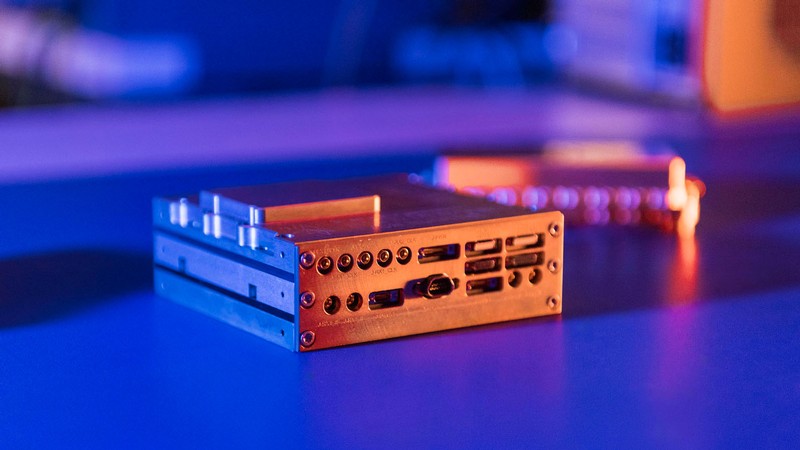
Following the successful CAPSTONE mission launched in 2022, SDL will design, manufacture, and test two flight-qualified Iris Radios, along with communication and navigation hardware, for CAPSTONE 02’s twin 400-kilogram small satellites. These radios will facilitate both direct-to-Earth connections and spacecraft-to-spacecraft communication, crucial for new autonomous operational capabilities in lunar orbit.
CAPSTONE 02 builds on the original mission’s achievements, which validated a near-rectilinear halo orbit ideal for lunar exploration. It also showcased Advanced Space’s Cislunar Autonomous Positioning System (CAPS) navigation software.
The upcoming mission will feature two spacecraft operating in cislunar space, demonstrating autonomous rendezvous, spacecraft communications, and advanced navigation techniques that minimize reliance on Earth tracking.
“CAPSTONE demonstrated that small satellites can achieve significant objectives beyond Earth’s orbit. The Iris Radio facilitates reliable communication and precise navigation essential for mission control and data relay,” said Tim Neilsen from SDL. “CAPSTONE 02 will advance spacecraft communication and autonomous navigation capabilities.”
SDL’s Iris Radio is specifically designed for missions beyond low-Earth orbit, developed from technology at NASA’s Jet Propulsion Laboratory. Engineered to endure the challenges of deep space, it maintains continuous contact with NASA’s Deep Space Network.
The mission continues SDL’s legacy of supporting NASA’s exploration efforts beyond Earth, having previously contributed to missions like MarCO, Lunar Flashlight, and BioSentinel. CAPSTONE 02 is scheduled for launch in late 2027.
Based at USU’s Innovation Campus in North Logan, SDL is a nonprofit that addresses technical challenges for the military, scientific community, and industry, while supporting NASA’s exploration vision. For more information, visit sdl.usu.edu.


