CosmicWatch: Unlocking the Invisible Universe
Overview
Cosmic particles from space continually cross through Earth, despite being undetectable by our senses. Many of these particles are tied to cosmic rays which are highly energetic and originate from cosmic phenomena such as supernovae.
The CosmicWatch Detector
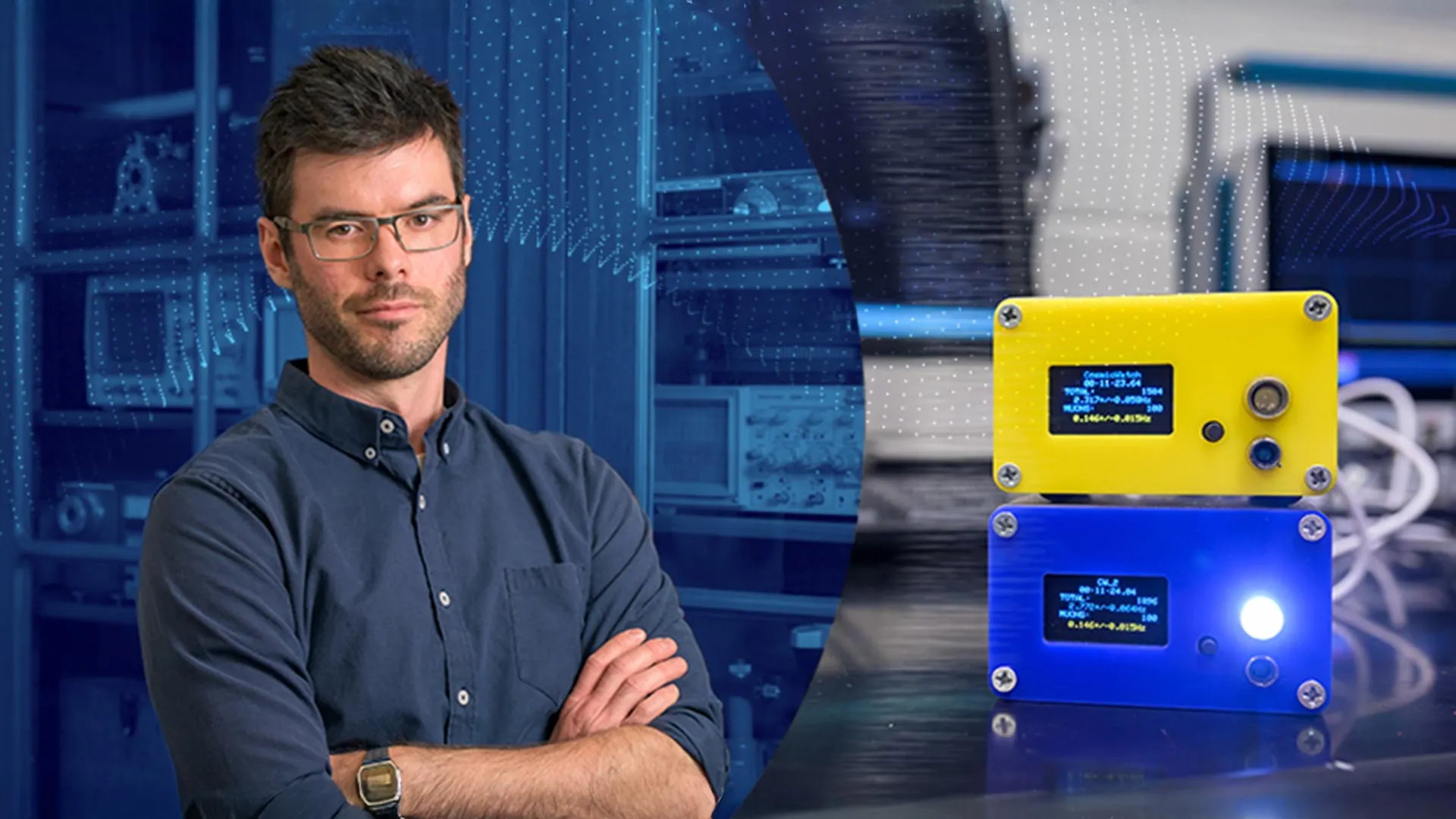
Developed by Spencer Axani, a physics professor at the University of Delaware, CosmicWatch is a compact and affordable device for detecting muons—particles created when cosmic rays interact with Earth’s atmosphere. Measuring about the size of a box of animal crackers and costing around $100, CosmicWatch records muon activity, enabling users to analyze the data after collection.
Key Features:
- Compact and portable design for ease of use.
- Ideal for educational purposes yet utilized in advanced research.
- Allows a range of experiments, contributing to physics education and outreach.
Significance of Muons
Muons are crucial for understanding cosmic events and the fundamental principles of physics. By studying muons, scientists can gain insights into:
- Origin Properties: Energy, mass, and direction of cosmic rays.
- History of Physics: Used in early confirmations of Einstein’s special relativity.
- Imaging: Can penetrate materials to reveal hidden structures, useful in archaeology and geology—like unveiling a chamber in the Great Pyramid of Giza.
Evolution of CosmicWatch
Initially conceived as a portable detector for IceCube, a neutrino observatory in Antarctica, CosmicWatch transitioned to an educational tool aimed at teaching particle physics. The latest version has enhanced features for data monitoring and radiation tolerance.
Research Applications
CosmicWatch is now involved in various advanced physics projects, including:
- NuDot Experiment at UD: For calibrating large-scale detectors.
- Coherent CAPTAIN-Mills Dark Matter Detector: In collaboration with Los Alamos National Laboratory.
- Space Missions: Future deployments on rockets to study primary cosmic rays.
Educational Impact
Beyond University of Delaware, CosmicWatch has been implemented in classrooms like those at Cornell University, where students construct and experiment with the device. This hands-on approach fosters excitement and understanding of particle physics.
Future Aspirations
Axani envisions a global network of CosmicWatch detectors operated by citizen scientists. This initiative would enable collaborative data collection on muon rates worldwide, contributing to a broader scientific database. Additionally, advancements could lead to satellite systems capable of communicating about environmental changes in space.
Conclusion
What began as a simple educational project has transformed into a multifaceted tool bridging education and advanced physics research. CosmicWatch epitomizes innovation, accessibility, and the excitement of discovering the universe’s hidden particles.


