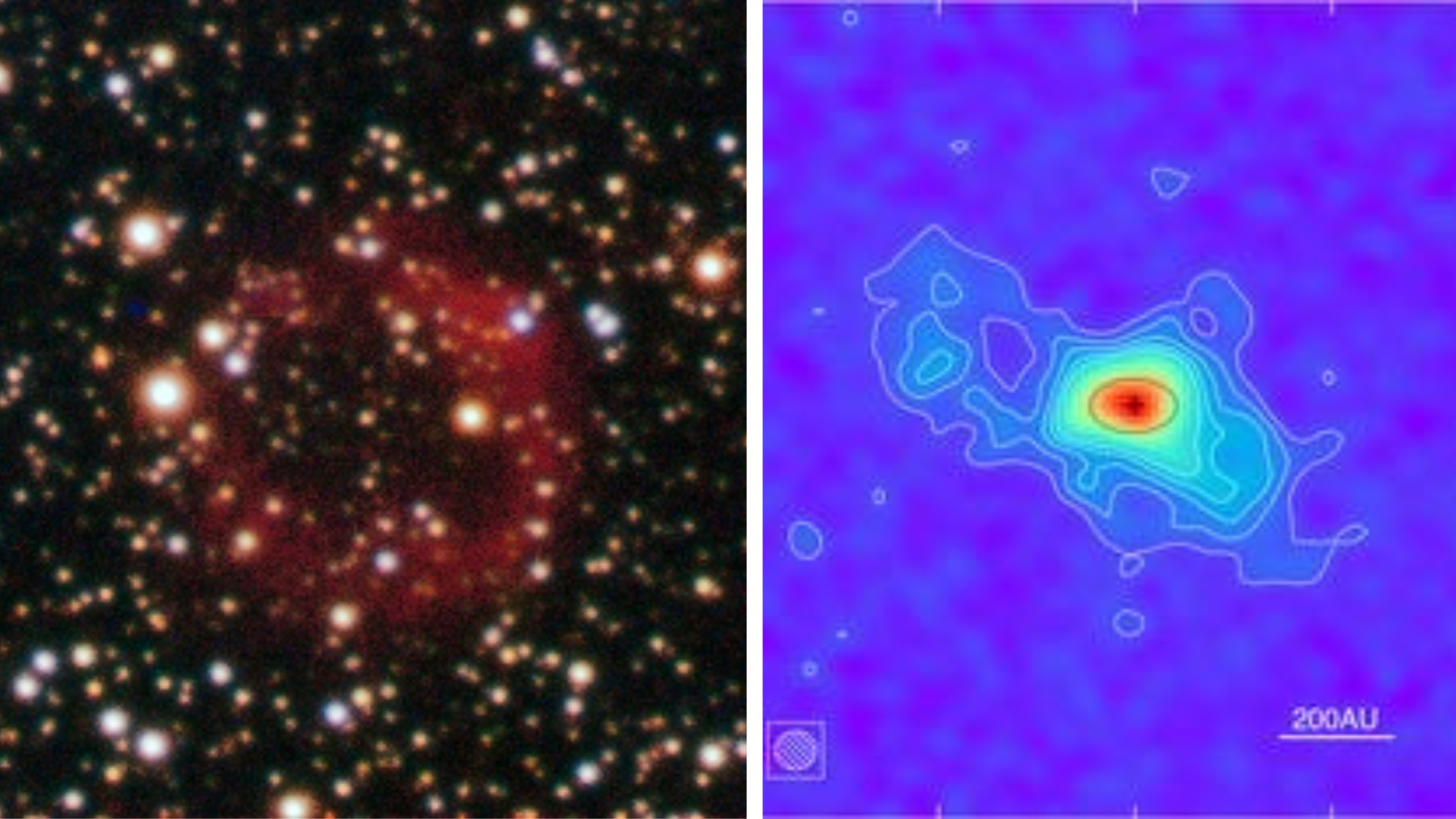
Sakurai’s Object: A Unique Stellar Evolution
Sakurai’s Object, also known as V4334 Sagittarii, has recently entered a new stage in its evolutionary journey. Located about 10,000 light-years away, this “born-again” star sheds material through a powerful stellar wind, expanding to a size comparable to our solar system. Its fascinating evolution captured the attention of astronomers since it re-ignited in 1996 after a long dormant phase.
Stellar Evolution Insights
Most stars evolve over millions to billions of years, making the rapid changes seen in Sakurai’s Object extremely rare. According to Albert Zijlstra from the University of Manchester, this star offers a unique opportunity to observe stellar evolution in real time.
Dying and Revitalization
Initially on a path to becoming a white dwarf, Sakurai’s Object experienced a very late thermal pulse, returning to an earlier evolutionary stage. This phenomenon, witnessed in only two stars (the other being V605 Aquilae), implies complex interactions within the star, resulting in significant ejection of gas and dust.
Observational Studies
Using the Very Large Telescope (VLT), researchers conducted detailed observations, uncovering that Sakurai’s Object now has a temperature between 48,000 and 35,700°F (27,000 and 36,000°C). This reheating phase is slower than predicted, prompting refinements in stellar evolution theories.
Future Research Directions
The research team plans to continue monitoring Sakurai’s Object as it transforms toward becoming a white dwarf, expecting to glean more insights into this intriguing phase of stellar evolution. Their findings were detailed in the Monthly Notices of the Royal Astronomical Society on September 16.


