In today’s rapidly evolving job market, understanding the impact of artificial intelligence (AI) on employment is critical. While many focus on the fear of widespread job displacement, a comprehensive analysis of historical workforce trends reveals a more nuanced perspective. This article underscores the resilience of occupations even in the face of significant technological advancements.
By William Skoglund, Post-doctoral researcher Uppsala University, Jakob Molinder, Associate Professor of Economic History Uppsala University and Kerstin Enflo, Professor in the Department of Economic History Lund University. Originally published at VoxEU
Concern regarding AI-induced job losses often stems from analyses that focus on the automatable tasks within jobs. However, labor markets hire, compensate, and terminate entire occupations—not just tasks. Over time, these occupations have demonstrated remarkable durability despite changes in job responsibilities. Utilizing 140 years of Swedish census data, we find that approximately 70% of today’s workers are employed in roles whose core functions have been around since the late-19th century. Thus, the fear of mass unemployment may be exaggerated; a more pressing concern is whether current technological trends will continue to create the specialized, sustainable jobs seen in previous waves of innovation.
In recent years, the question of how artificial intelligence will impact the economy and employment has garnered considerable attention. The current wave of apprehension dates back to Frey and Osborne (2017), who estimated that 47% of jobs in the U.S. were at high risk of automation. Subsequent research, inspired by Acemoglu and Restrepo (2019), has focused on the automation of tasks, with findings such as Eloundou et al. (2024), indicating that large language models could affect at least half the tasks in about 20% of U.S. jobs. Consultancies have also created automation-exposure maps, while the OECD has evaluated job loss among high-risk occupations (Georgieff and Milanez 2021).
Much of the existing literature addresses automation by examining the tasks that comprise jobs. However, the transformative effects of technology on tasks and jobs are distinct. A job cannot be viewed simply as a collection of interchangeable tasks; it is a cohesive unit with a market-defined value. When some tasks within a job are automated, the likely outcome is not the elimination of the job itself, but a shift in its content. Garicano et al. (2026) emphasize that AI reshapes job boundaries rather than dissolving them entirely; empirical evidence indicates that AI alters the tasks involved in work more often than it reduces overall job availability. Humlum and Vestergaard (2025) reveal that AI chatbots, to date, have had minimal impact on earnings and working hours.
If labor markets reward entire occupations instead of individual tasks, then accurately assessing technology’s true impact requires understanding how many people are employed in specific occupations and how those numbers evolve. This is the approach we take by examining historical data.
Insights from Historical Data
In our study (Skoglund et al., 2026), we analyze the employment landscape in Sweden from 1880 to 2019, utilizing comprehensive censuses and administrative records. We standardize occupations across 140 years of data using a unified classification system (van Leeuwen et al. 2002). Instead of focusing on changes in tasks within occupations, we highlight the functions that these occupations serve. Under our definition, a primary teacher from the 1800s retains the same occupational code as a contemporary primary teacher, even though the tasks performed may have evolved significantly.
We categorize occupations based on their inception: those that existed prior to 1900, during the second or third industrial revolutions, and in the 21st century. Despite multiple technological revolutions, the bulk of Swedish employment remains rooted in roles established before the second industrial revolution. By 2019, nearly 70% of workers were employed in these incumbent occupations. Notably, occupations such as nurses and retail workers, which are prevalent today, mirror the economic functions of their 1880s counterparts, despite undergoing extensive task transformation. The transition from carriage driver to truck driver, or from clerk to a computer operator exemplifies this persistence.
This pattern is not unique to Sweden. When we applied the same methodology to U.S. data, we found that occupations created since 1940 accounted for only about 9% of employment in 2019. This discovery contrasts with Autor et al. (2024), whose title-based approach claims that a majority of current U.S. jobs stem from specializations introduced since 1940. The disparity arises from differences in methodology; their analysis infers employment from the share of new micro-titles, whereas ours directly counts individuals employed in each role. Significantly, Autor et al. (2026) transitioned to person-level census data, which revealed a much stronger persistence trend—indicating only 18.3% of workers from 2011-2023 were in roles introduced post-1970, a figure that aligns closer to our findings. When examined by individual roles, it becomes evident that the occupational landscape remains firmly entrenched in historical practices.
Figure 1 Share of Swedish employment by technological occupational wave, 1880–2019
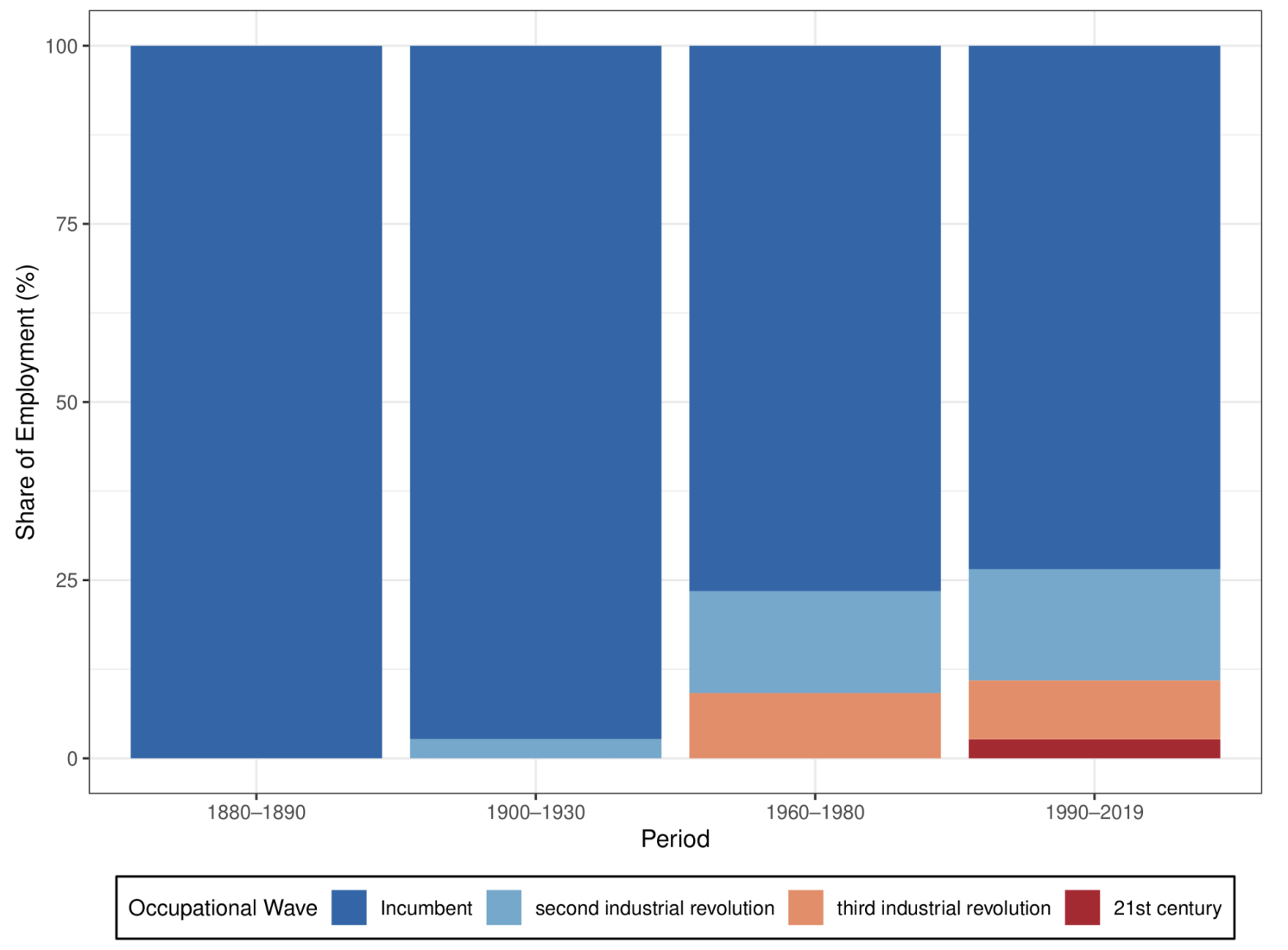
Note: Occupations are harmonised to 5-digit HISCO; vintages are defined by the year a code first reaches 50 workers. “Incumbent” refers to occupations present before 1900, while “Second industrial revolution” and “Third industrial revolution” pertain to those new between 1900-1930 and from 1960, respectively, and “21st century” jobs appeared after 2000.
Source: Skoglund et al. (2026), from IPUMS Swedish censuses 1880–1910, the 1930 census, and FOB/LISA registers 1960–2019.
Sources of New Sustainable Work
Given the persistence of occupations, an important question arises: where do new jobs originate? We identify two primary sources. Some new roles are Schumpeterian, emerging directly from technological advances (e.g., electricians, computer programmers), while others are Smithian, arising from the growing complexity and scale of markets and organizations (e.g., accountants, specialists, logistics personnel). The colonial-era general merchant, for example, divides into shopkeepers, brokers, and bankers—not because trade is novel, but due to market scale that enables finer divisions of labor (Chandler, 1978).
Our findings indicate that sustainable and well-compensated employment largely arises from the Smithian side. Such occupations are notably more adept at enduring market fluctuations. In our data, specialized roles exhibit a significantly lower likelihood of decline; conversely, those emerging from recent technological waves are much more prone to fade away—illustrated by the decline of the punch-card operator. The risk is linked to being part of a recent technological wave rather than merely being high-tech. The underlying mechanism involves a chain: technology fosters scale, which cultivates specialization, and ultimately drives durable labor demand. While Schumpeterian sectors boost productivity and broaden market reach, the jobs they create tend to manifest in the more stable domain of Smithian specialization. Thus, the panic surrounding potential job displacement might be overstated. Historical trends show that occupations tend to remain resilient, and economic growth can still lead to the creation of new Smithian roles.
Identifying Declining Occupations
To project future trends in the labor market, we assess the age of both Smithian and Schumpeterian occupations, drawing on the observation that declining roles often have an aging workforce (Autor and Dorn, 2009).
The sectors most closely related to innovation have matured significantly. Recent digital-era occupations constitute a small portion of employment and demonstrate increased volatility compared to earlier roles. Additionally, digital occupations have aged; computer programmers, historically much younger than the average worker, are now averaging around the overall workforce age—a notable shift for a sector once known for attracting younger talent (Figure 2). Conversely, engineers have maintained a consistent average age since the 1930s, indicating that the aging trend is specific to programming and operator roles that emerged from the digital wave. The youngest workforce segments are now increasingly found in lower-specialization service jobs.
Figure 2 Worker age relative to the workforce average, selected occupations, 1880–2022
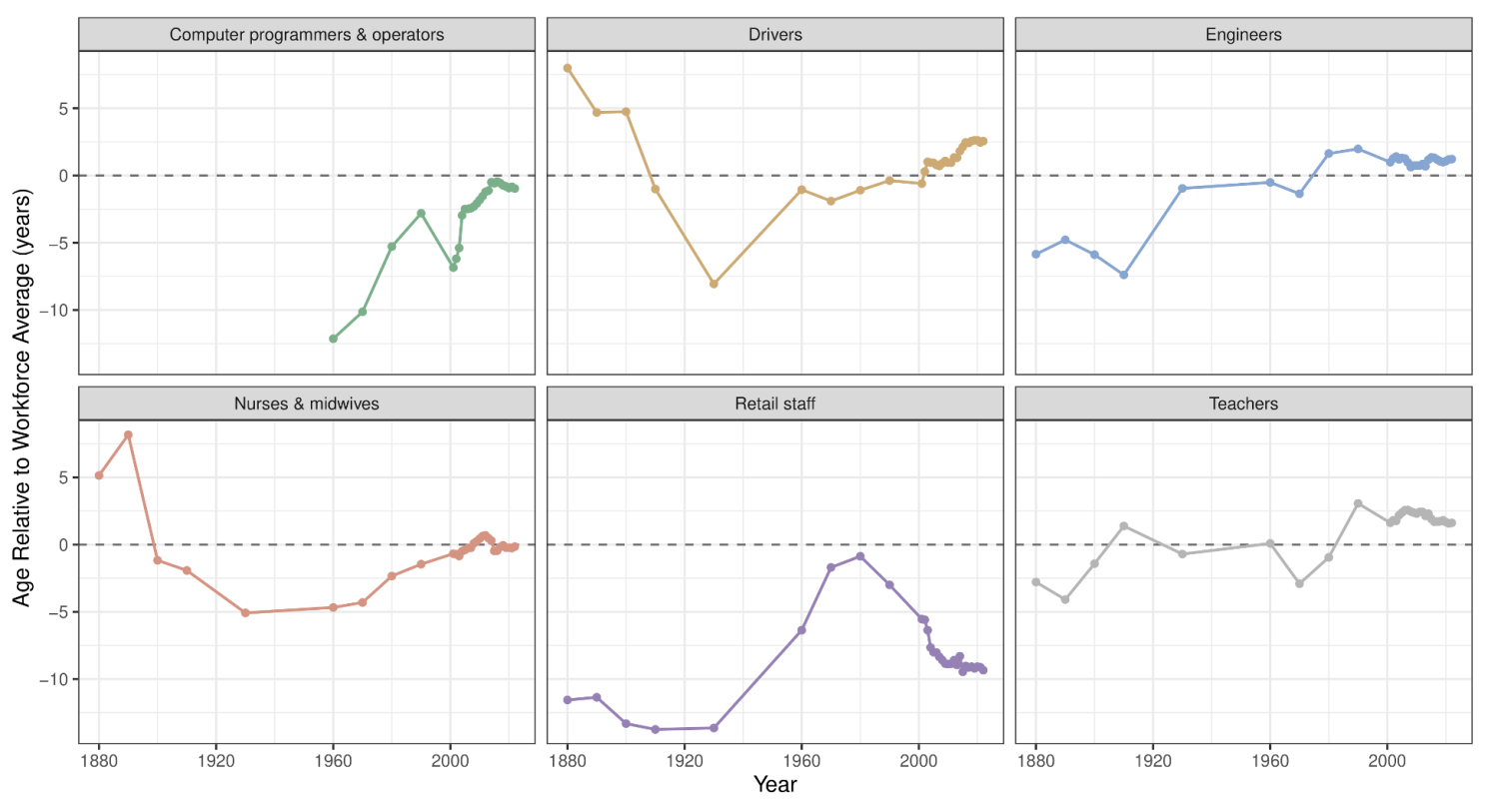
Note: Employment-weighted mean worker age within each occupation group, adjusted against the year-specific workforce average; positive values indicate older than the average worker for that year.
Source: Skoglund et al. (2026), from IPUMS Swedish censuses 1880–1910, the 1930 census, and FOB/LISA registers 1960–2022.
Further, we analyze earnings across different occupational types. Notably, we发现发现发现发现发现发现发现发现发现发现发现 no earners bonus exists for being technologically innovative. Instead, the premium is associated primarily with specialization; highly specialized roles yield substantial returns, regardless of their technology quotient, with twenty-first-century positions offering remuneration comparable to those inherited from the nineteenth century—and in some cases, slightly less. The market seems to favor depth of labor division rather than mere technological novelty.
Implications for the AI Discussion
Thus, the pressing question diverges from the sensationalist narratives dominating media discussions. It is not whether AI will displace workers from specific tasks—historically, entire occupations have usually absorbed such disruptions. Rather, the emphasis should be on whether the current technological advancement can replicate the successes of previous waves by generating sufficient productivity and scale to produce lasting, specialized, well-compensated roles. Previous general-purpose technologies consistently translated innovation into significant employment through labor division, yet the digital revolution has not yet demonstrated this capability.
This reframes the AI and employment conversation from task exposure to tangible changes in occupations and employment levels. Historically, technology has transformed jobs more frequently than it has eliminated them, with much of the employment impact arising from specialization facilitated elsewhere.
This should alleviate some anxieties regarding extensive technological unemployment but prompt a more nuanced concern. The critical question for AI remains whether it can uphold the traditional agreement of converting productivity gains into new, specialized work through a refined division of labor.
See original post for references