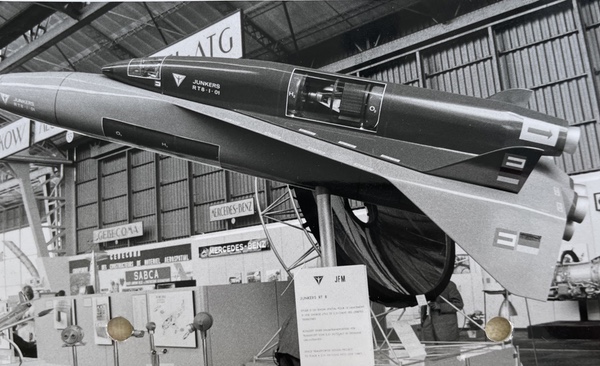
This article discusses the Junkers spaceplane project in West Germany during the early 1960s, detailing its design, challenges, and eventual decline. Here are the key points:
Historical Context
- Post-WWII Revival: Germany’s aerospace research resumed in 1953, with significant contributions from engineers who remained in the country.
- Eugen Sänger’s Influence: Sänger, a pivotal figure, advocated for reusable spaceplanes over ballistic rockets, aiming for innovation in European aerospace.
Project Development
- Initial Concepts: Junkers developed various models (RT-1 to RT-8), initially aiming for a single stage to orbit (SSTO) design before shifting to two-stage to orbit (TSTO) configurations.
- Funding Challenges: The project started with private investment but faced funding shortages from the German government. By 1965, financial support for development ceased, shifting focus to conventional aerospace projects.
Technical Innovations
- Nuclear Propulsion: Sänger’s visionary approach included studying nuclear engines for improved efficiency. However, the lack of a prototype held back their development.
- Cabin Design: Safety measures included ejection seats and a pressurized cabin, similar to later models like the Space Shuttle.
Conclusion
- Factors Leading to Decline: The project’s failures stemmed from financial constraints, political dynamics within Europe, and the loss of key leadership following Sänger’s death in 1964.
- Legacy: The Junkers spaceplane represents a significant “what if” in aerospace history, highlighting the interplay of innovation, funding, and political support in technological advancements.
Overall, the article underscores the ambition and technical potential of the Junkers spaceplane project while illustrating the challenges that ultimately hindered its realization.


