The ongoing mystery of our universe’s accelerated expansion is primarily attributed to a force called dark energy, which scientists have yet to fully understand.
Key Highlights:
-
Dark Energy Spectroscopic Instrument (DESI): Situated in Arizona’s Sonoran Desert, DESI has been mapping the cosmos for five years, resulting in the largest three-dimensional universe map ever created.
-
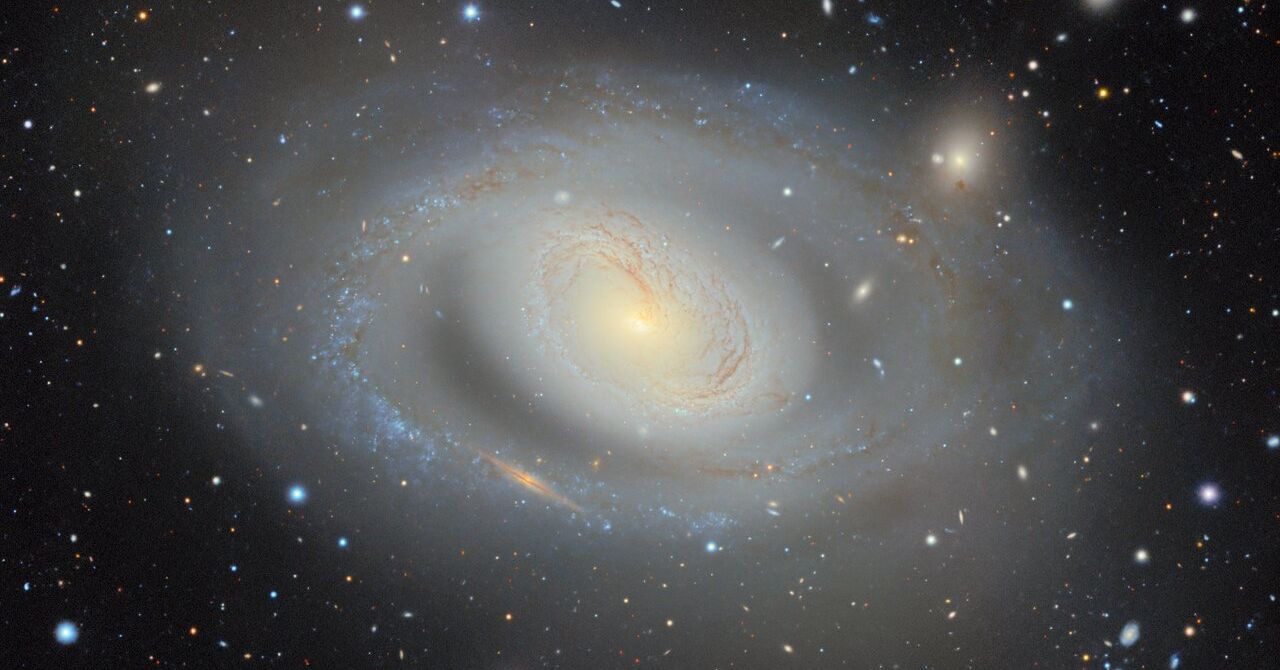
DESI Legacy Imaging Surveys: This tool allows the public to explore vast imaging data, featuring 5.6 trillion pixels that include approximately 4 billion celestial objects. It covers about 75% of the sky, capturing both visible and near-infrared wavelengths.
-
Data Challenges: The survey has difficulties capturing deeper parts of space obscured by our galaxy’s stars and dust. DESI’s mechanical eyes are strategically positioned to minimize obstruction and capture clearer images.
-
Significant Collaborations: Over 160 scientists contributed to this extensive project, which builds upon 13 years of previous work. The DESI data has already fueled about 1,800 scientific publications.
-
Understanding Dark Energy: Recent maps from DESI have reconstructed 11 billion years of cosmic history and visualized distances of 47 million galaxies and quasars to better comprehend the effects of dark energy on the universe’s expansion. Astronomers track dark energy by observing the movement of celestial objects away from us.
Notable Image
- The survey also includes spectacular visuals, such as a galaxy cluster in Leo, known as “Copeland’s Septuplets.”
David Schlegel, a researcher involved in the project, highlighted the importance of this data in contemporary astronomy, stating that it is now integral to the field. As our understanding of dark energy develops, tools like DESI will be pivotal in unraveling one of astronomy’s greatest enigmas.