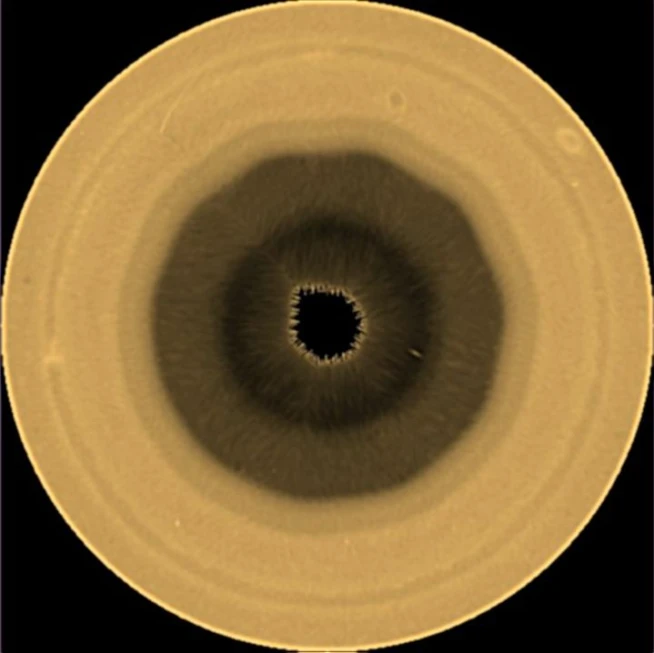
Scientists have discovered a massive 10-sided wave pattern, or decagon, in Saturn’s ammonia clouds at the south pole. This newly identified feature is even larger and more unstable than the well-known hexagon at Saturn’s north pole, observed by NASA’s Voyager missions in the 1980s.
The decagon was first captured by the Hubble Space Telescope in 2023, following a period where earlier observations had failed to detect it. Researchers believe this atmospheric structure may have formed between 2017 and 2023, as Saturn’s south pole was tilted away from Earth. One side of the decagon is already over 10,000 miles long.
The discovery suggests that the iconic hexagon may not be as unique as previously thought, prompting further investigation into atmospheric patterns on gas giants. Saturn is notable for producing polygon-shaped weather patterns, unlike other planets. The decagon is migrating eastward at around 6 mph, contrasting the relatively stationary hexagon.
Lead author Agustin Sanchez-Lavega from the University of the Basque Country expressed excitement to understand why such phenomena are unique to Saturn. Scientists hope to gather more data about the decagon and its longevity in the coming years, as it remains uncertain whether it will last as long as the hexagon, which has been tracked for over 40 years.