Mars’ Hidden Geological Complexity Revealed
Researchers at the University of Oxford have uncovered evidence suggesting that Mars may have harbored large, Earth-like magmatic systems deep beneath its surface, despite lacking the plate tectonics associated with such geological intricacy. This research, published in Nature Astronomy, raises intriguing possibilities regarding the evolution of rocky planets and their potential for habitability.
Mars as a “Stagnant Lid” Planet
Traditionally, Mars has been classified as a “stagnant lid” planet because its outer shell is not segmented into moving tectonic plates as Earth’s is. On Earth, plate tectonics significantly influences volcanism, crustal material recycling, and continent formation. With Mars lacking this dynamic, scientists presumed its crust formed through simpler processes.
Challenging Existing Assumptions
This new study challenges these longstanding assumptions, proposing that Mars could have produced a highly evolved crust through intense recycling internally, independent of Earth-style tectonics.
A Deep-Seated Mystery
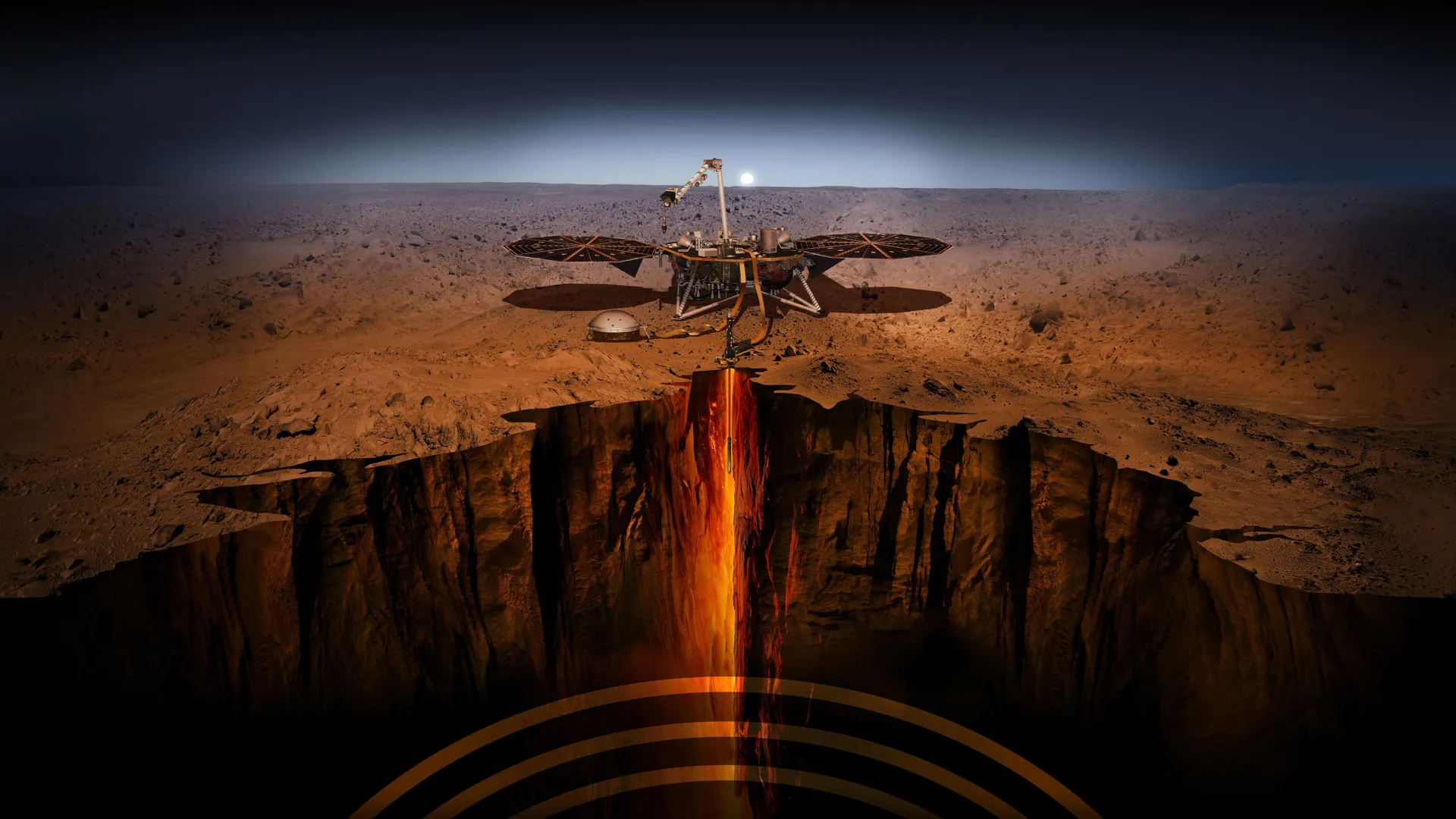
The researchers examined seismic data from NASA’s InSight mission, focusing on waves created by meteoroid impacts and marsquakes. Research teams analyzed an enigmatic boundary located about 24 kilometers beneath the Martian surface, previously identified but not understood.
By cross-referencing seismic observations with various rock compositions, they utilized thermodynamic modeling and statistical analysis to ascertain the materials matching properties at various depths.
Discovering the Composition
Results indicated that rocks below the 24 km boundary were primarily composed of “ultramafic” material (high in iron and magnesium, low in silica), while above this boundary, “mafic” rocks (higher silica content) were more prevalent.
Implications of a Vast Magma System
The buried layer likely formed as molten rock accumulated and gradually segregated into different materials. Dense crystals settled at the crust’s base, while lighter, chemically evolved melts ascended, akin to processes beneath volcanic arcs on Earth.
Dr. Tobermory Mackay-Champion, the lead author, remarked, “We’ve traditionally viewed Martian volcanism as simpler than Earth’s. This discovery suggests that Mars could support extensive, long-lasting systems where molten rock evolved and reprocessed throughout its crust, opening exciting avenues for investigating rocky planets beyond our solar system.”
A New Perspective on Mars
The sheer scale of this magmatic layer may reach hundreds or thousands of kilometers across Mars’ northern hemisphere, hinting that ancient Mars was characterized by interconnected magmatic systems rather than isolated volcanoes. This phenomenon, termed “transcrustal magmatism,” was previously thought exclusive to Earth.
Broader Implications for Habitability
These findings shed light on how rocky planets develop conditions necessary for habitability. Geological recycling could play a significant role in forming atmospheres, oceans, and suitable environments for life. Incessant climate regulation and the long-term cycling of water and volatile elements on Earth arise largely from plate tectonics.
These revelations imply that complex geological evolution and recycling might also occur on planets devoid of Earth-like tectonics. Professor Jon Wade, a co-author, emphasized the potential for habitability conditions to arise in more planets than previously believed, especially those overlooked for their size or tectonic inactivity.
InSight’s Transformative Contributions
This research leverages seismic data from NASA’s InSight mission, which inaugurated the use of a seismometer on Mars in 2018, thereby granting unprecedented insights into the planet’s internal structure.
The study involved collaboration across Oxford University’s Department of Earth Sciences and the University of Bristol, potentially reshaping our understanding of Mars and other rocky planets in the quest for habitable environments.