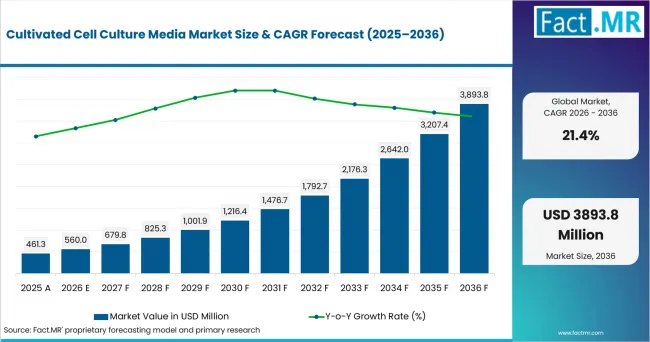
Country Growth Comparison in Cultivated Cell Culture Media Market
The comparative analysis of the cultivated cell culture media market shows significant growth potential across various countries, with specific percentages indicating projected growth:
-
USA: 24.2% CAGR
- Driven by FDA consultation activity and a robust food R&D infrastructure.
-
Netherlands: 22.9% CAGR
- Supported by cellular-agriculture funding and access to scale-up facilities.
-
Israel: 21.4% CAGR
- Backed by investments in bio-convergence and advancements in growth factors.
-
Singapore: 20.3% CAGR
- Enhanced by alternative-protein funding and food safety review capacities.
-
South Korea: 19.3% CAGR
- Strengthened through food-tech policies and the development of cell-culture food standards.
Key Insights
- The total growth range is 4.92 percentage points, dividing the countries into distinct growth bands.
- The USA leads the market growth, mainly due to its significant food R&D investments.
- Each country’s growth is supported by unique regulatory frameworks, funding initiatives, and innovation ecosystems.
- Full report coverage extends across various regions including North America, Latin America, Europe, East Asia, South Asia & Pacific, and the Middle East & Africa.
Factors Supporting Growth
- USA’s Adoption: Consumer spending in the food sector reached USD 2.51 trillion in 2025, driving interest in new protein systems.
- Netherlands’ Scaling: Focus on cellular agriculture with government backing for precision fermentation and cultured meat advancements.
- Israel’s Growth: Integration of cultivated meat within a broader framework of bio-convergence, linking biology and engineering.
- Singapore’s Development: Government investment in research projects aimed at enhancing food security through alternative proteins.
- South Korea’s Performance: Growth supported by expansive food-tech policies and a rise in government funding initiatives.
Conclusion
Overall, the cultivated cell culture media market presents unique opportunities in these countries, reinforced by targeted investments, regulatory support, and innovative research initiatives.