Automotive Alternator Market Overview
Current Market Status
- Date: September 1, 2026
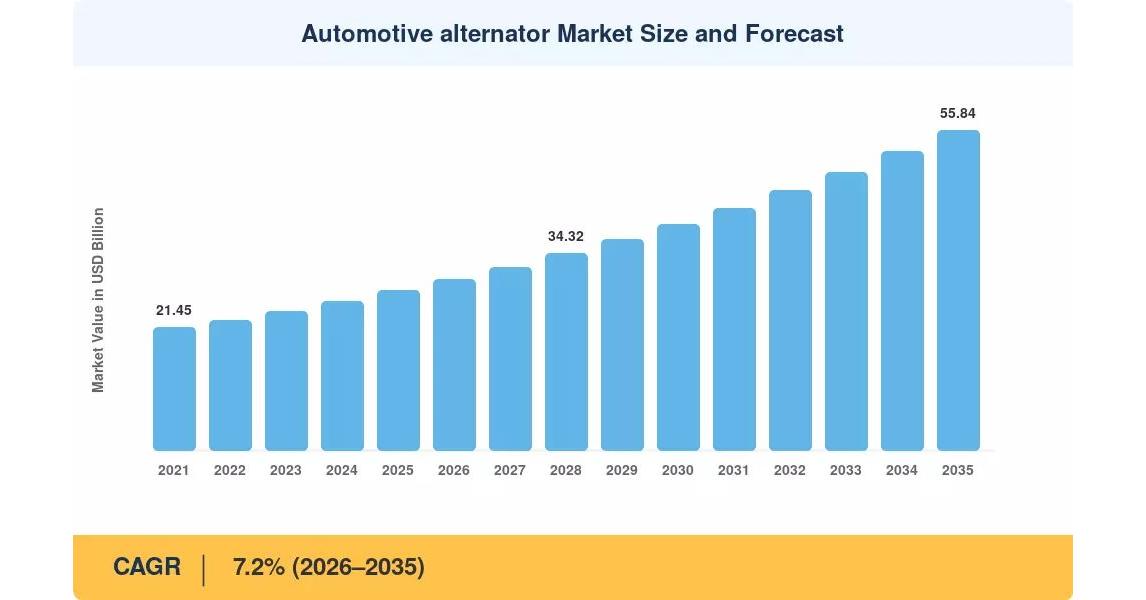
- Market Value: Projected to grow from USD 29.86 Billion (2026) to USD 55.84 Billion (2035)
- CAGR: 7.2% during the forecast period
Key Insights
- Asia-Pacific leads the market, with China representing over 22% of global value.
- Increasing power demands due to technological advancements in automotive electrical systems are driving this growth.
What is an Automotive Alternator?
Automotive alternators are electromechanical devices that convert mechanical energy from the engine into electrical energy, powering the vehicle’s electrical systems and maintaining battery charge. They are essential in both internal combustion engine vehicles and hybrids.
Growth Drivers
- Increasing Vehicle Production: Demand is supported by a global vehicle parc of over 1.9 billion light vehicles.
- Rising Electrical Complexity: With modern vehicles demanding more electronics (ADAS, infotainment, etc.), average electrical loads have increased.
- Technological Developments: The development of smart alternators and advanced energy management systems enhances energy efficiency.
Market Segmentation
- By Powertrain Type: Internal Combustion Engine, Hybrid, and Electric Vehicles.
- By Vehicle Type: Passenger Cars and Commercial Vehicles.
- By Sales Channel: OEM and Aftermarket.
- By Region: North America, Europe, South America, Asia Pacific, and Middle East and Africa.
Competitive Landscape
Key players include:
- Robert Bosch GmbH
- DENSO Corporation
- Valeo SA
- Mitsubishi Electric Corporation
- Hitachi Astemo, Ltd.
These companies are focusing on research and development for improving efficiency and interfacing with emerging technologies.
Challenges
- EV Adoption: Traditional alternator demand is affected by the rise of battery electric vehicles.
- Raw Material Volatility: Fluctuating prices for necessary materials like copper impact production costs.
Opportunities
- 48V Mild-Hybrid Architecture: A more cost-effective approach to compliance with emissions regulations.
- Predictive Maintenance: Connected vehicle platforms enable smart maintenance services.
- Remanufacturing: Growing circular economy expectations enhance demand for remanufactured components.
Conclusion
The automotive alternator market is set for significant growth, fueled by evolving vehicle electrification trends and increasing electrical demands. With the development of smarter, more efficient systems, and the adoption of 48V architectures, the market is poised to keep pace with innovations within the automotive industry.
For further market insights and detailed information, you can check the complete report here.