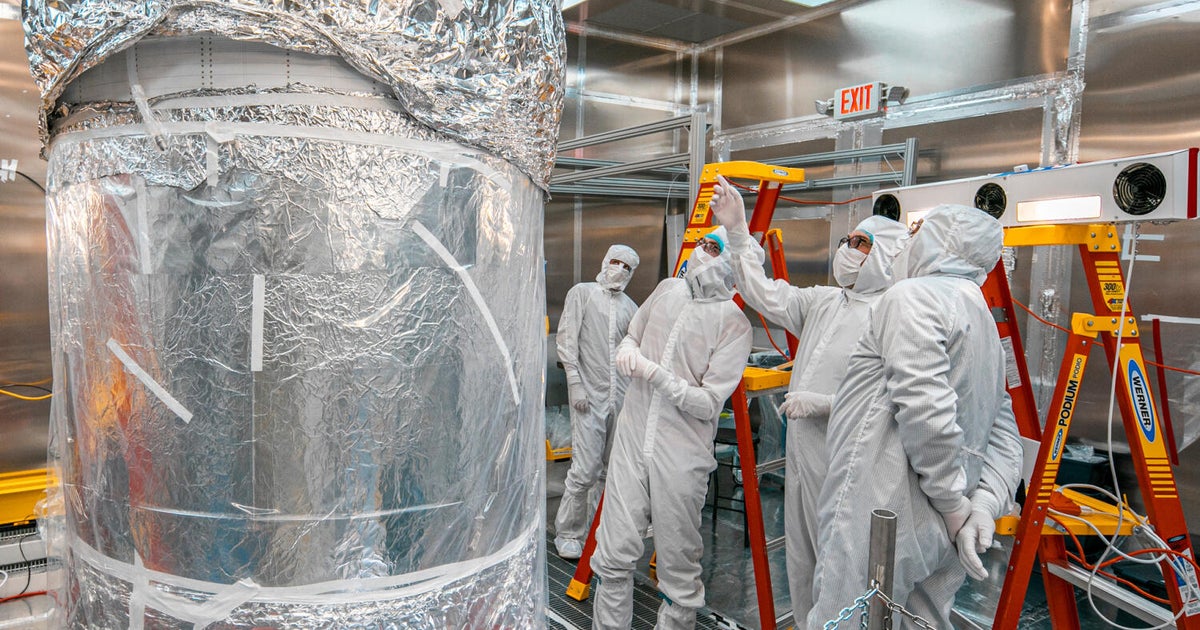
The search for dark matter has long been a significant focus in physics, representing roughly 85% of the universe’s matter yet remaining undetectable directly. Recently, scientists from the LUX-ZEPLIN experiment, including researchers from Northwestern University, reported a potential signal that may provide new insights into the nature of dark matter.
Key Findings:
- Mysterious Signal: A particle interaction was detected that cannot be explained by known background signals from regular matter, with only a 0.5% chance it originates from a known source.
- Location of Experiment: The experiment is conducted underground at the Sanford Underground Research Facility in South Dakota, utilizing a tank filled with ultrapure liquid xenon to isolate potential dark matter interactions from outside interference.
- Detection Mechanism: When a particle interacts with liquid xenon, it produces two detectable signals—a flash of ultraviolet light and an electric pulse of freed electrons, which are analyzed to infer the particulars of the interaction.
- Unexpected Energy Levels: The energy transferred during this mysterious interaction was significantly higher than what would be expected from a weakly interacting massive particle (WIMP). This suggests that if the signal is indeed linked to dark matter, it could challenge existing models and notions of what dark matter comprises.
Background Information:
- WIMPs: Weakly interacting massive particles are a leading candidate for dark matter particles. This new potential signal indicated energy levels that would require a WIMP to have an unrealistic mass equivalent to 200 protons.
- Challenges and Background Signals: Background signals from natural radioactive decay (like radon) complicate the analysis, necessitating careful evaluation to rule out alternative explanations.
Conclusion:
While this signal provides a tantalizing hint in the quest for understanding dark matter, extensive further analysis and data collection are required to confirm its nature and implications fully. The work at the LUX-ZEPLIN experiment continues, promising to deepen our understanding of the universe’s elusive dark matter component.