James Webb Space Telescope Reveals Neptune’s Dramatic History
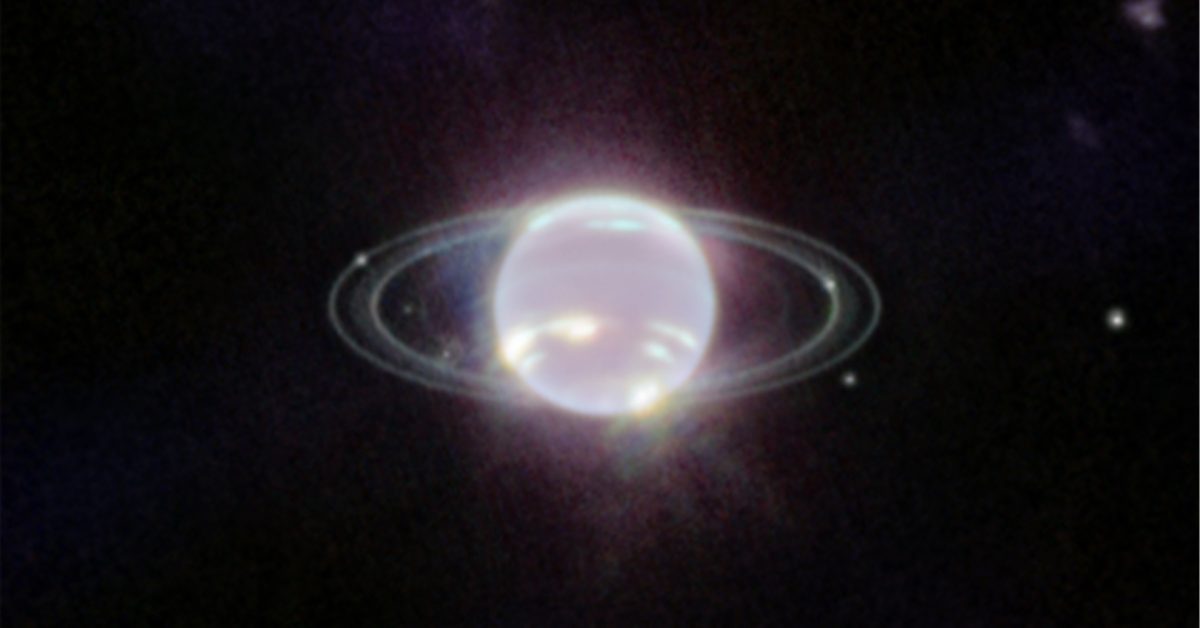
NASA’s James Webb Space Telescope is shedding light on the mysteries of Neptune, revealing that the distant ice giant may have undergone a significant transformation billions of years ago. This new research, published in Science Advances, proposes that Neptune’s original family of moons was largely destroyed before the formation of its current innermost moons and rings.
Key Findings:
-
Hydrated Clay Minerals: Observations using Webb’s Near-Infrared Spectrograph detected magnesium-rich phyllosilicates on three of Neptune’s innermost moons—Larissa, Galatea, and Proteus. These minerals form when liquid water interacts with rock over long periods.
-
Lack of Water Ice: None of the observed moons appeared to be dominated by water ice, indicating they are too small to have generated the internal heat required for liquid water to persist.
-
Triton’s Role: The study supports a hypothesis involving Triton, Neptune’s largest moon, which has a unique retrograde orbit. Scientists believe that Triton was captured after forming in the Kuiper Belt, altering Neptune’s original satellite system.
-
Debris Disk Formation: As Triton’s orbit evolved, its gravity likely led to the destabilization of Neptune’s first-generation moons, creating a debris disk that eventually formed the smaller inner moons and faint rings seen today.
Implications of Findings:
The presence of hydrated clay minerals serves as evidence that material from ancient, now-destroyed bodies may have survived violent collisions, impacting Neptune’s current moon system. The study highlights:
- The geological history of Neptune is more intricate than previously understood.
- There’s a possibility that different origins exist for its moons based on their chemical makeup.
- Webb is not just focused on distant galaxies and exoplanets but is also revolutionizing our understanding of the solar system.
Conclusion:
This series of discoveries hints at a complex dynamic past for Neptune, suggesting that its inner moons and rings are not mere remnants from its formation but products of a historical event that reshaped its entire system. The insights from the James Webb Space Telescope mark significant progress in planetary science, allowing researchers to trace back billions of years to understand Neptune’s history.

Image: NASA, ESA, CSA, STScI