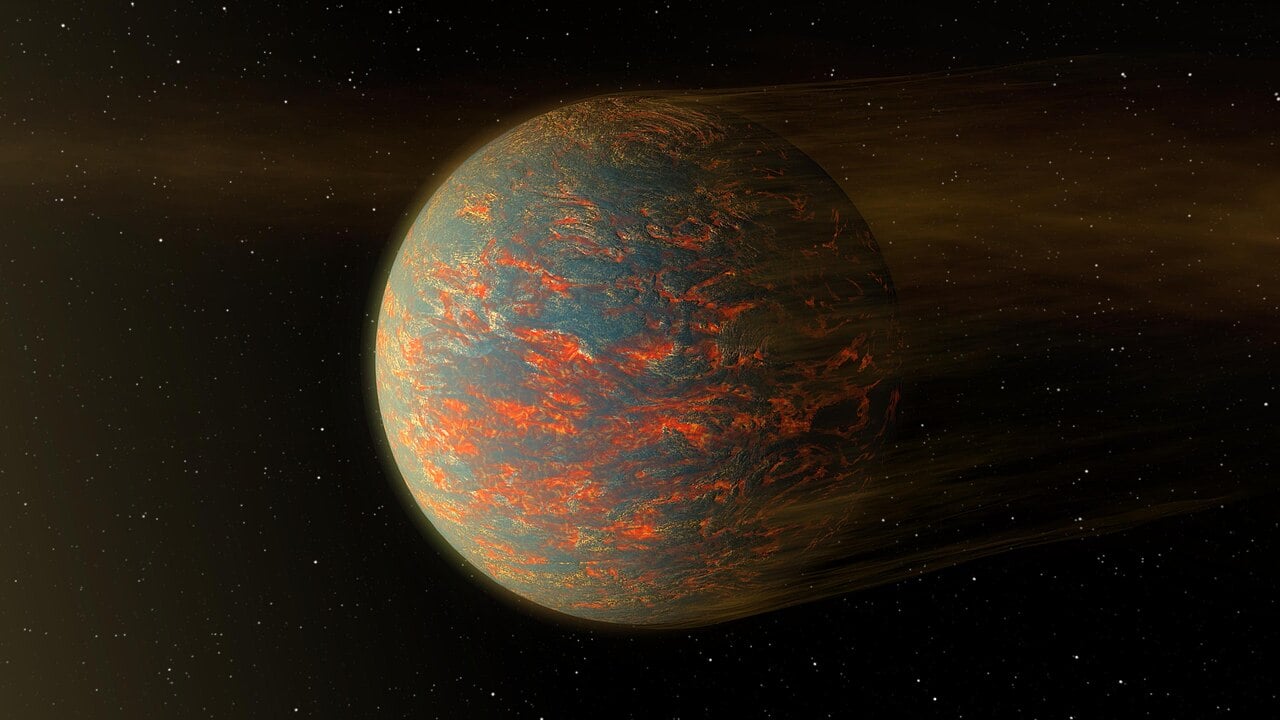
The article discusses the dynamics of exoplanet 55 Cancri e, a rocky super-Earth orbiting very close to its host star, resulting in extreme temperatures. Despite expectations that such planets should lose their atmospheres due to intense stellar radiation, recent findings by the James Webb Space Telescope suggest that 55 Cancri e retains a substantial atmosphere, likely rich in carbon dioxide or monoxide.
Research indicates that the extreme heat of lava worlds like 55 Cancri e may actually help preserve their atmospheres through a mechanism involving molten rock. The magma can store significant amounts of gases, only releasing them gradually, thus maintaining a volatile supply.
The study proposes a revised model of atmospheric retention that includes a “cosmic sandbar” region where intensely heated planets can sustain atmospheres despite their proximity to their stars. This model challenges previous notions of the “cosmic shoreline,” illustrating a more complex relationship between temperature and atmospheric survival.
The implications extend to understanding atmospheric dynamics across rocky planets, ultimately influencing how scientists assess other exoplanets regarding their potential to support life.