AI-Driven Transformation of Mexican Trade
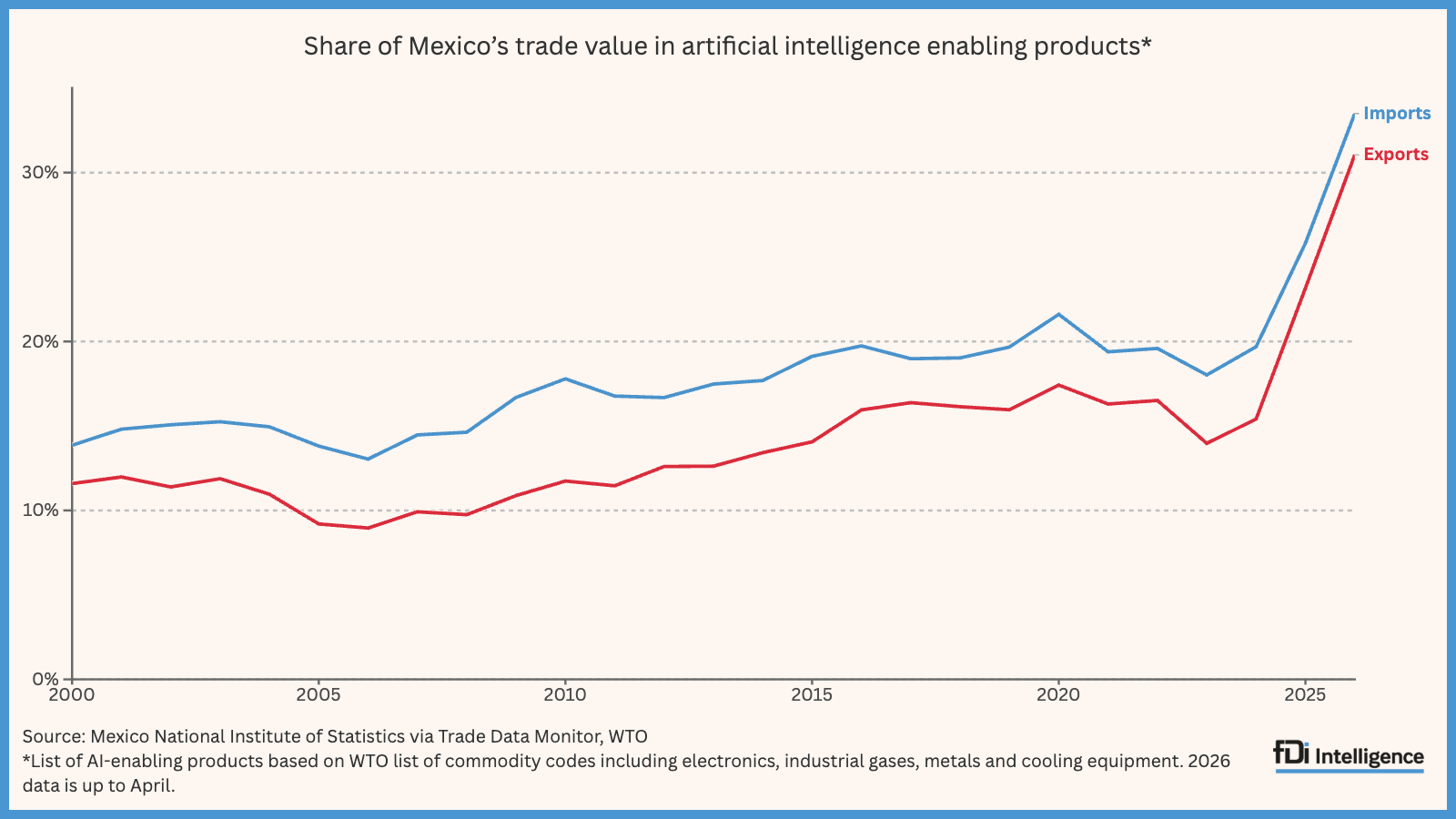
Products enabling artificial intelligence (AI) are redefining Mexico’s trade landscape, as the nation emerges as a pivotal hub for assembling hardware destined for U.S. data centers. Between January and April 2026, the value of Mexico’s AI-related exports and imports surpassed 30%, setting a new record, according to Trade Data Monitor.
Rising Exports
The surge in exports is primarily driven by data processing machines, or AI servers, which reached a remarkable value of $84.6 billion in 2025. This marks a significant milestone, positioning AI servers as the country’s largest export, overtaking passenger cars valued at $58.5 billion for the first time.
Gilberto García-Vázquez, chief economist at Johns Hopkins’ Net Zero Industrial Policy Lab, describes this shift as “amazing,” yet cautions that Mexico’s minimal contribution to the overall AI value chain could pose economic risks.
Import Dynamics
In the early months of 2026, AI products accounted for 33.5% of Mexico’s total imports, up from 25.8% in 2025. This increase reflects a rise in imports of AI server components from Asia, with Taiwanese firms finalizing assembly before shipping to the U.S. Concurrently, AI product exports rose from 23.2% to 31.1%.
The sophistication of AI servers has led to a substantial increase in their average export unit value, which jumped from $1,179 to $4,840 between the first quarters of 2025 and 2026.
Chihuahua’s Central Role
The northern state of Chihuahua has emerged as the leader in AI server assembly, leveraging its established electronics industry, skilled workforce, tariff exemptions, and proximity to the rapidly expanding U.S. markets in Texas and Arizona. From 2021 to 2025, Chihuahua attracted roughly $2 billion in investment from Taiwanese firms, with an additional $750 million committed in 2026 alone.
Fernando Alba, the undersecretary of economy for Chihuahua, emphasizes the evolving requirements for new facilities that demand higher power and automation. Companies like Foxconn and Pegatron have significantly expanded their operations in the state, with Inventec recently announcing a $450 million investment in its Chihuahua facility.
Chihuahua’s exports reached an unprecedented $35.99 billion in the first quarter of 2026, doubling compared to 2024. Alba notes, “Chihuahua is the only ecosystem globally that is so well connected with the U.S. and Taiwan.”
Economic Implications
While AI-related trade has given a boost to Mexico’s economy, García-Vázquez warns against overestimating the long-term benefits. He highlights that compared to the automotive sector, where Mexico adds substantial value, the assembly of AI servers contributes minimally to the value chain. Most of the value is generated in chipmaking nations like Taiwan and South Korea, making these investments potentially more transient than those in the automotive industry.
“The investment can arrive in six months and leave just as quickly,” he cautions, especially with the rise of AI server factories in Texas altering the competitive landscape.
Conclusion
The transformation of Mexico’s trade dynamics through AI-driven products underscores the potential and challenges of emerging technologies. As investments pour into assembly operations, the future of the economy will hinge on enhancing domestic value addition while navigating the risks of dependency on mobile capital.