In recent months, geopolitical tensions have escalated in the Caspian Sea region. Following US strikes on July 23-24, which targeted locations in Iran’s Gilan Province, significant damage was inflicted on Bandar Anzali, the largest Iranian port on the Caspian coast linked to the national railway system. This escalation was followed by Ukraine’s attack on an Iranian commercial vessel on July 25. Such events underscore the risk of regional conflicts intertwining with the ongoing war in Ukraine.
For some time, we have been forecasting a potential spillover of Middle Eastern conflicts into the Caucasus and Central Asia. Currently, the war in Ukraine seems to be catalyzing this shift.
The US, along with allies Turkiye and Israel—backed by European nations—are advancing eastward. They focus on energy procurement, logistics, and establishing CIA-backed corridors ranging from Türkiye to Kyrgyzstan. This strategy has long aimed to create a path that effectively sidelines Russia and Iran, which would undermine the concept of a cooperative and prosperous Asian heartland.
Progress is evident, with Armenia and Azerbaijan now aligned with US interests. The upcoming effort will likely push across the Caspian Sea, where Central Asian nations are increasingly gravitating toward NATO and Israel. This raises the question: how will the region manage its largest, though rapidly shrinking, inland body of water?
Caspian Connections
In light of the destruction of Nord Stream and Europe’s efforts to distance itself from Russian gas supplies, including resistance to Russian gas via Turk Stream, there is a renewed focus on securing energy flows from Central Asia.
The European Union has tapped Azerbaijan’s resources to its limits and is now turning its attention to Kazakhstan and Turkmenistan. However, a quick glance at the map reveals the challenges of pursuing energy routes that exclude both Russia and Iran.
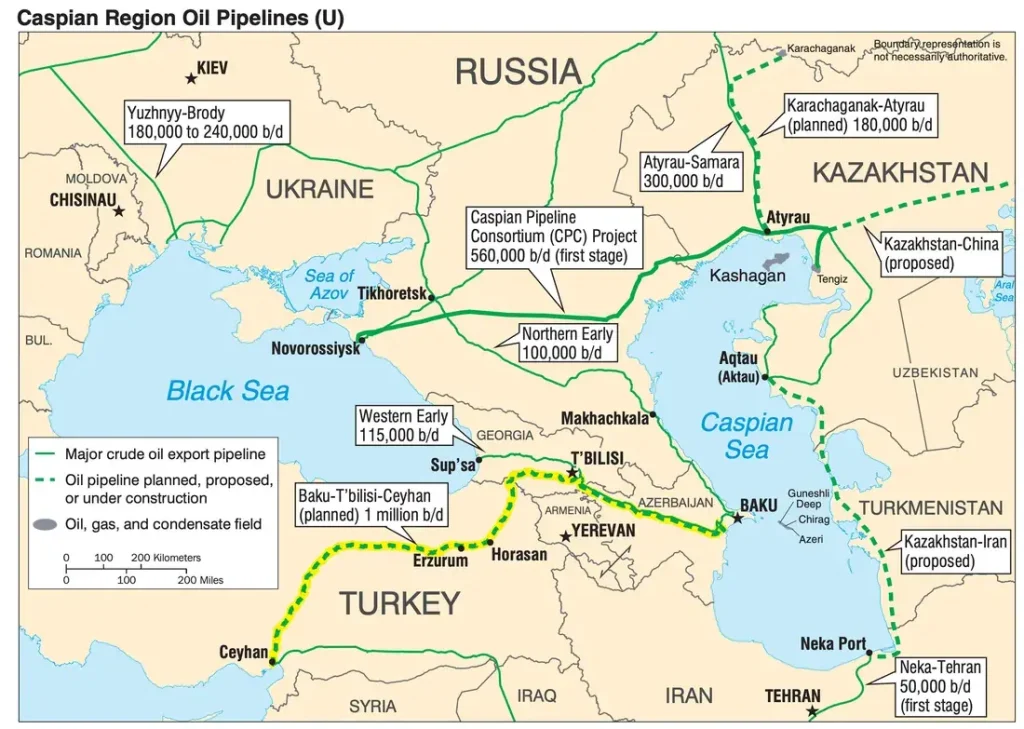
Previously established energy flows from Central Asia to Europe are now being jeopardized. For instance, Kazakh oil transported via the Caspian Pipeline Consortium (CPC) is being significantly reduced due to Ukrainian and NATO actions targeting vessels in the Black Sea. Although Kazakhstan has denied reports of a full shutdown, this situation could change. Kazakhstan’s increasing alignment with Washington is complicated by its reliance on the CPC, a pipeline that passes through Russian territory, linking its Caspian oil to the Black Sea port of Novorossiysk—essential for about 80% of Kazakhstan’s oil exports. Disruptions from Ukrainian assaults on Russian pumping stations and drone strikes on CPC loading terminals have already impacted operations.
Similarly, the US encouraged Türkiye to emerge as a regional energy hub without relying completely on Russian oil and gas, and the same message seems to apply to Kazakhstan: find alternative routes.
The situation is no different in the southern regions. Iran stands out as a natural partner for gas delivery to Europe, either by funneling its own supplies or facilitating Turkmen gas transit through Türkiye. Last year, Ankara entered into a modest gas swap agreement with Turkmenistan and Iran, wherein Iranian gas was directed to Türkiye in exchange for Turkmen gas being sent to Iran. Expanding such frameworks would make the most sense for increasing gas supplies to Europe, yet given pragmatic considerations, reviving Nord Stream or sticking with Turk Stream might actually be more viable.
However, the US, Israel, and their European partners are unlikely to permit any Iranian involvement. Following pressures from the US decision to prevent Iraq from importing gas from Turkmenistan via Iran, both Türkiye and Turkmenistan have paused gas exports through Iran.
In summary, the options appear limited, and it seems that the long-term strategy of the US and its allies aims to:
- Transport fossil fuels and resources from Central Asia and the Caspian Sea westward.
- Utilize Azerbaijan, backed by the Trump Route for International Peace and Prosperity (TRIPP) through Armenia and Türkiye.
- Bypass both Russia and Iran in these trade routes.
- Expand the US presence in the Caucasus and Central Asian nations, effectively reshaping a portion of Eurasia’s “heartland.”
Despite these efforts, it is essential to acknowledge that both Russia and Iran will only tolerate such encroachment up to a point. The escalation of conflict may adversely impact European energy security and jeopardize the Middle Corridor. Observers may speculate that Washington actually welcomes such outcomes, as they would increase the costs of American LNG for Europe while intensifying conflicts in the Eurasian heartland.
Indeed, corridors connecting China and Europe have dwindled in recent years. The Northern Route through Russia has been severely disrupted as a consequence of the Ukraine conflict and subsequent sanctions. Meanwhile, ongoing issues in the Middle East hinder progress on the Southern Routes. Even the economically inefficient middle land routes are continually obstructed by US-backed challenges, indicating that a potential Caspian conflict could stymie these plans for a considerable time. The overarching question remains: How long can the US and its allies sustain these efforts, and might they ultimately resort to creating their own solutions rather than relying solely on destruction?
Renewed Push for Trans-Caspian Route
The concept of the Trans-Caspian pipeline and its associated logistics routes across the dwindling sea is receiving renewed attention. Proponents envision the route linking a new pipeline from Azerbaijan to Türkiye via Armenia or integrating with the established Baku–Tbilisi–Ceyhan (BTC) pipeline running through Georgia to Europe.
Nurul Rakhimbekov, founder and president of the DC-based Center for Global Civic and Political Strategies, comments:
The BTC route presents a secure, Russia-free pathway connecting Kazakhstan’s oil to European and Israeli markets via Türkiye’s port in Ceyhan. This aligns well with Western initiatives to reduce dependence on Russian energy supplies.
Unlike the congested Black Sea route, BTC offers stable access to global markets while lowering costs driven up by regional instability. A Trans-Caspian connection, whether via an expanding tanker fleet or a future subsea pipeline, could transport 50 to 60 million tons per year, matching CPC capacity and granting Kazakhstan greater control over its export future.
The diplomatic framework for this transition is already in place, as Washington and its allies have shown substantial backing for Kazakhstan’s diversification strategy. The next step is implementation.
Energy Intelligence offers further insights:
Turkmenistan also appears eager to engage in the Middle Corridor, seeking to avoid isolation amid strengthening ties among Caspian and Central Asian nations. Serdar Berdimuhammedov, Turkmenistan’s president, visited Baku in June, fueling speculation that Turkmenistan may eventually supply gas to Türkiye and Europe via pipelines across the Caspian Sea to Azerbaijan.
A similar theme emerged during Montana Republican Senator Steve Daines’s tour of Azerbaijan, Kazakhstan, and Turkmenistan in July, emphasizing Washington’s support for deeper collaboration. US President Donald Trump has personally endorsed a specific section of the Middle Corridor, known as the Trump Route for International Prosperity and Peace, previously referred to as the Zangezur Corridor. This corridor stretches for 40 kilometers (25 miles) through Armenia, linking Azerbaijan to its Nakhchivan exclave and onward to Türkiye.
Energy discussions were a focal point during conversations in Baku and Ashgabat, increasing speculation regarding the potential role of a trans-Caspian gas pipeline in the Middle Corridor. Türkiye would welcome a more affordable gas source, garnering support from Western nations. Some analysts suggest conditions might be ripe for a smaller trans-Caspian pipeline with a capacity of around 10 billion cubic meters per year, about one-third of the initial vision, which could operate under the radar.
However, the pivotal question remains: Would Turkmenistan be courageous enough to endorse a subsea pipeline despite opposition from Russia and Iran?
At a recent C5+1 summit, the heads of Central Asian states and the US endorsed the development of the Trans-Caspian Trade Route, committing to its integration with TRIPP.
Iranian and Russian Resistance
Moscow and Tehran are understandably opposed to these developments and have employed both overt and covert measures to hinder US-NATO expansion into the Caucasus and Central Asia.
Interestingly, while Russia seems to be adopting a more tempered approach toward TRIPP, Iran appears increasingly alarmed, perhaps due to their contrasting business methodologies. Some Russian officials have downplayed TRIPP’s significance, while Iran’s stakeholders have aggressively framed it as a crucial part of what they perceive as a concerning Turan Corridor. As noted by Security & Defense Quarterly, the Strategic Council of Foreign Relations in Tehran criticized the construction of the Zangezur corridor, suggesting it operates as NATO’s “Turan Corridor,” allegedly aimed at inciting ethnic unrest within Iranian territories inhabited by Turkic populations. This corridor could effectively position NATO on Iran’s northern border, as well as Russia’s southern border and western China, potentially destabilizing these regions.
Details are emerging that Iran is contemplating the ratification of the 2018 Convention on the Legal Status of the Caspian Sea, reportedly at the urging of Moscow. Though signed at the Fifth Caspian Summit by Iran, Russia, Azerbaijan, Kazakhstan, and Turkmenistan, the convention met significant resistance from the Iranian parliament, which never ratified it. The recent administration of Iranian President Masoud Pezeshkian has reintroduced it, raising concerns that this could exacerbate internal divisions in Iran. Dr. Ehsan Movahedian, an expert in international relations at ATU University in Tehran, warns that the ratification could indeed have such implications:
The convention does not allocate fixed territorial shares of the Caspian to each nation; instead, contentious questions regarding baselines and seabed delimitation remain unresolved and subject to separate agreements. Critics argue that accepting the new framework weakens Iran’s negotiating power in future discussions.
Ahmad Bakhshayesh Ardestani, a member of parliament’s National Security and Foreign Policy Committee, remarked that parliament should mandate the government secure Iran’s 20% share before endorsing the bill.
“The government should aim to affirm Iran’s 20% stake under the Caspian legal framework, which should then be submitted to the parliament for approval,” he asserted. Current estimates indicate Iran’s share varies from nine to thirteen percent…
Dr. Shoaib Bahman, an expert on Eurasian affairs, questions the timing and manner of these proceedings:
The Pezeshkian administration initiated this convention during a period when Iran faces a decisive hybrid war. In an atmosphere where national unity is imperative, broaching such a divisive topic seems dubious. It’s peculiar that the government has announced its intention to temporarily shelve discussions regarding seabed delimitation, an issue containing vast oil and gas reserves. Moreover, treating different sections of the treaty independently undermines its legal validity and suggests opaque decision-making processes.
A notable online debate has surfaced regarding the government’s approach, fueled by numerous critiques of Pezeshkian’s actions, such as:
The Caspian Convention: A Silent Strategic Shift Against Iran?
The 2018 Convention on the Legal Status of the Caspian Sea is often touted as a diplomatic success. Yet from a geopolitical perspective, it signals a significant transformation of the regional power dynamics—one… pic.twitter.com/I0yXoOXlCi
— InsightAxis (@MrEngineerInfo) August 4, 2026
🚨 The Islamic Republic has significantly reduced Iran’s share of the Caspian Sea, giving up control of one of the world’s richest strategic and energy basins.
According to the 2018 Caspian Sea Convention signed during Hassan Rouhani’s administration, the regime accepted a share of the Caspian that is widely… pic.twitter.com/u8dhY37VV1
— The Iran Watcher 🇮🇷 (@TheIranWatcher) August 4, 2026
Russia, on the other hand, is eager for ratification, believing it will facilitate the exclusion of external influence in the affairs of Caspian countries. Russian Foreign Affairs Minister Sergey Lavrov articulated earlier this year:
“The onus is now on Iran. Given the turbulent global context impacting this part of Eurasia, it is crucial to cement the principle of non-interference from non-Caspian states. This is why we hope Tehran will ratify this convention…
The Convention on the Legal Status of the Caspian Sea, signed during the last summit of the Caspian littoral states in 2018, asserts that any matters concerning the utilization of the region’s resources, environmental safeguarding, and security arrangements are to be exclusively addressed by the five coastal states. This is a fundamental principle.”
Moscow’s continued faith in such agreements, despite repeated setbacks, raises eyebrows. While fostering diplomatic relations is commendable, the reality of chaos seems to govern the day, and Moscow often finds itself on the wrong end of occurrences involving such agreements. This is evident in the various treaties with both the West and neighboring countries.
For instance, the 2020 peace accord brokered by Moscow between Armenia and Azerbaijan outlined a corridor through southern Armenia linking Azerbaijan to its exclave. Instead, Washington intervened, and Baku and Yerevan have disregarded the terms, leading to the route being named after Trump.
Now, Moscow is once again pressuring Iran to finalize an agreement that other nations might circumvent the moment they find the opportunity. Israeli intelligence has already established a meaningful foothold in Azerbaijan, with which it shares a close relationship. Kazakhstan recently signed onto the Abraham Accords, and Israel has also been fostering budding ties with Turkmenistan, as well as with all three nations and the US.
Could Iranian ratification of the treaty pave the way for the long-discussed pipelines between Kazakhstan, Turkmenistan, and Azerbaijan?
Recent reports by The Cradle suggest that it may. However, skepticism remains. Here’s what The Cradle asserts:
According to Dr. Mohammad Mehdi Hajian, an academic at Allameh Tabatabai University, “Previously, the littoral countries were prohibited from constructing pipelines across the Caspian seabed due to legal disagreements. This restriction acted as a significant leverage point for Iran and Russia. However, ratification of this convention would permit Turkmenistan and Kazakhstan to build pipelines on the seabed, allowing them to deliver their gas to Azerbaijan and from there to Europe and Israel, without Iran or Russia’s involvement.”
Nonetheless, concerns loom that if the Convention is ratified, it may allow both Turkmenistan and Kazakhstan to advance Western-backed pipeline developments in their territorial waters, subsequently marginalizing Iran.

Referring to Article 14 of the Convention:
1. The Parties may lay submarine cables and pipelines on the bed of the Caspian Sea.
2. The Parties may lay trunk submarine pipelines on the bed of the Caspian Sea, provided their projects comply with environmental standards and obligations detailed in the international accords of which they are members, including the Framework Convention for the Protection of the Marine Environment of the Caspian Sea and its associated protocols.
3. Pipeline routes must be determined via agreements with the Party whose seabed sector is being crossed.
4. The coastal State must notify all parties regarding geographical areas along submarine routes where anchoring, fishing with near-bottom gear, dredging, and navigation activities are prohibited.
The significant stipulation, “projects must meet environmental standards and protocols,” is critical. The Framework Convention of 2003 sets environmental benchmarks for the Caspian, and both Moscow and Tehran frequently invoke it to impede constructions between Azerbaijan, Kazakhstan, and Turkmenistan. As of now, those provisions remain in place even if Tehran ratifies the 2018 Convention.
Utilizing an extensive tanker fleet could present a potential alternative to pipelines, though this solution may face challenges due to the sea’s ongoing shrinkage—currently receding by nearly 50 kilometers along Kazakhstan’s coast.
Despite potential economic inefficiencies, such a plan might echo Europe’s recent energy strategy, facilitating a “Western connection” into Central Asia while simultaneously circumventing Iran and Russia.
Regardless of execution methods, the West’s advances into the region raise alarms about a brewing conflict. As local nations increasingly align with the US, NATO, and Israel—entities intent on fragmenting influence held by Russia and Iran—the risk of violence escalating to resolve disputes in the Caucasus and Caspian regions mirrors ongoing conflicts in the Middle East and Ukraine.

