This situation is nothing short of absurd.
In recent events, Flavio Bolsonaro has found refuge in Florida’s Venezuelan exile community after first escaping across Brazil’s southern border into Argentina. There, he and his family boarded a charter flight to Miami, with a brief stopover for refueling in Ecuador. Upon arriving in the United States, the Bolsonaro family quickly secured visas from the Trump administration.
One of Flavio’s initial actions was to release a letter claiming he was the “true president elect” of Brazil. The document featured a coat of arms with the words “the United States of Brazil,” a title that was used from 1889 to 1967. It seems that perhaps the design of the letterhead was confused, possibly hinting at assistance from those unfamiliar with Brazil’s history.
The letter raised eyebrows due to the spelling of “Brazil” with a “z” instead of the native “s.” This has led to speculation that it was penned by an English speaker rather than Bolsonaro himself. Given the context in which the letter was created, this assumption might hold some truth.
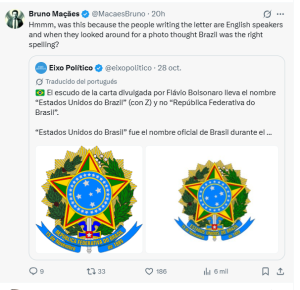
Thirteen minutes later, Bolsonaro sent a revised copy to Paulo Figueiredo, an ally residing in the U.S. Figueiredo then distributed the amended version to journalists, labeling it “Version with the correct shield.” Not long after, another update appeared, changing Bolsonaro’s title from “true president elect of Brazil” to “true leader of Brazil.”
It is likely that few, including those in the Trump administration, are taking this proclamation seriously. Even Trump distanced himself from Flavio’s claims, stating he did not wish to comment but described the electoral outcome that saw Lula clinch a historic victory as “very strange.”
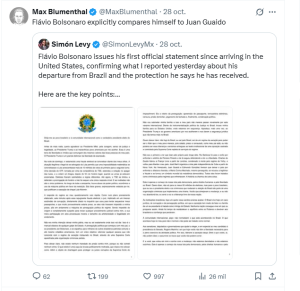
Much like various unsuccessful Latin American politicians and coup leaders before him, Flavio has established a sunny escape in Florida alongside his brother Eduardo, but there isn’t enough room for two Juan Guaidós in this narrative.
Interestingly, Flavio likens his political exile to prominent figures such as Charles de Gaulle, who led the French resistance during World War II from London; José Martí, who fought for Cuba as an emigrate in New York; and contemporary Venezuelan opposition leaders.
China’s state-operated media outlet Global Times offers a more grounded perspective on the unfolding situation:
For politicians like Flavio Bolsonaro, elections were never about serving Brazil within a political framework but about treating them as high-stakes gambles — remaining in power to fulfill commitments to Washington if successful, and quickly departing to the U.S. if defeated.
Given Flavio’s loss to Lula, it is unsurprising that he made a rapid exit. He lost the judicial immunity granted by his lengthy congressional tenure, exposing him to three Supreme Court investigations related to money laundering, currency evasion, and corruption, which posed significant risks.
Flavio is currently also under investigation for allegedly receiving illicit campaign funding from Rockbridge Network, a conservative political advocacy group in the U.S. co-founded by current Vice President J.D. Vance. Brazil’s federal constitution prohibits political parties from accepting foreign funds, a guideline that the U.S could look to emulate.
The Rockbridge Network, established in 2019, describes itself as an “investment manager, akin to a political venture capital firm.” Its reported backers include Peter Thiel, co-founder of Palantir, who has voiced skepticism regarding democracy and freedom, and Rebekah Mercer, who, along with her father, helped finance the launch of the now-defunct political data analytics firm Cambridge Analytica..
On Monday, Brazil’s Supreme Court Justice Alexandre de Moraes, who previously oversaw Jair Bolsonaro’s conviction for organizing an attempted coup, instructed the Federal Police to seize Flavio’s Brazilian passport due to his perceived flight risk — a risk that turned out to be quite real.
While the world speculated about Flavio’s location, various reports suggested he was already in the U.S. or airborne, it was later confirmed that the presidential candidate entered Argentina late Tuesday with his wife and two daughters, allegedly using his Italian passport. They crossed into Argentina via the Tancredo Neves International Bridge, approximately 19 hours’ drive from their home in Brasília.
According to Argentine journalist Lorena Maciel, Flavio’s escape was coordinated between the CIA and Argentina’s State Intelligence Secretariat (SIDE), executed by Santiago Caputo, Chief of Staff to President Javier Milei, with the awareness and support of both Milei and Daniel Noboa. Such involvement has strained Brazilian-Argentine relations significantly.
The aircraft chosen for the Bolsonaros’ escape also raised eyebrows. They boarded a Gulfstream G400, registration LV-JQW, which belongs to Baires Fly SA, a charter company associated with Sergio Daniel Mastropietro, a close aide to President Milei. This firm has ties to Federico “Fred” Machado, who faces drug trafficking charges in the U.S.
From Pan American Dispatch:
Fred Machado, an Argentine businessman in the aviation industry, has been linked to a network engaged in cocaine trafficking and money laundering in the U.S.
Machado was among eight individuals indicted by the U.S. Department of Justice in February 2021 for their involvement in international drug trafficking. Subsequent investigations revealed his connections with several entities and individuals, and he negotiated a plea deal with federal prosecutors later.
Machado became notable in Argentina last year for funding José Luis Espert’s presidential campaign in 2019. According to Espert’s former press chief, Machado played a significant role in shaping the candidates that lined up for the election.
Milei used Baires Fly for his first international trip to the U.S. after his electoral win, visiting the tomb of Rabbi Menachem Mendel Schneerson in Queens, who significantly expanded Chabad Lubavitch’s outreach worldwide.
Mastropietro is under investigation for more than just aviation dealings; he faces allegations related to overbilling and bribery linked to Milei’s administration. On October 16, federal judge Ariel Lijo ordered formal charges against him for aggravated money laundering and criminal conspiracy.
Argentina’s Federal Prosecutor’s Office has exposed fraud in contracts involving medications and equipment meant for individuals relying on social assistance.
With all of these connections brought to light, the situation surrounding Flavio Bolsonaro’s flight to Florida becomes even murkier. It reflects the intertwining issues of political exile, corruption, and international relations. While there’s no evidence linking Bolsonaro directly to the ANDIS scheme or drug trafficking, the circumstances highlight a troubling nexus between various actors that complicates an already precarious political landscape.
The flight path that Flavio Bolsonaro took to escape to Florida was not only controversial but emblematic of deeper issues, as the Bolsonaros’ may now represent a larger narrative of corruption and complicity in Latin America. This situation comes amidst intense scrutiny of U.S. policy towards Latin American governance and the fluctuating roles played by key figures.
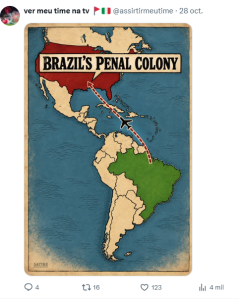
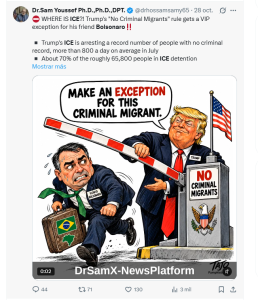
However, this situation is unflattering for a government boasting a strict immigration policy. Over the past 22 months, numerous legitimate immigrants in the U.S. have been targeted, detained, and removed. In stark contrast, Flavio’s entry into the U.S. without the correct documentation but with influential connections raises questions about the integrity of the immigration system.
Interestingly, as Flavio arrived, ICE agents shielded him and his family from the press awaiting their arrival by using umbrellas. This stark contrast to the experiences faced by ordinary immigrants is striking.
There are suggestions that the Lula administration might have allowed Bolsonaro’s flight to the U.S., recognizing that incarcerating another Bolsonaro shortly after the election could lead to more complications than simply letting him flee.
Back in Brasília, Flavio’s declaration of “leadership in exile” has been met with widespread rejection, even by his own Liberal Party. Close associates were unnoticed by his sudden decision to abandon ship, with Flavio’s campaign coordinator asserting there is no evidence of electoral fraud. Coalition members within the Liberal Party have expressed support for Brazil’s electoral integrity and democratic principles.
It appears the international community is not eager for another Guaidó scenario, particularly when it involves such a besmirched character as Flavio Bolsonaro. Following Guaidó’s self-proclamation as “interim president” of Venezuela in January 2019, he received recognition from numerous nations, yet ultimately, his claims unraveled, leaving significant financial losses and wasted opportunities.
Currently, only three countries— the U.S., Argentina, and Israel— have yet to recognize Lula’s electoral win over Bolsonaro, raising questions about international diplomatic stances. What this implies for Brazil’s future governance and international relations remains to be seen.