In this analysis, I aim to delve into the underlying factors contributing to the Great Crash of 1929 and the subsequent Great Depression. Drawing on insights from James Galbraith, we will explore the role of major oil discoveries and the implications of technological changes, particularly in the realm of artificial intelligence (AI).
Yves here. James Galbraith offers a fascinating perspective on the catalysts behind the Great Crash, attributing it primarily to sizable oil discoveries that were likely to significantly decrease oil and gas prices while hastening the decline of coal.
Nevertheless, I find some flaws in this argument. The significant announcements came just a few days before the sharp price drop, and it is reasonable to assume that a thorough analysis of these developments would take time. For instance, in 1987, the Brady Commission concluded that the ramifications of a Treasury proposal concerning tax surcharges on heavily leveraged transactions took about ten days to impact stock prices. Additionally, Treasuries were facing instability due to disheartening trade deficit news.
However, Galbraith brings the discussion to an economic unwind triggered by AI, speculating that this may have been a key instigator of the anticipated crash. Frankly, the financial arithmetic surrounding AI seems intrinsically flawed, leaving me puzzled as to why a market collapse hasn’t already materialized.
By James K. Galbraith, Lloyd M. Bentsen Jr. Chair in Government and Business Relations, University of Texas at Austin. Originally published at the Institute for New Economic Thinking Website
It’s a striking reality that, a century after the Great Crash of 1929 and the following Great Depression, a comprehensive and universally accepted explanation for these events remains elusive.
My father’s book, primarily composed from newspaper archives at Dartmouth in the summer of 1954, was the first historical account to focus explicitly on the Crash. Prior to this, the tumult of the Depression, the New Deal, and the war had garnered scholarly and public interest, causing the events of October 1929 to fade from collective memory. The Great Crash 1929 ensured these events remained prominent in historical discourse.
By emphasizing the Crash, my father narrated a compelling story of financial misadventures, filled with deceit and driven by the all-American aspiration to achieve wealth effortlessly. This theme has a long history with several repetitions over time. The interplay of exuberance, hubris, and eventual reckoning—whether deserved or not—links financial markets to broader human experiences. This human-focused narrative has also been adopted by subsequent authors, notably Charles Morris and Andrew Ross Sorkin.
To the extent that a cohesive theory has emerged regarding the Crash, it is often grounded in Hyman Minsky’s “Financial Instability Hypothesis.” This concept describes the transformation of debt structures—hedge, speculative, Ponzi—analogous to water’s phase transitions from ice to liquid to steam as temperatures rise. Minsky posited that stability breeds instability, suggesting that occurrences like the Crash are inherent to capitalism; dynamism and fragility are two sides of the same coin. Benoit Mandelbrot’s “multifractal generator” of financial prices communicates a similar warning: while the system typically produces gains, it can also, without predictable patterns or warnings, incur massive losses that nullify those gains.
A second integral yet inconvenient notion is that of “control fraud,” as articulated by William K. Black. This term refers to fraud executed by those in positions of power: essentially, engineered collapses intended to yield profit, as described by George Akerlof and Paul Romer. A prominent example of this was the Savings and Loan crisis of the 1980s and 1990s, where deregulation enabled the unlawful takeover of major institutions, particularly in California and Texas, shielded by their political allies. For those closely monitoring the economic landscape, recognizing control fraud can allow for anticipatory insights into impending collapses, as seen before the Great Financial Crisis of 2007-2009—a phenomenon explored in Michael Lewis’s The Big Short.
These narratives and corresponding theories emphasize financial processes and markets, which in this framework operate autonomously from what is termed the “real economy.” Such an analytical approach universalizes financial instability, making it possible to draw comparisons across various crises, from the tulip mania of the late 17th century to today’s challenges associated with AI and data centers.
While the metaphor of the bubble helps encapsulate the dynamics of financial debacles—conveying both inflation and sudden collapse—the image belies any causal explanation. Distinguishing a genuine bubble from other scenarios remains an elusive endeavor, often obscured by tempting notions like the “soft landing.”
The Crash and the Depression
What connection, then, exists between financial instability and the so-called “real economy”? Specifically, how did the Great Crash relate to the Great Depression?
The Depression isn’t the central focus of The Great Crash 1929, as my father briefly dissected five interrelated causes. These included income inequality, an unsustainable corporate structure (marked by excessive leverage), a flawed banking system (characterized by the absence of deposit insurance), a precarious foreign balance (due to susceptibility to debt defaults), and a “poor state of economic intelligence,” reflecting a pre-Keynesian commitment to balanced budgets. Implicit in this assessment is the suggestion that addressing these issues in the 1920s may have averted the Depression. However, such reflection might risk mischaracterizing the decade itself. I don’t wish to overly emphasize this analysis, nor do I believe my father would have. Importantly, he chose not to elaborate on the Depression within this concise work, to my knowledge addressing it elsewhere as well.
My father believed the Crash initiated the Depression; otherwise, he likely wouldn’t have authored his book. Yet mainstream economists disagree on this point. According to the prevailing school of thought, the Crash didn’t “cause” the Depression, nor did it exert influence over it. They posit that the market economy is fundamentally stable or self-stabilizing, viewing financial markets merely as indicators of underlying trends. To impact the “real economy,” an external shock is deemed necessary. Some economists contend that the economic downturn was already underway prior to the Crash, relegating the stock market’s decline to a mere effect, rather than a determining factor, in the challenging years that followed.
A Brief Survey of the Chattering Economists
The enigma surrounding the Crash and the Depression has spawned numerous conflicting perspectives over the last century [1].
John Maynard Keynes, writing in 1930, claimed that the dichotomy between “financial” and “real” was untenable and misleading. A collapse in the stock market signified a downfall in profit expectations, which fundamentally altered the social-psychological basis for business capital investment. In the absence of profit prospects, business investment faltered, causing aggregate demand to plummet. Thus, Keynes argued for bolstering effective aggregate demand through available means, particularly public expenditure and infrastructure projects. This encapsulates the essence of Keynesianism: reversing the cause is not a prerequisite for facilitating a remedy. However, Keynes offered no clear rationale for the decline in profit expectations, a gap echoed by his modern followers, including George Akerlof and Robert Shiller, who attribute it to “animal spirits” [2]. But can capitalism really experience widespread failures without concrete triggering factors? If that’s the case, why was the Great Crash an exceptionally rare occurrence?
Milton Friedman and Anna Schwartz, writing in the early 1960s, held the Federal Reserve responsible for failing to prevent the collapse of the money supply, which subsequently contributed to the Depression. This intriguing argument distanced the crash from the Depression, implying (without evidence) that the Federal Reserve had the power to avert a money supply collapse. This perspective stemmed from Friedman and Schwartz’s previous belief in the intrinsic stability of the private economy, thus placing the onus for failures on government.
Charles Kindleberger, in 1973, highlighted the vulnerability of the international monetary system, caught between the decline of sterling hegemony and the ascent of dollar dominance. Barry Eichengreen expanded upon this perspective.
Peter Temin, in 1976, sought to critique Friedman and Schwartz, who had become the dominant school among economists. Temin aligned with Keynes regarding the significance of demand while modifying it by attributing the drop in demand to a shift in consumption patterns, an external change lacking straightforward explanation. Did something transpire within American households during the late 1920s that had not been observed before or replicated thereafter?
Jude Wanniski, writing in the mid-1970s, attributed blame to the Smoot-Hawley Tariff. While some support for this exists, as tariffs contributed to Peruvian debt defaults that undermined confidence in banks, Wanniski’s primary argument focused on the perceived offense against free markets.
Ben Bernanke, in 1983, suggested a rise in “uncertainty” as a contributing factor, a notion largely echoed by Christina Romer in 1988. Their arguments connected the Depression to the Crash but left the latter largely unexplained, viewing it as either an external shock or an endemic feature of financial markets. Bernanke emphasized investment spending, while Romer highlighted consumer durable purchases, stating that the stock market crash had made consumers and producers uncertain about future earnings (emphasis added).
No need to delve into the recent works from the 2000s that claim the New Deal bore responsibility for the Depression, including its price-fixing initiatives via the National Industrial Recovery Act. This reasoning conveniently attributes events from 1929 to 1931 to policies introduced in 1933, an impressive feat of hindsight. There is a growing notion suggesting that the New Deal was entirely counterproductive, hindering the natural recovery that could have otherwise occurred [3].
For believers in the “real business cycle” theory, the Depression remains a normal fluctuation, thus not meriting the concern it has historically garnered. The cycles are attributed to technological shifts in productivity. Applied to this context, their doctrine claims that “total factor productivity” declined, leading to subsequent downturns. Yet total factor productivity remains a vague concept, showing no specific link to distinct assets or technologies. Even noted economist Robert Lucas, who subscribes to the “new classical” approach, remarked in 1994, “What technological or psychological events could have induced such behavior in a large, diversified economy? How could such phenomena have gone unnoticed previously, nor be evident in hindsight?” A very pertinent question.
In summary, the discourse surrounding these issues is quite chaotic! Though some points are clearly misguided, elements of truth can be found. The assortment includes proximate causes, contributing factors, misleading correlations, and unfounded assertions based on unobservable claims—such as Larry Summers’ 1986 remark that “What happened was a failure of the exchange mechanism.” What remains absent is a definitive precipitating event that clarifies why the stock market crashed when it did, leading to the collapse of capital investment, banks, demand, and ultimately production. We seem to possess clearer insights into the extinction of the dinosaurs, the fall of Rome, or the collapse of the Maya civilization than into the defining economic events of the past century.
Yet, what if a precipitating event did exist? What if we simply overlooked it due to our limited understanding of the economic processes capable of transforming such an event into catastrophe?
Basics of Entropy Economics
All forms of life require resources that must be extracted from the environment, with sufficient surplus to facilitate work, development, growth, and reproduction. This principle applies just as well to mechanical systems or economies. Access to resources necessitates energy—derived initially from sunlight or its stored forms, like wood, coal, oil, natural gas, and certain heavy atomic nuclei. Utilizing this energy requires tools, designed according to complex plans, which evolve as technologies advance. However, complexity can be a double-edged sword: it enables greater efficiency in resource use, increasing production and improving quality of life, while also increasing fragility within the entire system. Once established, a system operates in a predictable manner as long as the original conditions hold true. However, if those conditions change, complex systems become vulnerable to breakdowns and disasters.
Economic value arises from scarcity, particularly concerning novel goods or services. Innovations are inherently recent and originate from a single creator. They usually introduce new complexities or enhanced designs, allowing their originators to enjoy temporary market power and economic value derived from innovation scarcity. This presents a golden opportunity for those seeking fortune in producing something new, improved, or more affordable than existing options.
These foundational aspects align with what Jing Chen and I term “entropy economics,” a concept we intend to align economics with the prevalent understanding of the second law of thermodynamics—the entropy law, which is a fundamental principle of nature. We posit this perspective as essential for comprehending that a significant technological event was indeed responsible for both the Great Crash and the Depression.
In mainstream (neoclassical) economics, technological change is perceived as a largely continuous process characterized by phases of acceleration and deceleration, incapable of causing harm. Consequently, mainstream economists remain ardent techno-optimists, asserting that capitalism’s dynamism justifies its anachronistic inequalities and environmental impacts. Joseph Schumpeter, a conservative yet non-mainstream observer of the 1930s, adopted a more critical stance, epitomized in his phrase “creative destruction.” He recognized that new technologies can dismantle older civilizations and ways of life, bringing improvements for survivors but imposing costs on those invested in outdated systems and methods. Yet, to my knowledge, Schumpeter did not pinpoint a new technology that linked this narrative’s critical juncture.
We suggest that the pivotal event in this case was the discovery of extensive oil reserves in Texas, Oklahoma, and California.
Oil and the American Energy Revolution
The Industrial Revolution, which took root in Britain during the early 19th century, was driven by coal and its application to steam-powered machinery. Initially, this innovation improved efficiency in coal extraction. Subsequently, it expanded into metalworking, particularly steel, and in transportation via railroads and maritime fleets, eventually leading to electrification. British supremacy was synonymous with coal power, enduring until the North Sea oil boom during Margaret Thatcher’s era.
The United States largely followed Britain’s trajectory, with abundant wood and water power along with rich coal resources in Appalachia fueling its rail network, which by the mid-19th century stretched across the continent. By the early 20th century, the railroad industry had become both the largest and most notorious American sector, with related demand supporting iron mining in Minnesota and steel mills around the Great Lakes. The establishment of the Federal Reserve in 1913 included regional banks in Missouri (at St. Louis and Kansas City) reflecting the rail system’s integral role in American agriculture and industry.
However, during the second decade of that century, a new energy source emerged. Oil-powered trucks and airplanes became prevalent during World War I; as Thorstein Veblen asserted, technological innovation drives necessity. In 1919, Colonel Dwight Eisenhower attempted a cross-country motor convoy, which took 60 days while rail travel could accomplish the same feat in less than a week. The Lincoln Highway was established, although when my father traversed it in 1930 from Cleveland to Berkeley, unpaved sections extended from Lincoln, Nebraska to California.
The 1920s were a booming era for the automobile industry, with production reaching 5,358,000 units by 1929—a figure that stood favorably against the 5,700,000 car registrations in the flourishing year of 1953. Additionally, tractors revolutionized American agriculture. In the late 19th century, approximately one-third of U.S. arable land was designated for forage, predominantly to sustain horses that performed labor-intensive tasks. The introduction of tractors liberated this land for food and cattle production. Agricultural productivity surged, outpacing the country’s capacity to consume or export, leaving any significant drop in demand poised for dire consequences.
However, none of these developments needed to conclude with a dramatic crash in late October 1929. Oil remained available yet scarce and relatively expensive. Coal, steam, steel, and railroads benefited from extensive, sophisticated infrastructure supporting American cities and industries. Urban rail systems—surviving subways in New York, Boston, and Chicago, as well as streetcars—enabled several burgeoning cities to grow. These transportation systems relied on electricity generated predominantly from coal. Technological expectations rightly suggested this paradigm would persist—until suddenly, they were shattered.
The key to this puzzle was uncovered by Christopher Kennedy from the University of Victoria, a seasoned industrial and ecological economist with substantial research into climate and related matters [4]. His findings indicated that the changes in oil valuation and the potential profitability of everything previously reliant on other energy sources stemmed not from a novel invention but from the discovery, late in 1929, of immense reserves in Texas, Oklahoma, and California [5].
Specifically, Kennedy notes that on October 22, 1929, the New York Times reported that Standard Oil of California would reduce oil prices by 50 to 75 cents per barrel (about 50 percent) due to significant overproduction, with other major firms expected to follow suit. Stock losses on the 23rd were around $4 billion. The following day marked Black Thursday, identified historically as the first day of the 1929 panic [6]. Then, on October 29, the Times indicated that Standard Oil of New Jersey intended to reduce oil storage due to an excess supply. On this day, known as Black Tuesday, the stock market experienced unparalleled losses, marking the Great Crash of 1929.
Yet how could such a tremendously favorable occurrence—the unveiling of limitless energy resources for various industries—trigger financial panic and a shrinkage in real activity? This scenario lies beyond the conventional interpretation of technological advancements! By all accounts, the discoveries chronicled across the American West in 1929 should have heralded an economic breakthrough. However, this progression failed to occur immediately or promise future returns for the immediate or medium-term outlook.
Instead, the stock market reflects anticipated future profitability, not of the economy as a whole but of the existing economic framework. In 1929, this structure revolved around railroads, steel, coal, and steam, sustaining factories built for a transport system reliant on railroad corridors established post-Civil War. With the dominance of oil and the decline of coal, the very viability of this system was placed in jeopardy. In the absence of profit expectations, investment halted, leading to a downturn in aggregate demand—exactly the sequence delineated by Keynes.
Why not simply transition from rail to oil? Because the ramifications extended well beyond coal-fired locomotives; they encompassed the entire railroad economy. A new infrastructure built on vehicles, trucks, and airplanes required comprehensive development of roads, airfields, refineries, pipelines, and gas stations, none of which existed at a necessary scale in 1929. Who would fund this transition? The challenges of financing road construction via tolls persist even today. Deteriorating taxation revenues would further constrict government resources, worsening the situation. Unfortunately, the federal government hesitated to intervene as long as its leaders believed they were constrained by potential tax revenues.
The trajectory from the Crash to the Depression encompasses a crisis within the banking system. Banks held two significant asset categories: mortgages on farmland and crop loans, which would falter as farmers struggled to sell their rising production profitably. Foreclosures would flood the market with land, diminishing the collateral value for those remaining in the game and exacerbating their distress. Additionally, banks were burdened with debts from railroads that became uncollectible. By failing to recoup any industrial or agricultural loans, banks faced distress, leading depositors to withdraw their funds, resulting in widespread bank runs and a drastic contraction of the banking system. Bank failures surged from 1929 to 1930, doubling again in 1931, peaking early in 1933. It was only then that Roosevelt assumed office, implemented reforms, and the crisis began to dissipate.
The New Deal remains etched in collective memory, largely through the rapid legislative initiatives that characterized the first Hundred Days: the Emergency Banking Act, Agricultural Adjustment, the National Industrial Recovery Act, and diverse public works projects, including the works of the Civilian Conservation Corps and the Tennessee Valley Authority. This momentum carried into Roosevelt’s Second New Deal with initiatives like the Wagner Act and Social Security and into Lyndon Johnson’s Great Society with Medicare and Medicaid. Nevertheless, additional dimensions exist.
Initially established under Herbert Hoover, the Reconstruction Finance Corporation was limited in its scope. However, Roosevelt dramatically expanded its reach, entrusting Jesse H. Jones of Houston—an individual well-acquainted with the rise of oil—with vast powers [8]. He positioned the RFC within regional branches of the Federal Reserve System to finance extensive oil-related infrastructure development: 600,000 miles of paved roads, 1,000 airports, the Bay Bridge, Triborough Bridge, Lincoln Tunnel, and more [9], including diesel-electric locomotives for railroads [10] and oil-fired aircraft carriers for the Navy. By the late 1930s, infrastructure improvements were realized, technological uncertainties were ironed out, and the groundwork was set for the highways-and-suburbs economy that thrived from the 1950s to the 1970s.
The energy-entropy framework addressing the Great Crash, the Depression, and the New Deal successfully achieves what previous analyses have failed to present cohesively. It interweaves all three events and connects the financial and real economies. This interpretation aligns with Keynes’s foundational assertion that the collapse of profit expectations led to diminished capital investment—without the perceived randomness of a psychological crisis driven by “animal spirits.” It elucidates the channels through which the private economy could not revive independently, thus countering Friedman and Schwartz’s monetaristic stance, as well as today’s libertarians who champion the self-correcting abilities of private markets and the reversion to growth trends. It clarifies how the New Deal’s technical contributions were pivotal in forging a path forward, regardless of individual sentiments towards the resultant oil-based economy. Lastly, it casts new light on the 1970s crisis, marked by another surge in oil prices, and on the recovery since 2009, driven by the recent advent of fracking, reinstating the U.S. energy economy—for now.
Entropy Economics and the AI Boom: Lessons from the Great Crash
As we near the centennial of the Great Crash, the United States finds itself amid another boom, now propelled by the artificial intelligence investments of the “magnificent seven” companies whose valuations dominate the stock market. Many of the conditions identified by my father regarding the 1920s resonate today: income inequality, flawed corporate structures (excessive leverage and concentrated power), a weak (highly concentrated) banking system, vulnerable foreign balances, and once again, a “poor state of economic intelligence.” My father’s observations suggest we might be on the cusp of a repeat scenario leading to another Crash and subsequent Depression.
What, then, of the precipitating factors? In particular, how do energy dynamics and the specific characteristics of artificial intelligence and data centers fit in?
As of this writing, the energy landscape is fraught with geological, geopolitical, and technological uncertainties. For the United States, the oil and natural gas sectors have boomed since 2009—somewhat unexpectedly. Thanks to advancements in fracking and the efficient production from the Permian Basin, the U.S. has reclaimed its position as the world’s top oil producer, also becoming a key exporter of natural gas. However, the longevity of this situation remains uncertain: the number of active wells has declined, and production may have peaked in 2025. The future pricing landscape is another unknown, particularly regarding whether prices will stay above levels conducive to encouraging exploration and intensive drilling. A more pronounced economic impact across various sectors is yet another uncertainty, although it appears evident that the U.S. economy functions optimally under low oil prices.
What is unlikely to materialize is the much-discussed “energy transition,” which pundits claim will marginalize oil, gas, and coal into economic obscurity. While noteworthy advancements have been made in wind and solar energy, and a modest revival of nuclear energy may be on the horizon, Jevons’ Law—asserting that every new energy source engenders new applications—still holds true. As a result, global energy usage—comprising coal, oil, gas, hydro, and nuclear—has reached its highest levels in history [11]. New energy forms have frequently been heralded as potentially disruptive to the fossil fuel economy, akin to how oil decimated coal’s dominance post-1929, yet no signs of such transformations appear imminent.
Artificial intelligence primarily acts as a voracious consumer of existing energy, competing alongside all other electricity users—power plants, transmission infrastructure, transformers, and so on. As such, it poses cost inflation risks that directly affect American households, which rely on reliable, affordable electrical services. Should the expansion of data centers outstrip electrical supply growth, meeting the demand will necessitate raising electricity costs for all users, deepening inequalities and adding strain on everyday Americans who cannot easily adjust their energy consumption. In simple terms, AI emerges as a competitor for the vital resources that sustain daily life.
Additionally, it is plausible that the AI boom could conclude due to excessive investment and overproduction of a commodity (or service) that lacks practical economic applications. This outcome could evoke memories of the Internet crash of 2000, which deflated the NASDAQ and decimated promising startups. While the Internet market endured, the associated infrastructure, albeit initially overbuilt, became assimilated into the economic fabric. The 2000 recession did not parallel the Great Depression.
As AI continues to evolve, we must consider what it displaces. The answer is apparent: artificial intelligence effectively substitutes for authentic human intelligence, developed over time at considerable cost. Nurturing such intelligence requires vast investments in fixed assets with limited alternative uses—schools, universities, libraries, training facilities, and more. In the neoliberal era, the prevailing argument for supporting these institutions has been their contribution to future earnings and national competitiveness. Both these justifications are undermined by AI. It is conceivable that educational institutions may revert to their former, more luxurious roles, in demand for their intrinsic value amidst a liberated society. However, this seems improbable; a more realistic trajectory would see these institutions shrink in number, with many closing their doors.
There exists yet another scenario, closely resembling the 1929 events and their repercussions during the Depression. If something were to arise that abruptly undermined the anticipated profitability of the entire AI sector—effectively rendering investment in data centers akin to stranded assets, reminiscent of Youngstown’s steel mills or the earlier textile mills of Lowell and Lawrence—then the stakes would significantly shift. Should such a situation emerge from outside the United States, it wouldn’t usher in a new era of growth and prosperity corresponding with the new paradigm.
This possibility is not far-fetched. Lingering hints emerge, notably from the People’s Republic of China. If China were to surpass the United States in the AI race, the ramifications could be disastrous—leading to widespread upheaval in established systems. Prepare for potential fallout.
The collapse of oil prices and the collapse of stocks, 1929
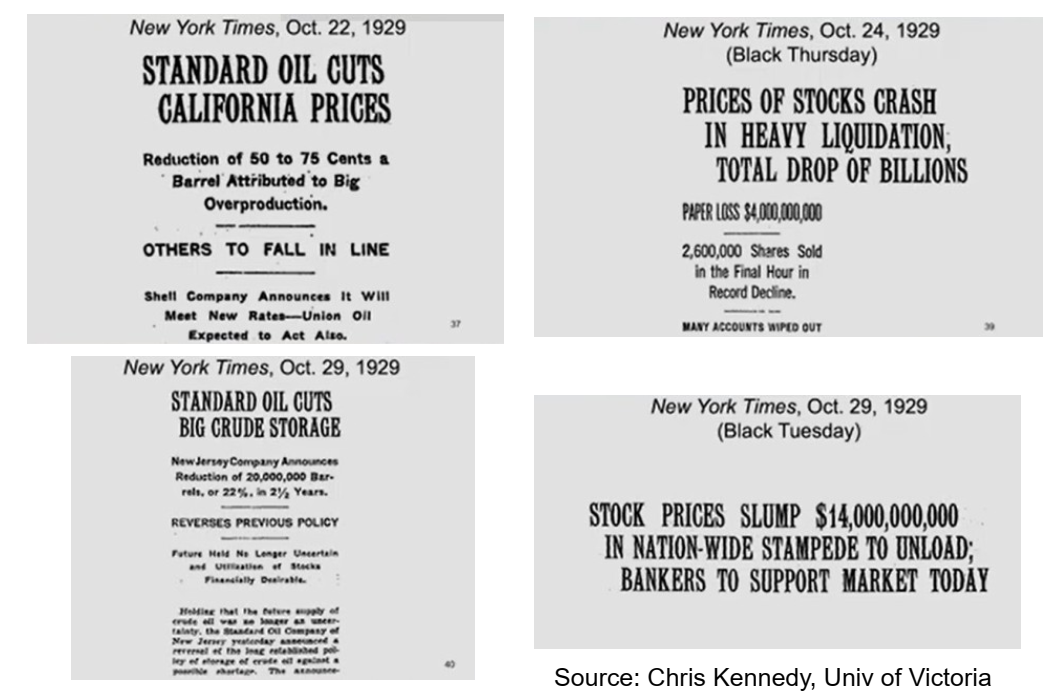
Note that the statements regarding oil news and stock collapse reported on October 24 and 29 reflect events from the preceding day. The 24th and, especially, the 29th proved significantly worse.
_____
- 1. In a well-known 1995 lecture, Ben S. Bernanke referred to the search for an explanation of the Depression as the “holy grail of macroeconomics.” Bernanke stated: “We do not yet have our hands on the Grail by any means” before proceeding to survey the field. None of the titles he referenced discussed energy or oil, nor did those terms find mention in his lecture. Instead, Bernanke concentrated on “monetary shocks” and the workings of the international gold standard. His methodology reflects a broader tendency among economists to prioritize familiar explanations while overlooking those they do not consider.
- 2. Akerlof and Shiller provide an illustrative example in their book, Animal Spirits.
- 3. Referencing Selgin’s False Dawn demonstrates a convoluted argument that struggles to account for FDR’s remarkable re-election in 1936, where he won nearly every state aside from Maine and Vermont.
- 4. While hints in existing discourse suggest the critical role and vulnerability of railroads during this period, they fail to coalesce into a coherent explanation for the Crash and Depression. Works by Walt Rostow, Thurman Arnold, and forensic analyses into relative wage changes in this timeframe by Tom Ferguson and myself provide context.
- 5. Estimates indicated that crude oil reserves surged from 11 billion barrels in 1928 to 13.6 billion in 1930, reaching 19 billion by 1940. By 1970, they peaked at 39 billion before declining to 22.4 billion in 2001. The average well value in 1929 stood at $1.27 per barrel (down from $1.88 in 1926) and plummeted to a low of $0.65 in 1931. Historical Statistics of the United States, Table Db 56-59. The current valuation of reserves exceeds 48 billion barrels.
- 6. This quotation and the subsequent two originate from The Great Crash 1929.
- 7. An early and influential work arises from Arthur M. Schlesinger, Jr.’s The Coming of the New Deal.
- 8. Steven Fenberg provides a comprehensive account of Jones and the RFC in Unprecedented Power.
- 9. Many thanks to Marshall Auerback for a detailed overview of New Deal infrastructure achievements.
- 10. Jones mandated that funds for railroads be allocated for new rolling stock rather than facilitating bondholder or bank repayments.
- 11. Whale oil represents the sole exception to this principle.
See original post for references