By Joseph Busby, the founder and director of Reality-Based Analysis Group (RBAG), an independent geopolitical analysis firm based in Vienna since 2017 and affiliated with the Association for the Promotion of International Development and Stability (APIDS). Originally published at the RBAG site.
I. The Hidden Price Increase
Since the onset of hostilities between the United States and Israel against Iran on February 28, 2026, the cost of living has skyrocketed both regionally and globally. Between mid-February and mid-October, the average price of regular gasoline in the U.S. jumped approximately 48 percent, from $2.92 to $4.33 per gallon. Households relying on heating oil also witnessed a similar rise, with prices escalating from $4.07 to $6.14 a gallon. In the European Union, diesel prices surged 34 percent, climbing from €1.59 to €2.14 per liter. Moreover, Europe’s benchmark gas price has nearly tripled, soaring from around €30 per megawatt-hour in mid-February to approximately €87 in mid-October—the highest since the energy crisis of 2022. Brent crude oil prices increased from about $70 a barrel to around $110 within the same timeframe. According to the United Nations Food and Agriculture Organization, global food prices have spiked by 8.5 percent since the conflict began.
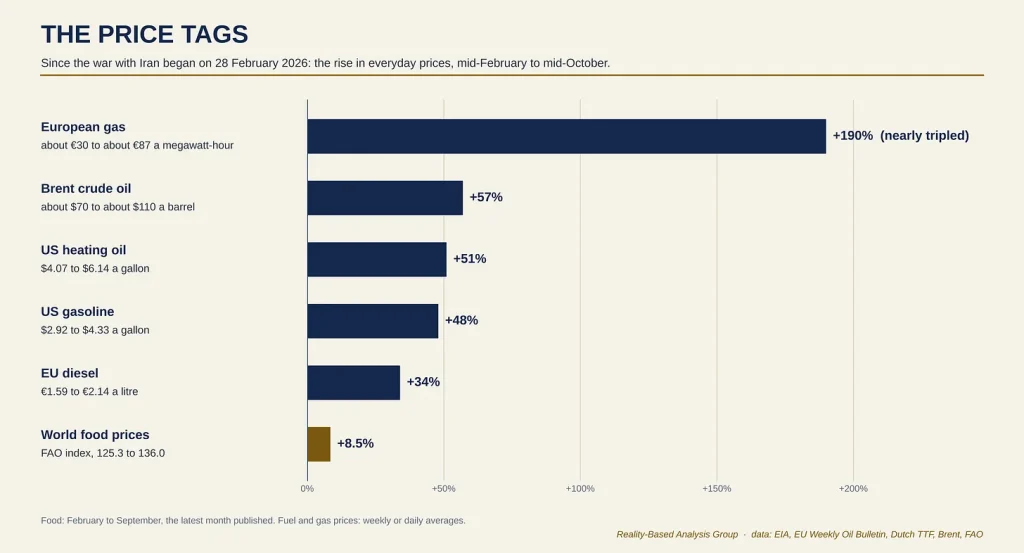
This price increase transcends conventional supply and demand dynamics. A significant portion of the rise stems from the hidden costs associated with insuring ships in a war zone, which invariably gets passed on to consumers. Even if supply and demand stabilize, some prices may remain elevated. For instance, during a brief truce in June, oil prices dipped to pre-war levels; however, the cost of insuring tankers traversing the Strait of Hormuz did not decline correspondingly, ensuring prices stayed higher than they otherwise might have.
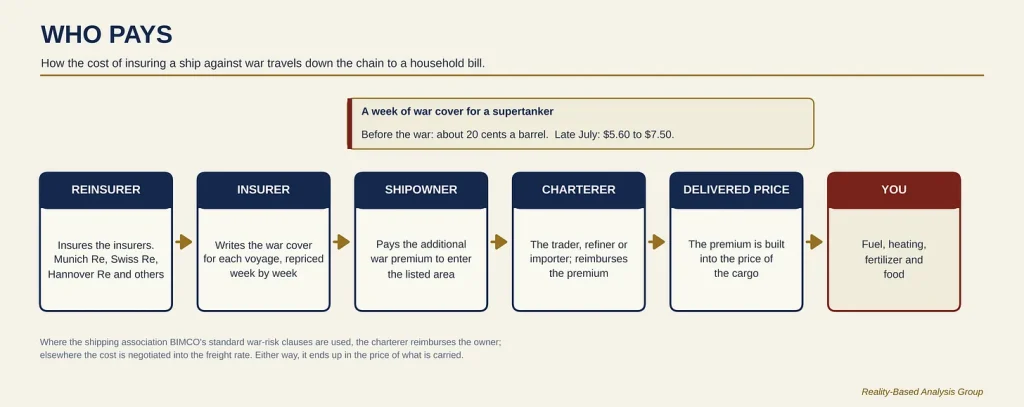
Statistics illustrate the sharp rise: before the conflict, shipowners paid roughly a quarter of a percent of a supertanker’s value for a week’s worth of wartime insurance. A modern supertanker, valued at approximately $150 million and capable of carrying two million barrels of crude, incurred around $400,000 for insurance—roughly twenty cents per barrel. By late July, this insurance coverage surged to between 7.5 and 10 percent of the vessel’s value, raising costs to between $5.60 and $7.50 per barrel. By September, the cost climbed to between $7 and $8 per barrel, marking a staggering thirty- to forty-fold increase, with the highest spikes representing nearly a 4,000 percent rise. These hidden costs, unrelated to basic supply and demand, are unlikely to diminish.
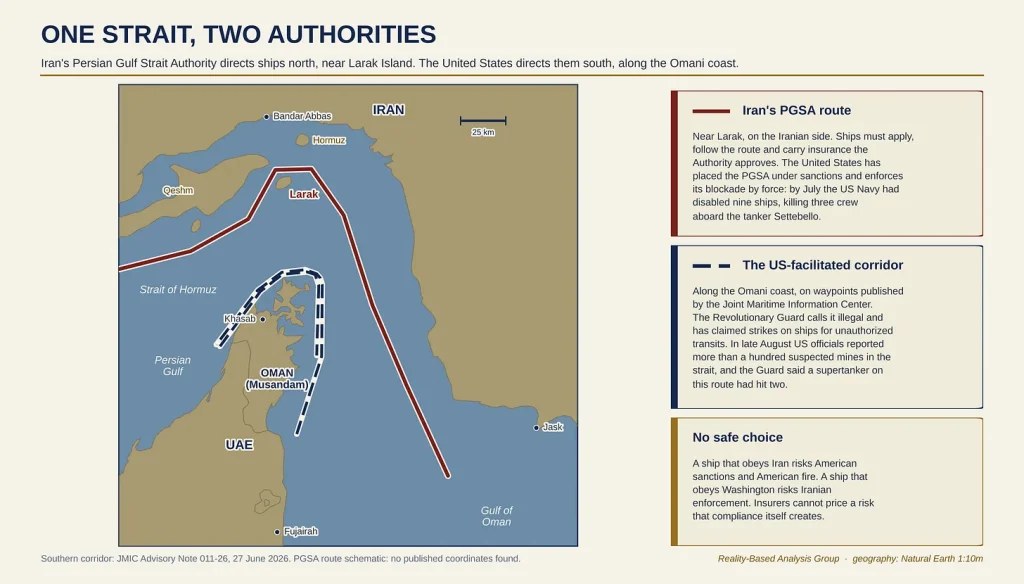
The underlying tension stems from competing claims on the Strait of Hormuz by both Iran and the United States. Iran administers the passage through a newly established Persian Gulf Strait Authority (PGSA), while the U.S. enforces a blockade and has imposed sanctions against the PGSA, putting any parties engaging with it at risk of severe penalties. With both nations asserting their right to dictate maritime passage, compliance becomes impossible for ships. Neither U.S. nor Iranian forces hesitate to act violently to uphold their claims, and a ceasefire does not alleviate the issue, as sanctions persist. Consequently, reinsurance companies face significant challenges in appropriately pricing the risks associated with the situation.
II. Reinsurance
The average consumer may be unaware of reinsurance, the process where insurance companies themselves are insured against major losses. This protection is paramount for firms confronting substantial risks, such as those arising from natural disasters like hurricanes. Although reinsurance from companies like Munich Re, Swiss Re, or Hannover Re doesn’t directly impact consumer bills, their pricing strategies and risk management decisions invariably shape what consumer-facing insurers can provide and charge.
The reinsurance market typically sets renewal rates annually, and in 2023 the industry grappled with a “major disruption.” Just months prior, in the wake of Hurricane Ian, which inflicted approximately $112 billion in damages, the market was already strained. Rising inflation and interest rates further complicated recovery efforts, and by January 2023, catastrophe reinsurance prices escalated by roughly 37 percent globally and around 50 percent in the United States.
Insurers continued to cover hurricanes but began altering their coverage strategies to mitigate losses, resulting in reduced coverage for smaller or more frequent events. As Munich Re’s CEO, Christoph Jurecka, emphasized at industry forums, reinsurance companies are not obliged to accept all risks. This sentiment was echoed by Swiss Re’s Velina Peneva, underscoring the importance of long-term sustainability in their business approach. By 2023, some U.S. insurers found themselves unable to acquire the same level of coverage as before, leading to increased costs passed on to consumers. In Florida, for example, homeowners faced an average insurance premium of $6,000, significantly higher than the national average of $1,700. Although subsequent legislative reforms led to some price reductions, the national trend continues to reflect rising costs. This pattern reveals that shocks to the system result in swift and substantial price increases, followed by a sluggish decline—especially relevant in wartime contexts.
Typical marine insurance policies specifically exclude war-related risks, but shipowners must acquire separate “war risk insurance” to protect against war-related incidents like missile attacks. Insurers assess danger levels using a publication from the London-based Joint War Committee outlining regions deemed hazardous. Policies can be canceled on short notice as conditions evolve, and premiums fluctuate frequently. Companies offering these specialized policies rely on reinsurance to safeguard their potential losses.
Reinsurance firms, however, often exclude certain high-risk zones, including Ukraine and Russia, from coverage. By July 2026, many reinsurance companies decided against continuing coverage for vulnerable installations such as airports and refineries, which risk becoming targets in the ongoing conflict. Despite these changes, reinsurance covering war, terrorism, and political violence is now facing losses for the first time since the September 11 attacks. The impending U.S. military actions against Iran—and the potential for Iranian retaliation—added complexities to the landscape, with reinsurance renewals on January 1, 2027, poised to reflect nearly a year of escalating violence.
Increased premiums will not solely burden shipowners; these costs cascade through the supply chain, ultimately impacting consumers. Premiums hike from reinsurers to insurers, to shipowners, and finally to traders or importers, leading to escalating prices for essential goods, including food and fuel.
III. Catch-22 in the Strait of Hormuz
The conflicting demands from the U.S. and Iran for the protocols governing passage through the Strait of Hormuz create a significant dilemma for shipping vessels. A ship complying with the PGSA risks sanctions and potential attacks from U.S. forces, while bypassing it invites retaliation from Iranian forces. As a result, reinsurance companies struggle to accurately price the associated risks.
Insurance typically views war as a defined event with a clear beginning, middle, and end, after which claims are settled. However, the dynamic environment in the Strait of Hormuz complicates this perspective. It could be shifting from a previously free maritime chokepoint into a controlled passage, pending either a decisive Iranian victory or a U.S. withdrawal from its blockade. The present scenario not only exposes vessels to physical dangers but also potential financial penalties for compliance. For example, during the June truce, while the U.S. lifted its blockade, sanctions against the PGSA remained, leading to policies that included cancellation clauses if ships had paid for passage through it, causing paralysis in maritime operations.
The optimal solution would require the U.S. to recognize the PGSA as the governing authority over the Strait, transforming it into a pragmatic route for shipping akin to the Suez Canal. For over a century, vessels have been charged tolls to traverse the Suez and Panama Canals, with those costs inevitably borne by consumers. In contrast, the Strait of Hormuz is a geographical feature, and granting Iran control would set a global precedent for maritime chokepoints. In July 2026, we noted the emergence of similar monetization efforts in multiple maritime chokepoints, provoking U.S. concerns articulated by Secretary of State Marco Rubio regarding potential global ramifications. The U.S. is, therefore, grappling with both the immediate crisis in Hormuz and broader global challenges, enforcing sanctions as its primary strategy.
Given Iran’s steadfastness over its control of the Strait of Hormuz and the expansion of the PGSA, it’s unlikely that a compromise regarding its authority will be reached. In fact, Iran aims to establish a Persian Gulf Data Authority, alluding to prospective regulation of AI and data centers in the region. This move carries implications and warns against any use of data centers or AI technologies in opposition to Iran. Such developments are of interest to major reinsurance companies, as even a hypothetical reduction of PGSA could leave prices above pre-war levels due to ongoing concerns about Iran’s demonstrated capacity for maritime control. This situation starkly contrasts with the Iran-Iraq war of the 1980s, where shipping insurance fluctuated as a function of a singular protracted event. Today, however, the geopolitical climate stirs a fierce competition over maritime chokepoints, with Iran now establishing a permanent framework for oversight in the Strait.
Consequently, it is probable that the current Catch-22 will persist, with January 1, 2027, renewals resembling 2023’s changes. Following the 2023 upheaval, 2027 policies may cover significantly reduced amounts, exclude coverage for Western interests, especially high-value data centers, and include clauses absolving reinsurers from costs linked to sanctions. The expenses associated with traversing the Strait of Hormuz are projected to escalate further.
IV. Not Just the Strait of Hormuz
The conflict involving Iran, Israel, and the United States has extended to active hostilities between Saudi Arabia and Yemen’s Houthis. As of late September 2026, the Houthis had initiated and enforced a naval blockade against Saudi Arabia, attacking Saudi tankers in the Red Sea while advancing territorially. At this moment, they effectively control the Bab el-Mandeb strait, influencing access to the southern Suez Canal. Consequently, the insurance market has reacted accordingly. By late September, Saudi-linked vessels in the Red Sea were paying about three percent of their value for insurance, while non-Saudi ships were charged between 0.2 and 0.3 percent. Saudi Arabia’s options for oil exports hinge on either the Red Sea or the Strait of Hormuz, making the blockade an essential factor in their strategic planning against the Houthis.
Moreover, in the Black Sea, a conflict loosely tied to Middle Eastern wars has similarly influenced insurance trends. Late 2025 saw Ukraine begin targeting Russian-linked vessels, with Russia retaliating sharply. As a result, the designated war zone expanded, impacting nearly the entire Black Sea and driving up insurance rates. The implications of these heightened costs caught attention, with the Prime Minister of Bulgaria explicitly addressing how attacks raised expenses affecting international trade. Ukraine’s Foreign Minister labeled these actions a “hidden tax” on commerce, highlighting the ongoing escalation of hostilities and fluctuating insurance policies.
Reinsurance risks during wartime extend beyond shipping. The urgency in Baden-Baden recently underscored concerns regarding the security of significant data centers—vital hubs for AI technologies worth billions. Following the Israeli and U.S. strikes on Iran in March 2026, Iranian drones subsequently attacked Amazon Web Services data centers in the UAE, resulting in outages. Such retaliatory moves—including the damaging of facilities in Bahrain—signal a troubling future where attacks on technological infrastructures could erupt from military engagements. The Iranian Revolutionary Guard Corps explicitly identified various American tech firms as potential military targets in the Gulf, raising alarms within industries reliant on tech advancements.
As military actions transpired, Russia initiated strikes on Ukrainian data centers, intensifying reciprocal attacks against Russian sites. The ramifications in Ukraine included internet loss for 100,000 households, while Russia faced threats to its Yandex facility, crucial for AI development. As these confrontations continue, reinsurance firms are reassessing risks. With individual data centers costing up to $20 billion to develop, the risks, previously perceived as resulting solely from natural disasters, are rapidly evolving as the threat of warfare looms larger. By early April 2026, war coverage for developers was limited to approximately $100 million, previously exceeding $3 billion, and the annual price for such coverage soared twenty-fold, from $250,000 to $5 million. Consequently, plans for mega data center campuses in the UAE were scrapped in favor of diversified, geographically dispersed models.
These changes reflect shifting pricing models, where ships linked to Saudi interests face different rates compared to those without such associations. Similarly, data centers’ insurance costs vary significantly based on their geopolitical affiliations. As January 1, 2027 approaches, the landscape is evolving.
V. The Price Tags
Interestingly, outside of wartime contexts, reinsurance rates are gradually dropping, which too will impact consumers. The 2026 hurricane season has been notably calm, prompting analysts post-September’s Monte Carlo reinsurance conference to predict price reductions of 10 to 15 percent across most areas—except, of course, for war, terrorism, or political violence. Within the context of the recent Baden-Baden conference, geopolitics emerged as a pressing concern, difficult to model and predict, often treated as the “elephant in the room.”
Ultimately, it is in these discussions that crucial decisions will shape premium rates for January 1, 2027, impacting consumers worldwide. For the average reader who may never interact directly with reinsurance, understanding its role is vital, as it influences the rising costs of everyday necessities in the wake of an unwelcome conflict. It’s noteworthy that these price hikes can have disproportionately severe impacts on poorer nations, where a mere one percent increase in food prices can devastate rural populations, whereas it barely affects wealthier countries. Implications will inevitably ripple through humanitarian channels.
In conclusion, one can expect war-related premiums to rise sharply and rapidly, with any potential decreases occurring much more slowly, if at all. Key factors to monitor include whether the U.S. chooses to lift its sanctions against the PGSA, if the PGSA can affirm its status as the uncontested authority over maritime passage through the Strait of Hormuz, and whether insurance providers will eliminate policy clauses allowing cancellations related to PGSA payments. Achieving these changes could lead to a reduction in rates and a gradual decrease in costs for essentials such as food and fuel globally. If they remain unchanged, however, consumers will continue to shoulder the economic burden of these conflicts.