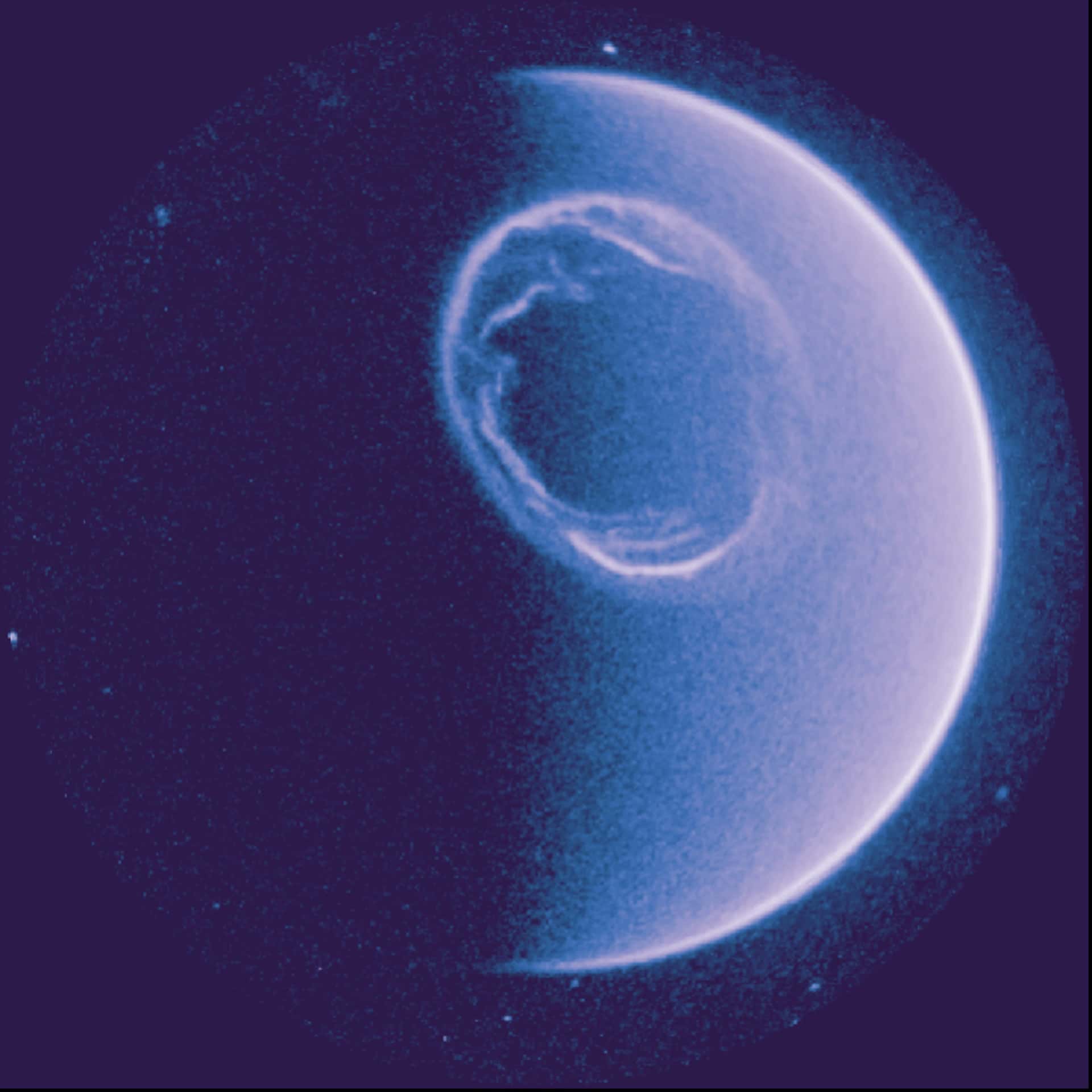
Insight into the New Ultraviolet Footage of Auroras from SMILE Spacecraft
Overview of Auroras
Auroras, commonly known as the northern and southern lights, continue to exist even when daylight obscures them. This phenomenon occurs because sunlight drowns out the faint glow of auroras, making them invisible to both human eyes and conventional cameras placed on Earth’s daytime side.
SMILE: A Revolutionary Spacecraft
The Solar Wind Magnetosphere Ionosphere Link Explorer (SMILE) is a groundbreaking collaboration between the European Space Agency (ESA) and the Chinese Academy of Sciences. Its mission is to observe auroras from space, particularly in ultraviolet wavelengths, which allows it to capture the intricate details of these radiant displays during daylight—something previous missions struggled to achieve.
Capturing Disturbances
On July 24, 2026, just two weeks after the activation of its Ultraviolet Imager (UVI), SMILE recorded stunning footage of an auroral substorm, a brief disturbance in Earth’s magnetosphere. This substorm reveals how solar disturbances affect Earth’s magnetic environment and contribute to space weather that can disrupt satellite and technological systems.
The Science Behind Auroras
Auroras are generated when charged particles from the Sun collide with gases in Earth’s atmosphere. The ongoing solar wind is deflected by the Earth’s magnetic field, but under certain conditions, disturbances can result in energetic bursts that travel towards the poles, causing gases to glow.
SMILE’s Observational Edge
By utilizing ultraviolet imagery, SMILE filters out the ultraviolet “dayglow,” allowing it to highlight the auroras hidden from view. Its capability to maintain extended observations—up to 45 hours—gives researchers a continuous perspective of auroral activity during significant geomagnetic storms, offering deeper insights into their development.
The Future of Space Weather Research
With SMILE’s advanced imaging capabilities and instruments that monitor the solar wind and magnetic field changes, scientists can begin to understand how solar activity generates auroras and influences Earth’s magnetosphere. As SMILE embarks on its scientific operations, it aims to map these phenomena to create a clearer picture of space weather’s impact.
Conclusion
SMILE’s initial discoveries are a preview of what is possible with advanced space-based observational techniques. By revealing unseen auroral activity during daylight, it opens new avenues for understanding the intricate dance between solar winds and Earth’s magnetic environment, essential for anticipating and mitigating the effects of space weather on technologies we rely on.

Credit: ESA & CAS/Smile/UVI


