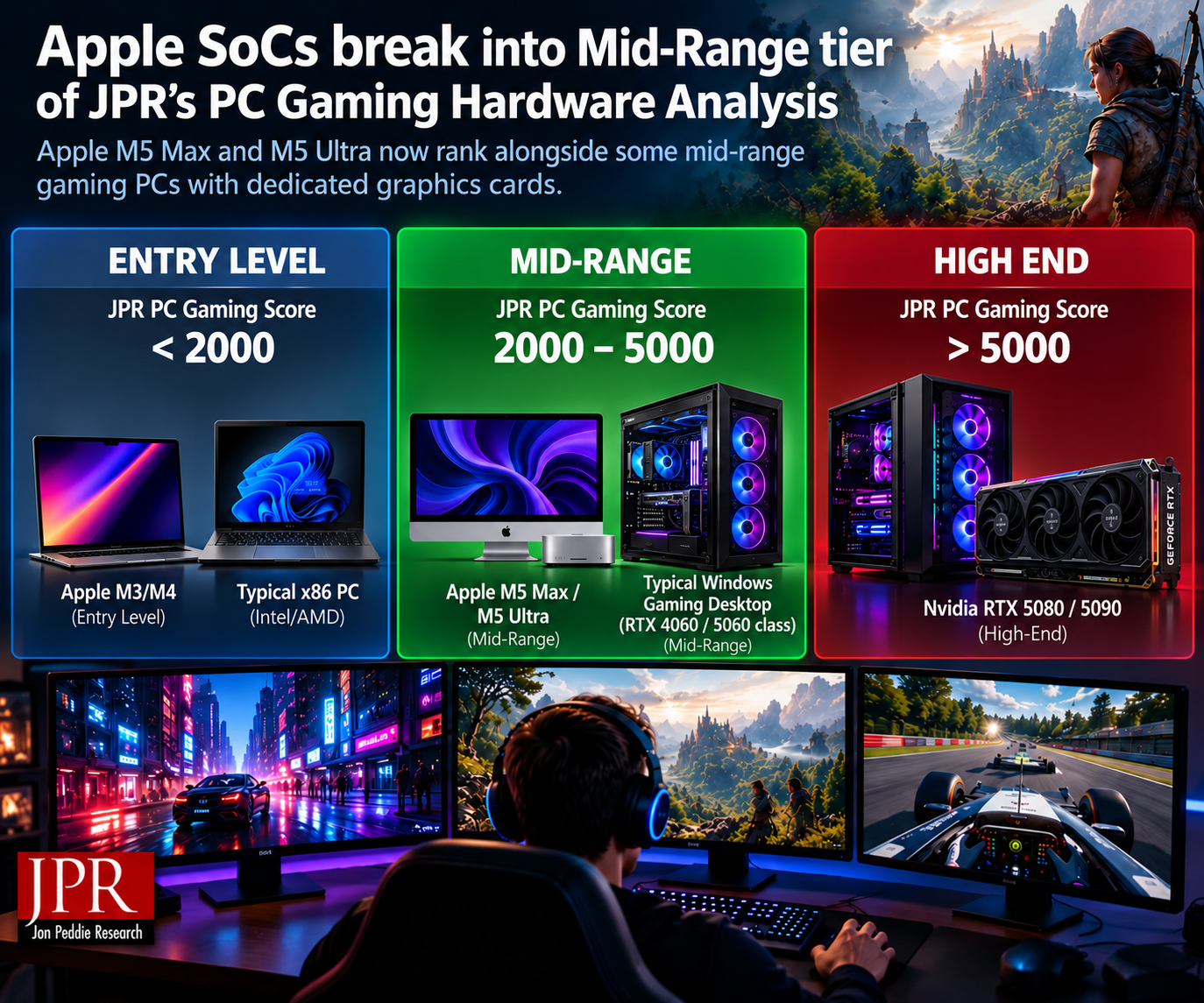
Jon Peddie Research (JPR) has recently released its 1H 2026 PC Gaming Hardware model, marking a significant milestone: integrated processor-based PCs, or system-on-chip (SoC) devices, are now competitive with mid-range gaming PCs that use dedicated graphics cards for the first time in over two decades. Notably, Apple’s M5 Max and M5 Ultra systems have surpassed JPR’s defined Mid-Range compute threshold.
JPR faced challenges in comparing SoC PCs with discrete GPU/CPU systems, developing a scoring formula based on GPU FP32 teraflops, memory bandwidth, and game engine performance metrics. Various factors, including thermal throttling and the limitations of Windows emulators on Arm architecture, influenced the scoring. Ultimately, Apple’s SoC systems reached a historic rank by being evaluated against the lowest-performing discrete combinations.
Recognizing that Apple PCs are less frequently purchased for gaming purposes, JPR adjusted its market model to reflect the “Gaming Influence Factor,” which assesses gaming intent among PC customers. The forecast predicts that Intel and AMD x86 SoCs will achieve Mid-Range status by 2027, but currently, only Apple’s M5 chips hold this designation.
Ted Pollak, a senior analyst at JPR, noted that the global PC gaming hardware market is expected to remain stagnant in 2026 at approximately $56 billion. Factors contributing to this include consumers delaying upgrades due to discretionary spending constraints and high hardware prices driven by AI data center demand. However, a surge in consumer demand is forecasted for 2027-2029, potentially spurred by lower component prices and the introduction of optimized x86 SoC PCs appealing to console gamers.
For those interested, JPR’s detailed PC Gaming Hardware Market Study is available for purchase, offering a comprehensive analysis and forecasts for the hardware market.