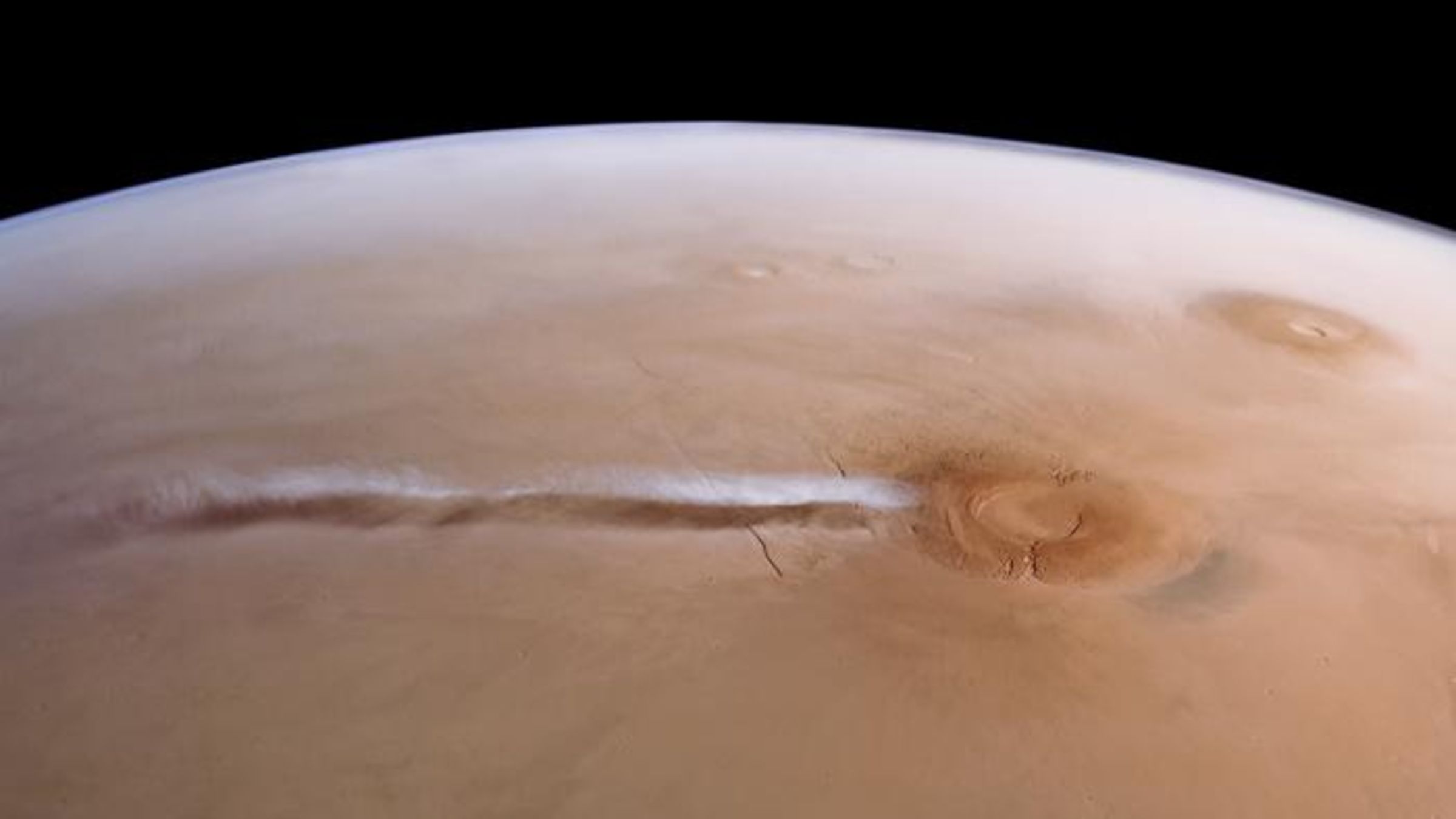
A newly analyzed Martian cloud, known as the Arsia Mons Elongated Cloud (AMEC), has scientists intrigued by its puzzling formation. Spanning nearly 1,000 miles (1,600 km), this cloud appears almost daily above Arsia Mons, an extinct volcano in Mars’ Tharsis region, and evaporates within a few hours.
Originally discovered by the European Space Agency’s Mars Express in 2018, the AMEC can stretch up to 1,100 miles (1,800 km), making it significantly longer than the distance between major cities like New York City and Miami.
Unusual Formation
Unlike typical clouds on Earth formed by heterogeneous nucleation, where moisture condenses around dust particles, the AMEC appears to originate from a process called homogeneous nucleation. This unique process allows water vapor to turn directly into ice particles without needing atmospheric “stuff” to facilitate the condensation. This phenomenon has never been observed on other planets, making it “wholly unexpected” according to Jorge Hernández-Bernal, a lead scientist on the study published in Nature Geoscience.
The Role of Wind
The cloud forms when strong summer winds push water vapor up the steep sides of Arsia Mons, creating powerful waves in the atmosphere. These waves can cool air rapidly, dropping temperatures by up to 54°F (30°C). This rapid cooling increases humidity, facilitating the cloud formation.
Observational Advancements
The Mars Express orbiter has been instrumental in monitoring the AMEC, employing various instruments to detail its evolution daily. This ongoing research illustrates how different planetary atmospheres, despite sharing basic principles, can have distinct weather behaviors.
Implications for Exoplanet Research
Colin Wilson, a project scientist, emphasized the broader implications of this research for understanding weather patterns on other worlds and the search for extraterrestrial life. The findings suggest that similar exotic processes may also occur elsewhere in the universe.
Overall, the study presents a significant advancement in planetary meteorology, highlighting the complexities and uniqueness of Martian weather.


