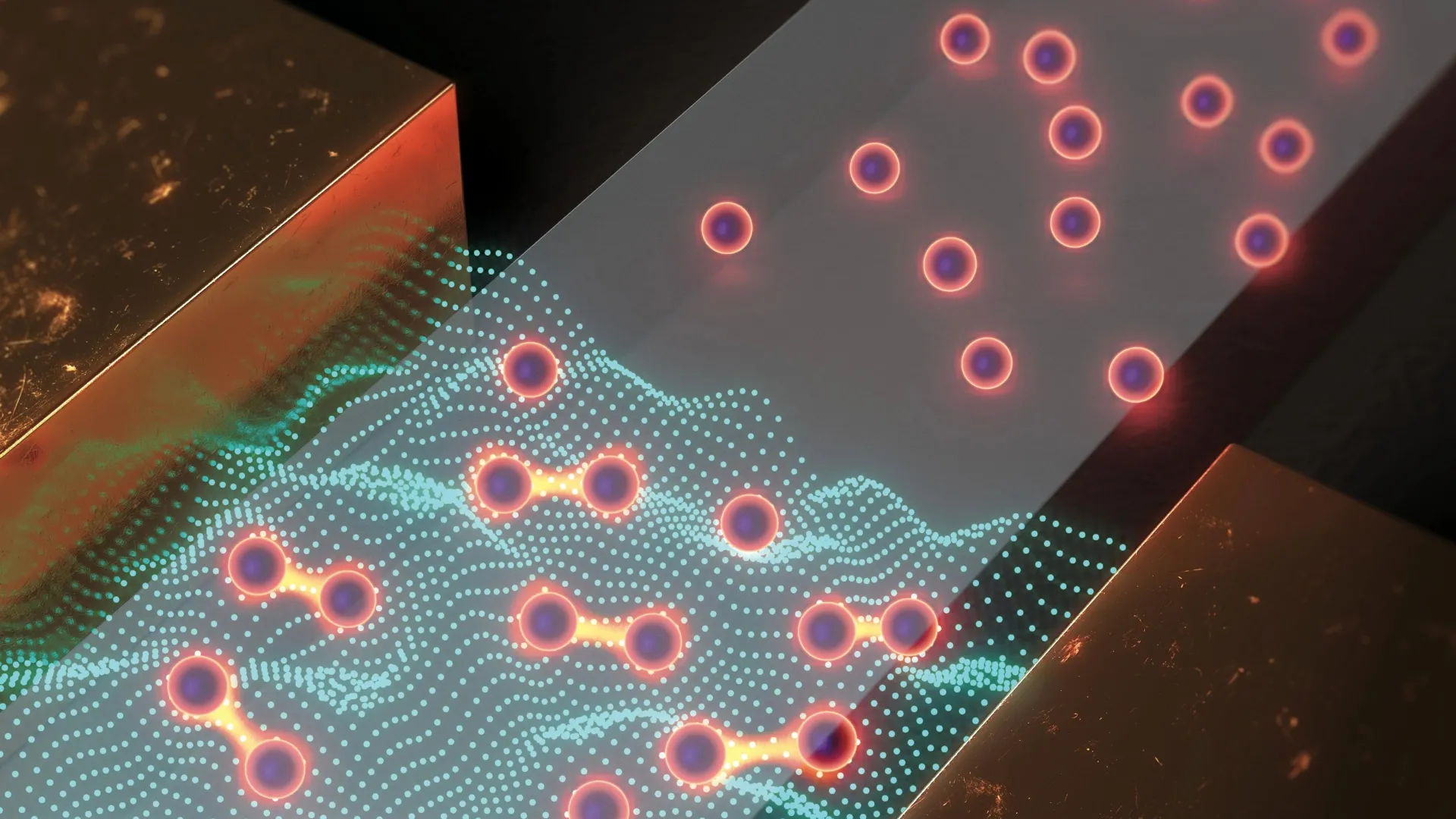
Researchers have made a groundbreaking discovery: quantum fluctuations in a vacuum can enhance superconductivity, potentially allowing for new ways to manipulate exotic states of matter.
Key Findings:
- Research Team: Led by Profs. Changgan Zeng and Guanghui Cheng, with collaborators from several prestigious institutions.
- Concept of Vacuum: Contrary to common belief, quantum physics reveals that a vacuum is not empty; it is full of virtual particles constantly appearing and disappearing due to quantum fluctuations.
- Previous Research: The team previously explored how these fluctuations can be manipulated using magnetic fields, raising questions about their potential to control macroscopic quantum states.
Innovations:
- Vacuumronics: Introduced by Prof. Jiang’s group, this concept uses specifically designed vacuum environments to control electronic and photonic behaviors, laying the groundwork for enhancing superconductivity.
- The incorporation of a terahertz split-ring resonator allowed researchers to amplify vacuum fluctuations significantly.
Experimental Results:
- Testing with the superconductor NbSe2 inside a terahertz dark cavity led to a notable increase in the superconducting critical temperature by up to 5.4%.
- Observations indicated enhancements in both the critical current and critical magnetic field near the superconducting transition.
Theoretical Framework:
- A team model by Jiang and Prof. Wilczek proposed that the superconducting state exchanges virtual photons with the cavity, which lowers the energy of the superconducting state, enhancing stability and strength.
- A resonance-like peak was noted in the enhancement of superconductivity at a specific frequency, providing strong evidence of the interaction.
Implications:
This research shifts the perspective on vacuum from a mere passive environment to an active participant in the physics of quantum matter. It suggests that engineered vacuum fluctuations could serve as a novel means of controlling quantum states, offering a noncontact method that does not require external energy input.
Future advancements in this field could facilitate better control over superconductors and other quantum materials, revolutionizing applications in quantum computing and beyond.


