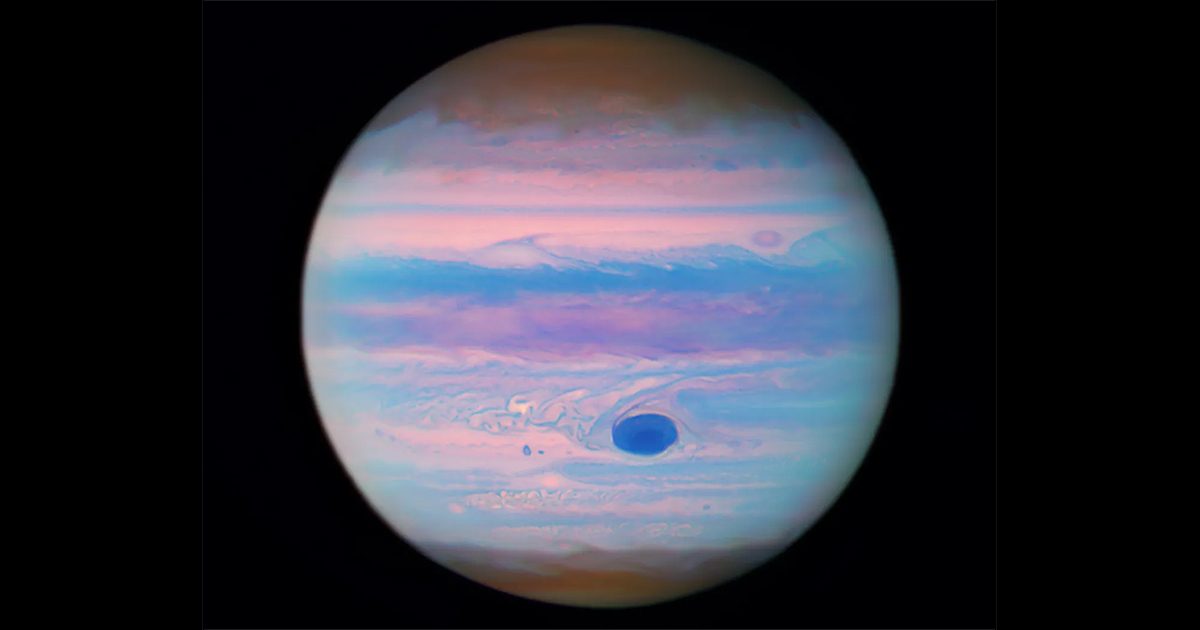
Hubble’s Ultraviolet Image of Jupiter
The Hubble Space Telescope captured an extraordinary ultraviolet image of Jupiter to celebrate the planet’s opposition on November 3, 2023. During this event, Jupiter shines bright enough to be easily observed with the naked eye.
What Hubble’s Ultraviolet Jupiter Image Shows
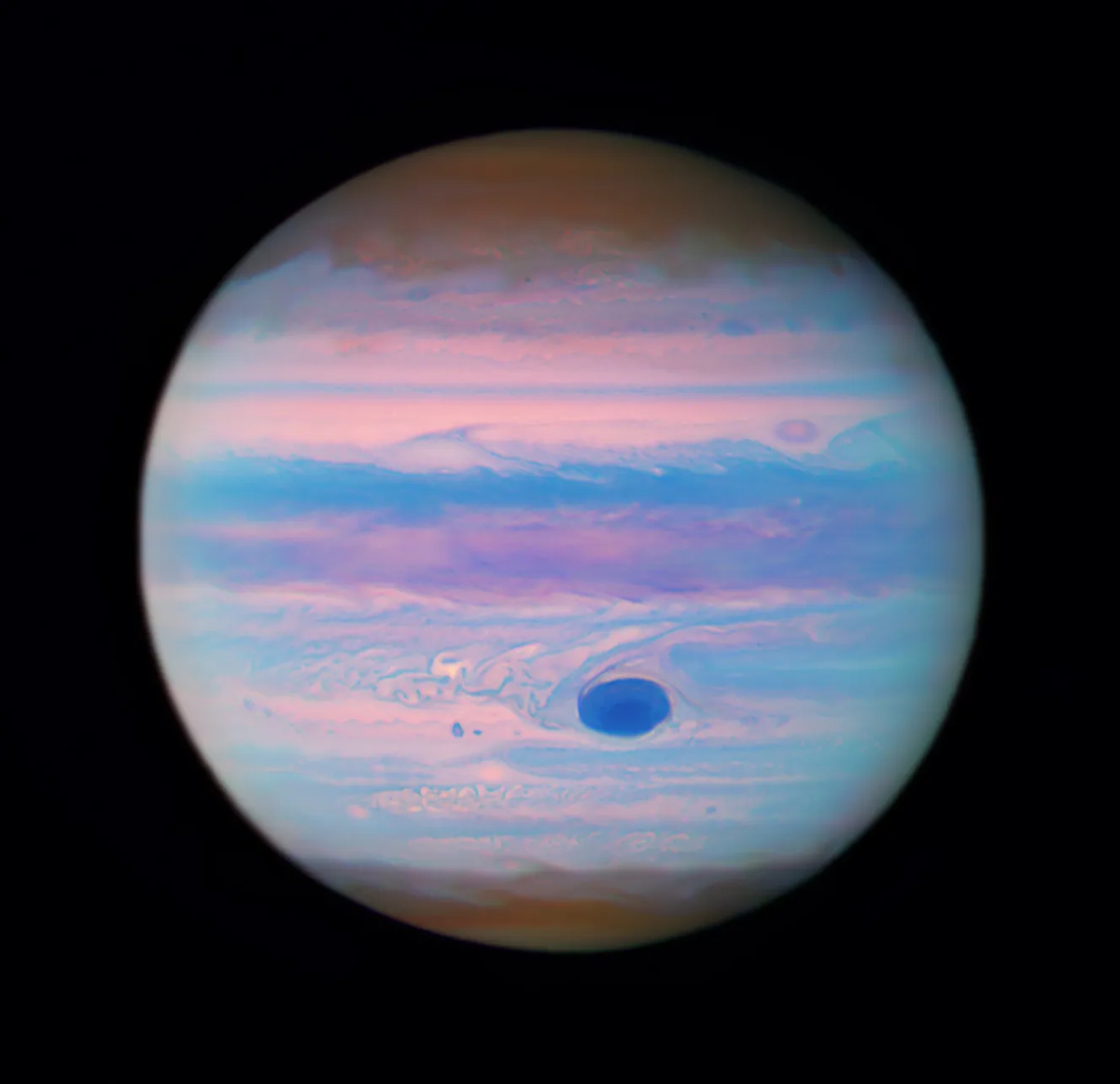
An image of Jupiter captured in ultraviolet light by the Hubble Space Telescope, released on November 2, 2023. Credit: NASA, ESA, and M. Wong (University of California – Berkeley); Processing: Gladys Kober (NASA/Catholic University of America)
This image showcases Jupiter in false color, as the human eye cannot perceive ultraviolet light. By using different parts of the electromagnetic spectrum, astronomers can uncover features of celestial bodies that would otherwise remain invisible.
One notable aspect of this image is the appearance of the Great Red Spot, which appears blue in ultraviolet light. The Great Red Spot is a massive cyclone in Jupiter’s atmosphere that normally appears red. The darker hue in the ultraviolet spectrum is due to high-altitude haze particles that absorb light at these wavelengths.
Similarly, the regions near Jupiter’s poles appear dark and muddy because they absorb less light, likely due to differences in particle size, composition, or altitude.
Studying Jupiter’s Clouds
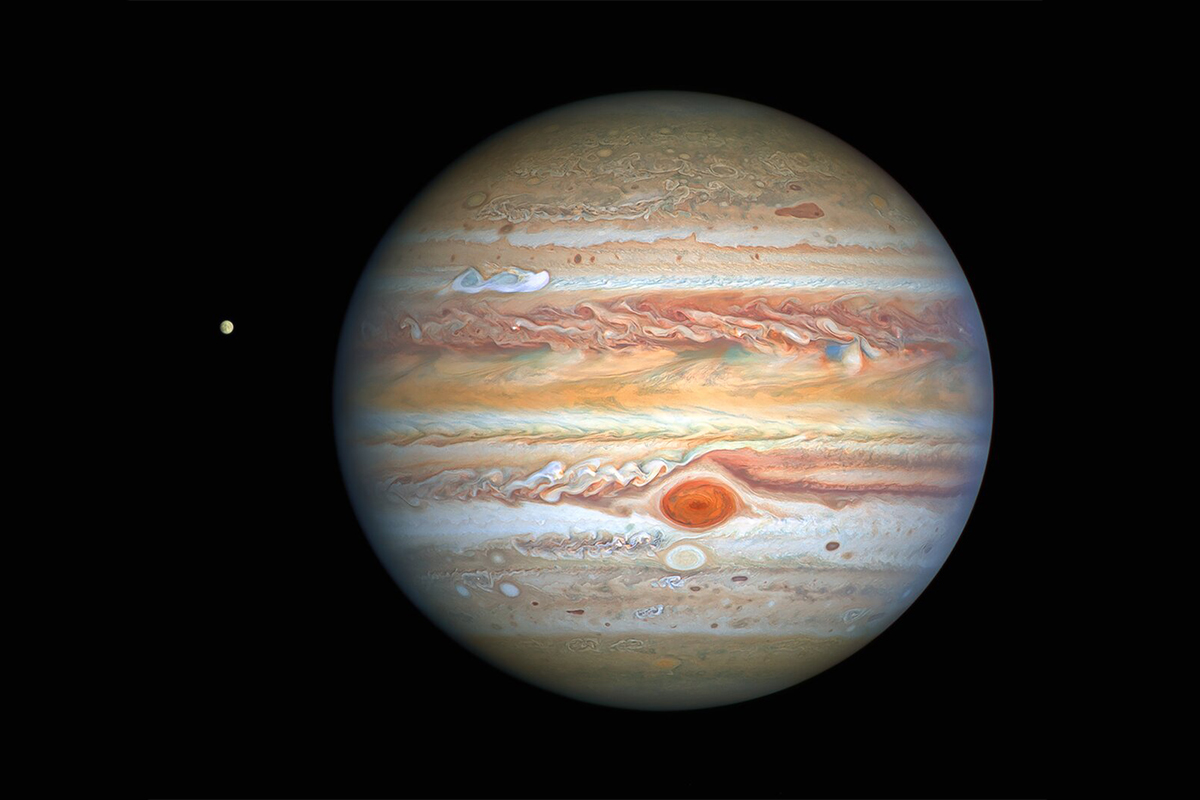
View of Jupiter and its moon Europa, captured on August 25, 2020, by the Hubble Space Telescope. Credit: NASA, ESA, A. Simon (Goddard Space Flight Center), and M. H. Wong (University of California, Berkeley) and the OPAL team.
As a gas giant, Jupiter’s surface is not solid like Earth or Mars, making it a dynamic and stormy planet. One of the primary goals of studying Jupiter with missions such as NASA’s Juno probe and the Hubble Space Telescope is to explore what lies beneath its thick cloud cover.
This ultraviolet image is part of an ongoing Hubble project to analyze Jupiter’s extensive storm systems. Researchers aim to map deep water clouds and define the 3D structure of the gas giant’s atmosphere.
For more on this topic and how to observe Jupiter, check out the links below:
- What is Opposition?
- How to Observe Jupiter Through a Telescope
- NASA’s Juno Mission to Jupiter
- Hubble Space Telescope Facts
For further insights into astronomy, visit NASA’s Science website.


