The Mystery of Fairy Rings
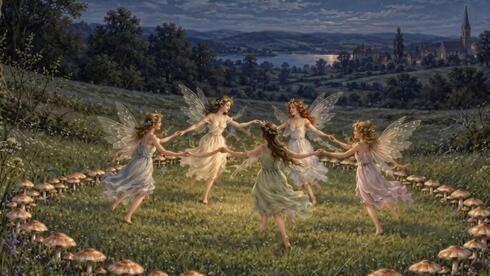
For centuries, “fairy rings,” circles of mushrooms that appear in lawns and forests, have inspired folklore and superstition. Stories claimed they were created by fairies and other mysterious beings dancing at night, and that anyone who stepped inside risked being transported to the fairy realm. This phenomenon fascinated people in the Middle Ages, as a seemingly ordinary lawn could transform overnight into a perfect circle of mushrooms.
A recent study from Sweden sheds light on why fungi form these expanding rings instead of spreading uniformly. Contrary to popular belief, fairy rings do not appear overnight; what we see above ground is only the fruiting body, the reproductive structure of the fungus. The true organism lies beneath the soil, represented by mycelium, a network of fungal filaments that can live for years.
Dr. Hanna Johannesson from Stockholm University describes fairy rings as an “entire evolutionary experiment within a single organism.” A ring begins when spores land and germinate, leading to the growth of fine fungal filaments. If conditions allow, the mycelium expands in a circular form and eventually produces mushrooms that are visible above ground.
Researchers investigated two fairy rings formed by Marasmius oreades in Uppsala, Sweden. They collected soil samples from different areas of the ring and sequenced the DNA to track the fungus. They found that most fungal DNA was concentrated along the edges of the ring, suggesting that the mycelium grows in a living ring that gradually advances outward, rather than spreading like a carpet.
The study further explored why the ring expands outward. One hypothesis is that conditions behind the growth front become unfavorable, potentially due to nutrient depletion or the release of a substance that limits growth. Transplant experiments showed that sections moved to the center of the ring resumed growth, indicating that unfavorable conditions do not persist indefinitely.
Under the researchers’ “temporary escape” model, the fungus moves into fresh soil due to changing conditions. The study narrows down possible explanations for this phenomenon, revealing that fairy rings are active and dynamic structures.
Despite ongoing mysteries surrounding the exact causes of unfavorable conditions in the soil, the fungi’s mycelium can remain underground for many years and may expand slightly each season. So, while fairies may not be dancing in these rings, the fungus below is definitely alive and growing.
Author: Ilana Kuzminsky
Davidson Institute of Science Education, Weizmann Institute of Science


