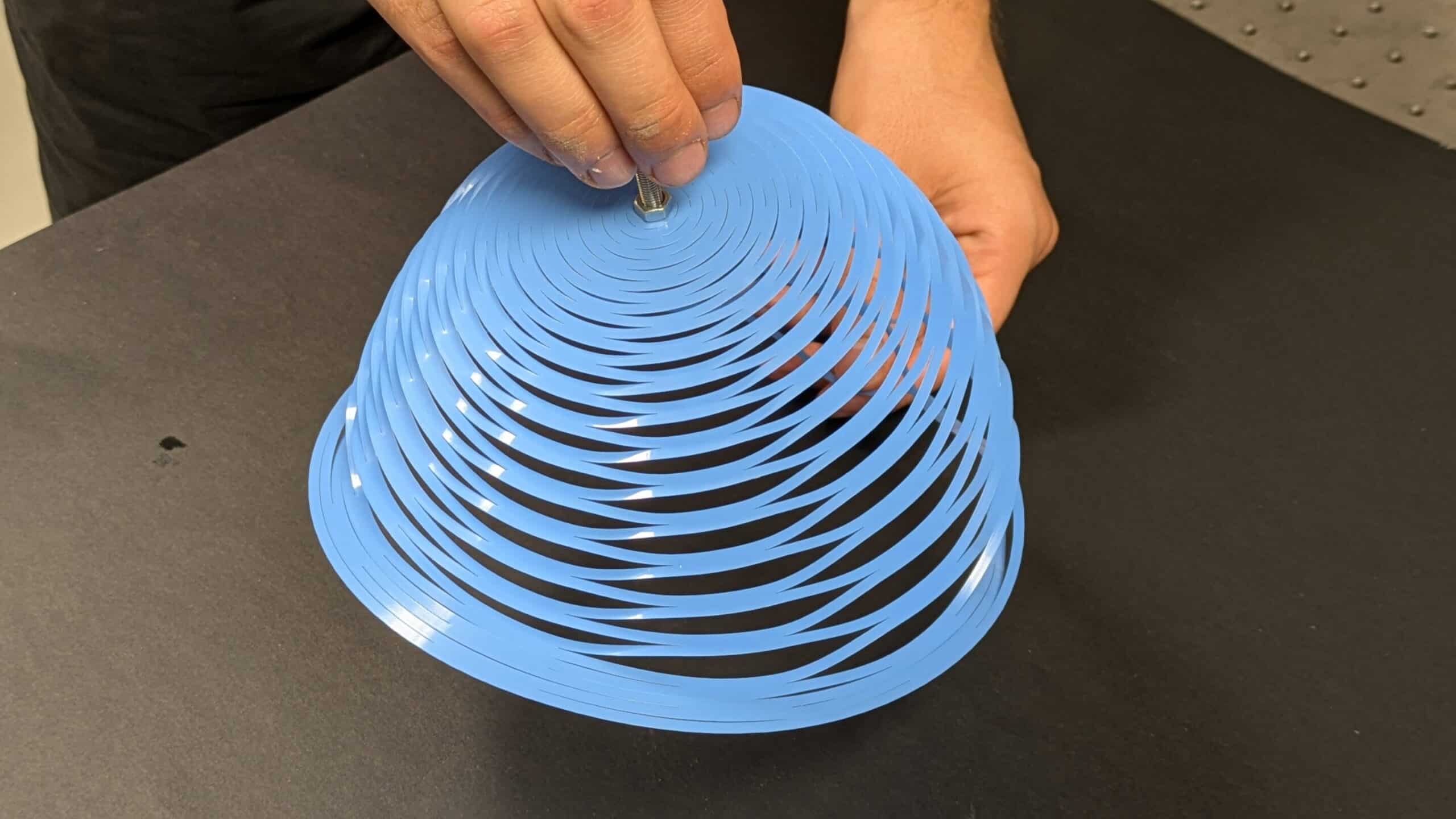
Innovative Kirigami Parachutes: A Leap Toward Precision and Safety
Parachutes, essential in combat, rescue operations, and humanitarian aid, often struggle with accuracy due to wind influence. Researchers from Polytechnique Montréal, Canada, and École Polytechnique, France, have innovated by integrating kirigami techniques into parachute design, enhancing precision during descent.
The Kirigami Approach
Inspired by the ancient Japanese art of paper cutting, engineers created lightweight and more accurate parachutes by cutting patterns into Mylar discs. Traditional parachutes work by catching air, making the idea of adding cuts counterintuitive; however, the kirigami design stabilizes the parachute’s descent by morphing into an inverted bell shape, resulting in a straightforward drop trajectory.
Testing and Results
In experiments, various disc designs were tested, revealing that the kirigami parachute significantly outperformed conventional designs in stability and landing accuracy. When released from heights of 16.6 meters, the kirigami parachute landed within a meter of the target despite varying release angles.
Potential Applications and Future Developments
This technology promises to revolutionize cargo delivery, especially in humanitarian contexts, due to its low production costs. The kirigami parachutes are mass-producible through simple laser-cutting methods, eliminating the complexity associated with traditional parachutes.
Future enhancements may involve adjusting the kirigami patterns to allow for even more complex trajectories, such as spiraling descent or targeted drops based on payload specifications.
Conclusion
By applying conventional kirigami techniques, researchers are paving the way for a new generation of precision parachutes that may transform not just military and rescue missions but also everyday applications in logistics and disaster response. This innovation marks a significant leap in parachute design, redefining an ancient technology for modern needs.


